
Hungry Judge Effect – a famous parole-board finding with an uncertain cause
Hungry Judge Effect is a popular name for a debated finding from a 2011 study of parole-board decisions. Favorable decisions were more common early in decision sessions and after food breaks, but the study did not measure hunger and could not separate eating from rest, mood, case order, or other factors.
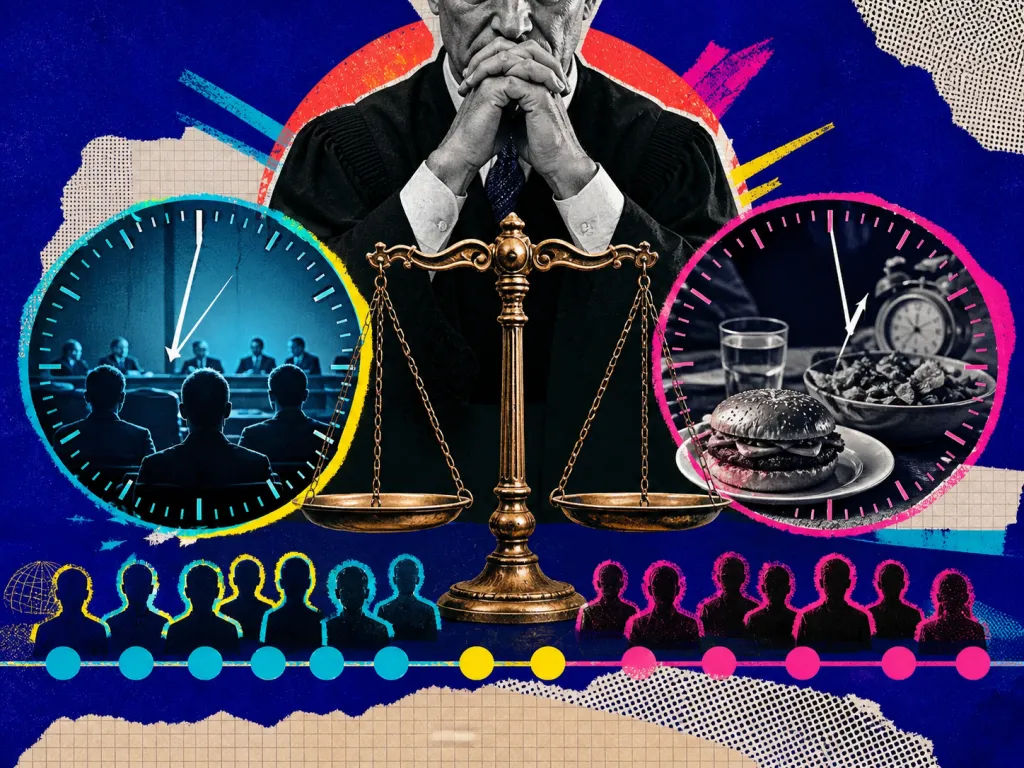
What the study showed
- Decision order: favorable rulings became less common later in a session and rose again after breaks.
- Observation, not a hunger experiment: judges were not randomly assigned to be hungry or fed.
- Alternative explanations: later critiques and simulations show that case ordering, representation, decision time, and session management could contribute to the pattern.
Questions to check
- Do not say that hunger caused a specific decision unless hunger was actually measured and competing explanations were tested.
- In repeated high-stakes decisions, monitor order, workload, break timing, case difficulty, representation, and decision duration separately.
- If a break effect appears, test whether rest, food, sequence, scheduling, or another variable explains it.
- Treat the original result as a useful warning about possible sequence and context effects, not as a law that hungry judges become harsher.
Long-form guide
The Hungry Judge Effect: When Your Body Starts Making Decisions For You
A parole board meets all morning. Case after case. At 10:45 a.m., a young father—first offense, solid rehabilitation plan—stands before the panel. The board taps through forms and denies parole. The same board, after a food break, hears a similar case at 11:30 a.m. This time, parole granted. Different legal arguments? Not really. Different judges? Same room. The main difference seems to be a break—and, maybe, a sandwich.
On this page
What Is the Hungry Judge Effect—and Why It Matters
That pattern has a name: the Hungry Judge Effect. It’s the shift toward safer, simpler, or lazier choices when your body—hungry, tired, stressed—leans on shortcuts. Your physiology nudges the steering wheel, and your “rational” mind rides shotgun. Let’s unpack what’s going on and how to reclaim the wheel. The term comes from a striking observation: judges in Israel were more likely to grant parole right after a food break, and more likely to deny it as time passed from the last break (Danziger, 2011). The graph looked like a staircase: approvals high after a break, then sliding down toward zero until the next snack. The point isn’t “judges are bad.” It’s that even trained experts are biological. Everyone’s brain runs on fuel, rhythms, and stress hormones.
So, what is it? The Hungry Judge Effect is the tendency to default to safer, easier, more conservative, or habitual choices as physiological strain accumulates—hunger, sleep debt, dehydration, stress—or as you move farther from a rest or food break; “Safer and easier” can mean rejecting uncertainty (deny parole, stick with the incumbent vendor, say “no” to a risky hire), leaning hard on defaults and rules, or delaying decisions altogether. Why it matters: It’s invisible while it’s happening. You feel “objective.” Yet your risk tolerance, generosity, and patience are being tilted by your gut and glands; It compounds across a day. Small nudges toward “no” add up to missed opportunities, unfair outcomes, and stale decisions; It hides inside teams and systems. A morning backlog groom feels lenient; the 11:45 a.m. one slashes ideas like a hedge trimmer. Your business looks inconsistent. Your kid feels whiplash. Your jury literally changes someone’s life based on lunch logistics.
The Hungry Judge Effect isn’t just about glucose. It blends three forces: 1) Decision fatigue: each decision drains a tank of self-regulatory effort; later choices rely more on heuristics (Baumeister, 1998). 2) Circadian and ultradian rhythms: our cognitive peaks and dips change across the day; timing matters (Bodenhausen, 1990). 3) Interoception and stress physiology: hunger, cortisol, and arousal change how we process risk and reward. The exact chemistry is debated. Some studies show strong time-of-day and break effects; critiques argue workload or case order also matter. The safest takeaway: your body and context shape your choices more than you think. Plan accordingly.
The Parole Board Staircase
Stories help because they stick. Here are real-feeling cases where the Hungry Judge Effect shows up. If you see yourself, good—you can fix it. The famous study tracked thousands of parole rulings. Approval rates peaked right after a meal break, then slid toward near zero by the next break (Danziger, 2011).
Critics suggested clerical case ordering could explain some of it; the original authors disputed that critique with further analyses. Whether fuel, rest, ordering, or some mix, the reported pattern was striking. Stakes: enormous. The lesson for the rest of us: even high-stakes experts drift toward the default when physiology sags.
The Recruiter and the 11:52 Resume; The Parent at the Kitchen Counter
A recruiter blocks two hours to screen applicants. The first 30 minutes, she highlights promising non-traditional candidates and writes thoughtful notes. By 11:45, with her stomach growling, the notes shrink to “No degree. Pass.” She doesn’t hate non-traditional paths; her brain just wants the easiest filter that feels defensible. Her post-lunch screens, ironically, recover nuance. The company’s pipeline quietly skews toward whoever landed early in the morning schedule. No policy changed; lunchtime did.
Two kids ask for screen time. At 5:30 p.m., just before dinner, the parent says, “No devices till after homework, that’s the rule.” At 7:15, with dishes done and blood sugar rising, the same parent negotiates, offers a trade (“clean the table for 15 minutes of Switch”), and even sits down to co-play. The rule didn’t change. The body did. The kids learn a meta-rule: ask for favors when the adult isn’t running on fumes.
The Product Manager’s Backlog Chop; The Nurse and the Final Insulin Check
In sprint planning, the team sorts backlog items. Fresh in the morning, the PM balances risk and explores uncertain but high-upside experiments. At 12:02 p.m., pressed for time, they start rubber-stamping safe tickets and closing ambiguous ones with “needs more definition.” Those “needs more definition” items rarely return. The roadmap calcifies by appetite, not strategy.
In a busy ward, a nurse works through double checks. Fatigue and hunger peak near shift end. The nurse catches most discrepancies but misses one decimal point—0.5 becomes 5.0. Hospitals know this pattern and build redundant safety checks around medication timing, barcodes, and peer verification because physiology is not a personal flaw; it’s an engineering constraint.
The Sales Discount at 4:58 p.m.; The Teen and the “Sure, Whatever”
A prospect asks for “just 10% off.” At 9:30 a.m., the account manager counters with value and nudges toward a smaller, justified concession. At 4:58 p.m., after ten calls and no lunch, they cave to the round number discount. It ends the call quickly. It also trains the market to call late and push hard. Not all hungry judges are adults.
Teens deciding on commitments right after practice often default to “no” (sounds like effort) or say “sure” just to stop the thread. Their choices look impulsive. Often they’re just padded in sweat and low fuel. In all these examples, nobody meant to be unfair or inconsistent. The pattern isn’t malice. It’s a nervous system doing what it does under load: conserve, simplify, avoid risk, end the discomfort.
Catch the Red Flags
You can’t coach what you can’t see. The most useful moves are boring on purpose. They add rails so your choices depend less on your blood sugar and more on your values. You delay hard choices, especially near meals or at the end of a block; You suddenly prefer defaults (“let’s just stick with the policy”);
Your generosity shrinks—fewer exceptions, fewer second looks; Your language gets absolute: “No,” “Not possible,” “We can’t risk it.” You rush to close loops—saying yes to discounts, no to complexity; Your notes get sparse or snarky; You start narrating your story as “bad options only.” That’s often fatigue.
Change What’s Easy to Change First
Timing is free leverage. Put complex, high-stakes, or creative decisions early in your energy curve. Put routine approvals later. If you’re an owl, flip it; Breaks change brains. Ten minutes off your feet and a snack can pay for itself in better calls; Audit defaults. If “no” is the default, ensure reviews happen when you’re not starving. If “yes” is the default, put small speed bumps near end-of-day agreements;
Sketch criteria in advance. Decide the rules while fed and calm. Then follow them when hungry. That’s you-from-the-past lending you-from-the-future a spine; Add delay levers. A script like “Let me revisit this after lunch; I’ll reply by 1:30” saves face and saves quality; Use two-person traps for risk. If you’re about to deny something consequential after a tough stretch, get a second set of eyes.
Build Lightweight Rituals and Design the Environment
The decision hour: block one hour for “judgment-heavy” work with water nearby, no meetings right before it, and a five-minute pre-brief to surface criteria; The break bell: set alarms for short breaks and a protein-heavy snack. Not sugar bombs—those crash; The flip card: keep a paper card on your desk with your own warning signs: “hungry, hurried, heated.” If two are lit, pause or add a check.
Place meetings with real stakes before lunch or right after a break. If you schedule for others, steward their brains, too; Standardize packet order. In hiring or legal reviews, shuffle or randomize the order of cases across days. Don’t always put the “long shots” just before lunch; Pre-commit to review numbers. e.g., “We will discuss at least two ‘stretch’ candidates per session, no matter the time.” Build “cooling-off defaults.” For requests that trigger quick “no’s,” create a 12-hour review queue by design. Automation is honest.
1) Map Your Energy Curve
In teams, name it out loud: “I think we’re in Hungry Judge territory.” That phrase gives permission to pause without ego. Culture beats willpower. Let’s go deeper with examples and templates you can copy and paste. You’ll see the same logic: move tough calls to strong hours, anchor to criteria, and build friction where your body derails you. You don’t need a wearable to do this. For one week:
Mark a quick hourly note from 8 a.m. to 8 p.m.: “Focus: H/M/L; Mood: +/0/-.”; Add hash marks for decisions made; At the end of the week, circle recurring high-focus windows. Now schedule: “Strategy/approve/hire” in circled windows; “Inbox/admin” in low windows; A 10-minute break 10 minutes before any “approve/hire” block.
2) Pre-Write Criteria; 3) Install Delay Scripts
When you’re fed and calm, write 5–7 lines that define good outcomes. Example for hiring: Must-haves: X, Y, Z; Evidence types: portfolio, code sample, behavior story; Deal-breakers: A, B; Stretch factor: if candidate has 2 must-haves plus strong adjacent skill, proceed to interview; Bias check: does non-traditional path meet must-haves? If yes, do not reject on pedigree. Paste this into every review session. It’s not perfect. It’s ballast.
Keep scripts visible: “Looks important. I’ll review this after lunch and get back by 1:30.”; “We’re at the tail end of a heavy block; let’s give this the attention it deserves tomorrow morning.”; “I want to judge this on criteria, not on how starved I am. Can we reconvene after a break?” Scripts make pausing feel normal, not weak.
4) Pair the “No”; 5) Configure Calendar Defaults; 6) Eat Like It’s Part of the Job
When denying something consequential near breaks, ask a peer: “Gut check this denial?” If they also say no, proceed. If they hesitate, move it to tomorrow morning. The cost is a small delay. The benefit is fairness and confidence. 25/50 minute meetings instead of 30/60; use the leftover 5–10 for water and stretch; Block buffers around judgment-heavy meetings; keep the day from becoming a wall-to-wall drain; Bundle similar decisions to reduce context switching, but cap bundles at 60–90 minutes.
You don’t need a perfect diet. You do need a plan: something simple with protein and fiber that doesn’t spike and crash you. If you manage others, normalize breaks. You’ll get better thinking, not less work.
Decision Fatigue and Ego Depletion
The Hungry Judge Effect touches several neighbors. They overlap but aren’t the same. The idea that each choice uses self-control juice, making later choices more impulsive or more conservative (Baumeister, 1998). It’s been debated—some replications are mixed (Carter, 2015). Still, many real-world systems behave as if decision costs accumulate. Whether we call it “fatigue” or “resource allocation,” the pattern shows up: later choices lean on shortcuts.
A specific form of decision fatigue: self-control taps a limited resource that depletes with use. The exact mechanism is contested, but practical advice still holds: rest, fuel, and breaks improve self-regulation, and pre-commitment reduces the need for raw willpower.
Circadian Bias, Hot–Cold Empathy Gap, Status Quo, Stress, and Interoception
Time-of-day swings in attention and risk tolerance. Morning people do analytical work best early; night owls shine later (Bodenhausen, 1990). Match decisions to your chronotype. A judge at 8 a.m. is not the same judge at 4 p.m. We mispredict how visceral states—hunger, anger, pain—will shape choices (Loewenstein, 1996). In the “hot” state, everything feels urgent or threatening; in the “cold” state, we forget how hot feels. The Hungry Judge Effect is a cousin: a hot physiological state tilts you toward fast, safe defaults.
When drained, we exaggerate potential losses and stick with the current state to avoid regret. The hungry brain asks, “What’s the least painful move?” Often that’s “do nothing,” “deny,” or “delay.” Stress hormones narrow focus and make novelty feel risky. High load—many threads open at once—pushes you toward rules and routines. Those are gifts in emergencies and liabilities in nuanced decisions. Your sense of internal body signals—heartbeat, gut feel, breath. People who read their signals accurately can sometimes regulate better; others misinterpret noise as threat (Critchley, 2004). You don’t need perfect interoception; you do need habits that don’t require it.
Wrap-Up: Be Kinder Than Your Biology
This is the part where we admit something soft: most of us want to be fair, curious, and brave. We want our decisions to reflect our values, not our blood sugar. We want to be the person who notices the quiet outlier and says yes when it counts. But bodies have a vote. They always have.
You can pretend you’re above it until the graph of your approvals maps perfectly onto your snack schedule. Or you can accept the human machine, then design around it: move the hard calls to strong hours, add a break before judgment, write your criteria in ink and your urges in pencil, and build systems that assume you’ll sometimes be hungry, tired, rushed, or stressed. You don’t need to become a robot. You need a humane process that forgives the animal in you. Eat. Pause. Decide. Let snacks and systems be your quiet allies.
Decision checklist
- Block high-stakes decisions in your personal peak hours; schedule routine tasks in dips
- Insert a 10–15 minute break before any decision block longer than 90 minutes
- Keep water and a protein-heavy snack within reach during decision blocks
- Write decision criteria beforehand; use a simple template or rubric
- Randomize the order of cases, resumes, or items across sessions
- Set a “cool-off” rule: defer non-urgent “no” decisions made within 30 minutes of a break
- Pair-review consequential denials made when you’re hungry or rushed
- Use a one-line script to buy time: “I’ll confirm after I eat and review.”
- Track decisions briefly: context, time, hunger state; spot patterns monthly
- Encourage teammates to call “Hungry Judge” time-outs without penalty
Evidence review
What the evidence supports
The famous 2011 parole-board study found favorable decisions were more common early in a decision session and immediately after food breaks. It did not directly measure hunger, glucose, fatigue, or mood, and the authors explicitly could not separate eating from rest. A contemporaneous critique argued that non-random case ordering could explain the pattern; the original authors disputed that critique with additional analyses. Treating this as a general law that hungry judges become harsher goes beyond the evidence.
How researchers describe the pattern
The original paper interpreted the sequence pattern as consistent with resource depletion and recovery after a break, but its design was observational. Alternative explanations include case ordering and representation differences. Because food, rest, time, sequence position, and other factors were entangled, the study cannot identify hunger itself as the causal mechanism.
Practical interpretation
Do not use this effect as evidence that a decision-maker's hunger caused a specific ruling. The safer operational lesson is broader: high-stakes repeated decisions deserve checks for order effects, fatigue, break structure, workload, and case assignment. If you want to test a hunger hypothesis, measure hunger separately rather than using meal timing as a substitute.
Reviewed sources
- Extraneous factors in judicial decisions observational study · 2011 · DOI 10.1073/pnas.1018033108
- Overlooked factors in the analysis of parole decisions data critique / letter · 2011 · DOI 10.1073/pnas.1110910108
- Reply to Weinshall-Margel and Shapard: Extraneous factors in judicial decisions persist author reanalysis / reply · 2011 · DOI 10.1073/pnas.1112190108
Editorial review: 2026-08-18. The controlled evidence class is an editorial reading aid, not a numeric truth score; the descriptive status above carries the entry-specific qualification.
Continue from here