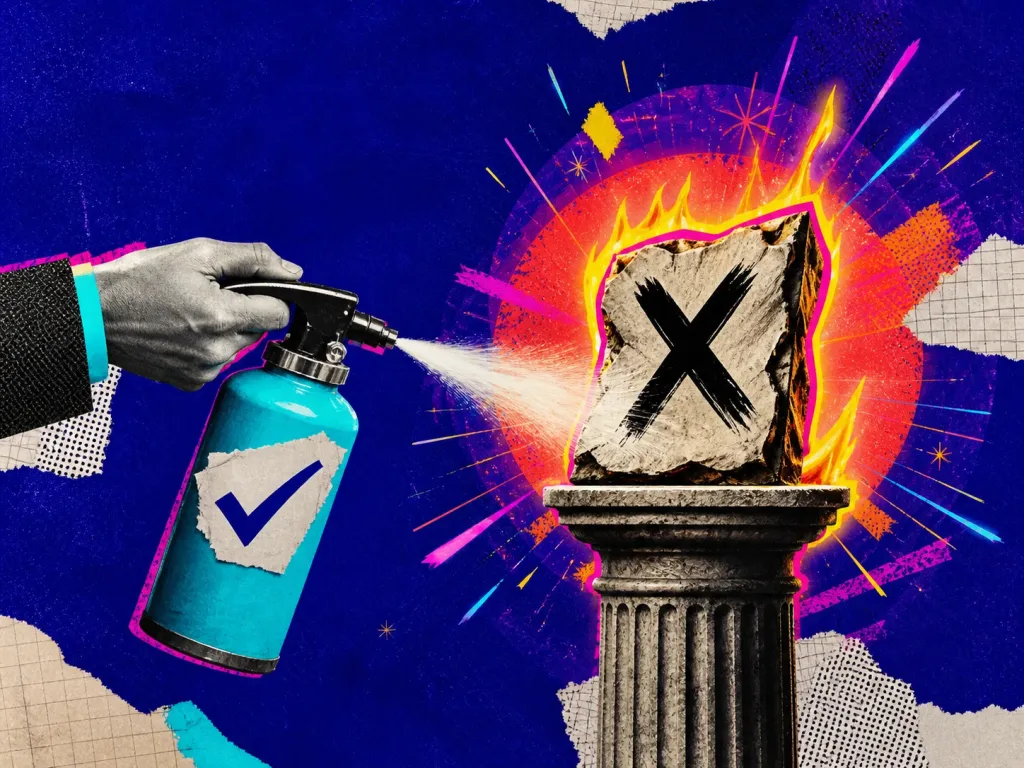
Forer (Barnum) Effect – when vague statements feel deeply personal
Have you ever read a horoscope or personality test and thought, “This is so me!”? That’s Forer (Barnum) Effect – the tendency to believe vague descriptions are uniquely accurate for you, even though they apply to most people.

Examples and situations
- Astrology – “You are intelligent but sometimes doubt yourself.” Sounds right? But it applies to nearly everyone.
- Fortune telling – predictions feel personal, but they’re worded vaguely enough to fit many people.
- Personality tests – you take a quiz, and the results ‘nail’ your traits, yet thousands of others get the same result.
Questions to check
- Look for specifics – if a statement is broad and could fit anyone, it probably does.
- Remember that your brain seeks confirmation – if you want to believe it, you’ll find reasons to.
- Be skeptical of pop psychology – real personality analysis is deeper than flattering generalizations.
Long-form guide
The Forer Effect: Why Vague Statements Feel Like They See Your Soul
There’s a moment we’ve watched happen in coffee shops and co-working spaces, at kitchen tables and in late-night group chats. Someone reads a three-sentence horoscope, or a sleek personality profile a tool spits out. Their eyes widen. They whisper, “This is so me.” The words feel like warm light coming through blinds—oblique but personal. It’s soothing to be seen. It’s even better to be predicted.
On this page
What Is the Forer (Barnum) Effect and Why It Matters
The Forer (Barnum) Effect is our tendency to accept vague, general statements as highly accurate and personal—especially when they’re flattering or framed with authority. It’s one of those “harmless” biases that turns out to be everywhere: in brand copy, in onboarding flows, in cold emails, in team reviews, even in the answers AI systems produce. The danger isn’t just that we’re easy to flatter. It’s that we build decisions, products, and relationships on foggy words we mistake for clarity.
Let’s walk through this together—story-first, then tools you can use on Monday morning. In 1949, psychologist Bertram Forer gave students a personality test, then returned results. Each student received the same analysis packed with broad statements like “You have a great deal of unused potential” and “You pride yourself as an independent thinker” (Forer, 1949). On average, students rated the accuracy 4.26 out of 5. They felt seen. That’s the Forer Effect. Also called the Barnum Effect (“there’s a sucker born every minute,” attributed to P.T. Barnum), it captures a simple phenomenon with big consequences:
Vague, general statements feel specific when they’re positive and framed as expert insight; We unconsciously fill in the blanks, searching for ourselves in the fog; We overestimate accuracy, underestimate generality, and often stop asking questions. Why it matters: In product design, it seduces teams into shipping “personalized” experiences that are actually generic sentiments wrapped in slick UI. Users might trust the product blindly, then feel betrayed; In hiring and performance reviews, it invites managers to use generic feedback that feels caring but gives no concrete direction; In personal growth and coaching, it creates emotional resonance without accountability; In data and AI, it encourages us to take confident-sounding outputs as truth because they “feel right,” even when they’re templated language. The Forer Effect doesn’t make us gullible. It makes us human. We want to be seen, and we often accept poetry as evidence.
The startup persona doc
The text: “You value honesty in relationships, but lately you’ve been holding back. Trust your intuition. A change in work could open doors this week.” Nine out of ten people agree. Why? It’s sweet, specific-ish, and safe. Most of us value honesty, and most weeks carry some “work change” we can project into the line.
A product team drafts a persona: “Maya is busy, tech-savvy, and loves experiences over things.” Vibe: accurate. Practicality: low. The phrases have no teeth. Without numbers, behaviors, or disconfirming details, the persona steers design toward generalities that look clever in slides and flimsy in code.
The performance review
A growth team adds a “smart setup” step. After three questions, users see: “You’re ambitious but pragmatic. You like tools that get out of your way. We’ll tailor your dashboard accordingly.” The UI looks personal. Under the hood, every user sees the same three layouts. Users feel delighted. Then confused when the “tailored” dashboard behaves like a default template. Trust fractures.
“I appreciate your independence and team spirit. You aim high but sometimes second-guess yourself. Keep leaning into your strengths.” Sounds supportive. Yet it could apply to anyone. The employee leaves with warmth but no handle to pull. Improvement stalls.
The AI that “knows your voice”
“Your profile shows you as a visionary operator. I sense you’re at an inflection point. Curious: if we 2x your output without more hours, what might you build?” Somehow flattering, weirdly personal. A script. A hit rate. Tarot’s magic isn’t a secret: it’s a mirror you look into with intent. Many OKR documents work the same way. They reflect back values you already hold—“impact,” “focus,” “quality”—then build motivation on wording that could fit any quarter. When results disappoint, nobody knows what to fix.
You paste three writing samples. The AI returns a “profile”: “You write conversationally but with a craftsperson’s attention. You like vivid verbs and brisk pacing.” Compliment? Yes. Instruction? Not really. It’s a flashlight with no battery.
Why We Fall For It: Mechanics, Not Blame
We complete patterns. The brain craves coherence. Given ambiguity, we add detail from memory and context; We prefer positive feedback. Flattering claims feel safer to accept. We resist evidence that reduces our self-image; We trust authority packaging. Tests, charts, dashboards, and “insights” language signal expertise; We confuse familiarity with accuracy.
If a sentence is easy to process, we treat it as true; We anchor on the first plausible frame. Once an idea “fits,” we stop looking for conflict. None of this makes us foolish. It makes us efficient. But in product decisions, relationships, and learning, the cost of untested acceptance is high.
1) Replace identity labels with behavior snapshots
You don’t need to become a cynic. You do need better questions. Here’s a practical, reusable checklist you can use with horoscopes, product advice, performance reviews, marketing copy, and AI outputs. Run this checklist in 60 seconds. The act of checking often dissolves the spell. We develop apps and tools. We also write a lot of words. Here’s how we try to keep ourselves honest in our studio and products.
Instead of “You’re an optimizer,” say: “In the last 14 days, you changed notification settings 6 times and created 3 automations.” Behavior beats branding. Tie any “insight” to specific logs or events; Show users the path from their data to your output. Practical application:
4) Show your work
If you present a profile, include a “this is probably not you if…” box. It builds trust and sharpens action. Present two plausible alternatives and show why you selected one; Offer a toggle: “Does this sound right?” and update the model when users say no. Practical application: If your personalized copy boosts trust but harms retention, you’ve discovered persuasive fluff. Measure it.
Track whether “insight screens” change meaningful downstream metrics; If they don’t, cut or sharpen them. Practical application: Where did this “insight” come from? Show a mini trace. “We derived this from: 12 sessions, 4 documents tagged X, and 2 missed deadlines.” Provide a transparency panel users can open; Let users correct false inferences and log the correction. Practical application:
6) Train your team to smell Barnum
If you say “You’ll likely prefer keyboard shortcuts,” default the UI to them. If users turn them off, learn and adapt. Tie personalization to actual changes the user can feel; Commit to updatable preferences based on behavior, not vibes. Practical application: In onboarding, include common Forer phrasings and why they seduce us.
Reward precise language in product specs, not just creative flair. Include two examples of “United States of Vague” in every spec review and rewrite them with specificity; Adopt a “could this apply to half the population?” rule in copy reviews.Practical application:
A Quick Field Guide: Red Flags and Clean Signals
Compliments without stakes: “You’re a strong leader with a unique perspective.” Confident vagueness: “You value connection but also independence.” Universal tensions framed as insight: “You take time for big-picture thinking, but details matter to you.” Authority costume: dashboards, charts, ratings without method. Red flags (Forer fog): Measured behavior: “You responded to 83% of comments within 24 hours last month.”
Comparisons with context: “Your completion rate is 12% above team average on tasks under 30 minutes; it’s 18% lower on tasks over two hours.” Predictions with risk: “Given your last four sprints, there’s a 60–70% chance you’ll miss Thursday’s delivery unless scope is reduced by two tickets.” Disconfirmer: “If you finish deep work blocks before 10 a.m., this doesn’t apply.”. Clean signals (real traction):
Halo effect: Forer
The Forer Effect often hangs out with other mental shortcuts. Knowing the neighbors helps. What it is: We look for evidence that confirms beliefs and ignore contradictions; How it relates: Forer statements give you a soft target to confirm. You happily supply examples that fit; The fix: Ask, “What would disprove this?”. What it is: We trust people and tools that look authoritative; How it relates: Test-like formatting and data viz make generalities feel scientific; The fix: Judge the method, not the costume.
What it is: We let a single positive trait color our entire judgment; How it relates: A flattering phrase (“You’re a natural collaborator”) makes the rest of the profile feel true; The fix: Evaluate claims independently.
Illusory correlation: Forer
What it is: We rely on immediate examples that come to mind; How it relates: If you recently led a big meeting, any leadership-flavored line feels accurate; The fix: Sample across time, not just last week. What it is: We attribute success to ourselves and failures to external factors;
How it relates: Positive Forer statements slide in easily; negative ones get deflected; The fix: Balance praise with precise, testable constraints. What it is: We see relationships where none exist; How it relates: “Every time I wear green socks, I close deals” energy. Vague patterns encourage false links; The fix: Demand side-by-side comparisons and baselines.
Transform vague praise into useful feedback
Forer’s classic study showed people rate generic personality feedback as highly accurate when told it’s tailored to them (Forer, 1949); Later reviews and experiments replicated the effect across horoscopes, graphology, and generalized assessments (Dickson & Kelly, 1985); Positivity and expert framing amplify acceptance; negative or highly specific content weakens it (Furnham & Schofield, 1987). Key takeaway: the package (authority, positivity, personalization) often matters more than the payload.
Words are tools. Use them precisely. Vague: “You’re an independent thinker with great potential.”; Sharp: “In the last two sprints, you proposed 3 approaches we adopted. Next step: write brief pre-mortems for each proposal to catch risks earlier.”. Vague: “Trust your intuition more.”; Sharp: “Set a 20-minute cap on exploration before committing to a prototype. Track whether decisions made within 20 minutes perform worse than ones made after an hour.”.
Vague: “You work best in flow.”; Sharp: “You completed 70% more tasks in 90-minute blocks than 30-minute blocks last month. Want us to auto-block 2x 90-minute windows on Tues/Thu?”. Vague: “Users love quick wins.”; Sharp: “Median time-to-first-value is 7m 40s. Goal: cut to under 4 minutes. Hypothesis: pre-fill example data and show contextual progress bar.”.
A Short Field Journal From Our Studio
We tried a “soft personalization” feature in an early product: a little card that summarized how you worked based on your first session. It said things like, “You seem curious and decisive.” Everyone loved it. Then we looked at the numbers. People who viewed the card trusted the product more but didn’t retain better. When we replaced the card with a plain list of recent actions and one suggested next step, retention improved. It felt less magical, more useful.
Magic has its place. But we build tools to reduce time-to-traction. These days, when we’re tempted to add “insight” copy, we ask: can we back it with data, show our work, and trigger a behavior that users can feel in their hands? If not, we cut it—even if it gets us compliments in demos.
When Vague Words Are OK (And When They’re Not)
Grab two “insight” sources: a horoscope or typing test result, and a recent performance note or app “personalized” screen. 1) Highlight all statements that could apply to most people. 2) Circle any concrete numbers, dates, or observed behaviors. 3) Write a disconfirmer for each remaining statement: “This wouldn’t apply if…” 4) Turn one vague line into an experiment with a measurable outcome. 5) Decide: keep, reframe, or discard. Do this once, and your eyes start catching fog everywhere. It’s oddly freeing.
Some ambiguity is fine—even healthy. Early exploration: let language breathe when you’re hunting ideas. You need room to see patterns; Inspiration and morale: poetic lines can rally a team if you don’t mistake them for plans; Identity and brand: we all live through stories. Just don’t use them to justify decisions they can’t carry. But when money, time, or a user’s trust is on the line, switch to verbs and numbers.
Wrap-Up: Seen, For Real
You don’t need to become an analyst to beat the Forer Effect. You need a habit. Prefer behavior over identity; Prefer time windows over timeless truths; Prefer predictions over platitudes; Prefer actions you can test over descriptions you can admire. Specificity isn’t colder; it’s kinder. It gives people handles. We started with that familiar jolt—when a sentence feels like it knows us. The Forer Effect explains the jolt. It doesn’t say you’re silly for feeling it. It says: don’t build your next week on it.
As a creative dev studio, we fight this bias in our own work every day. We’re building an app called Cognitive Biases because we want sharper tools in our pockets—reminders to check method, to ask for disconfirmers, to prefer plans over poetry when it counts. The goal isn’t to kill magic. It’s to make the magic honest, and the results useful. If a sentence tells you who you are, ask it to show its work. Then ask yourself what you’ll do differently by noon.
References cited by the original article
Forer, B. R. (1949). The fallacy of personal validation: A classroom demonstration of gullibility. Journal of Abnormal and Social Psychology; Dickson, D. H., & Kelly, I. W. (1985). The ‘Barnum Effect’ in personality assessment: A review of the literature. Psychological Reports; Furnham, A., & Schofield, S. (1987). Accepting personality test feedback: Effects of feedback, sex, and self-esteem. Personality and Individual Differences.
We build creative tools and knowledge hubs so you can build with clearer minds and steadier hands. The Forer Effect doesn’t vanish when you name it. But your next decision gets better when you ask the plain question: what, exactly, does this change?
Decision checklist
- ✅ Specificity: Does the statement include concrete behaviors, time frames, and measurable details? If not, it’s probably Forer fog
- ✅ Exclusivity: Could this describe at least half of people you know? If yes, it isn’t personal
- ✅ Disconfirmers: Does it include what you are not? Real insights narrow by excluding plausible alternatives
- ✅ Source and method: How was this derived? From data, observation, or a template? If method isn’t clear, assume generality
- ✅ Risk and skin: Does the source take a risk by making a prediction that could be wrong? If there’s no risk, there’s no commitment
- ✅ Replicability: Could someone else independently reach the same conclusion using the same inputs? If not, treat it as vibes
- ✅ Actionable next step: What would you do differently tomorrow? If you can’t translate it into behavior, it’s not guidance
- ✅ Feedback loop: Is there a way to test and update the statement? Without iteration, flattery calcifies into myth