Denomination Effect – when the shape of money changes our willingness to spend it
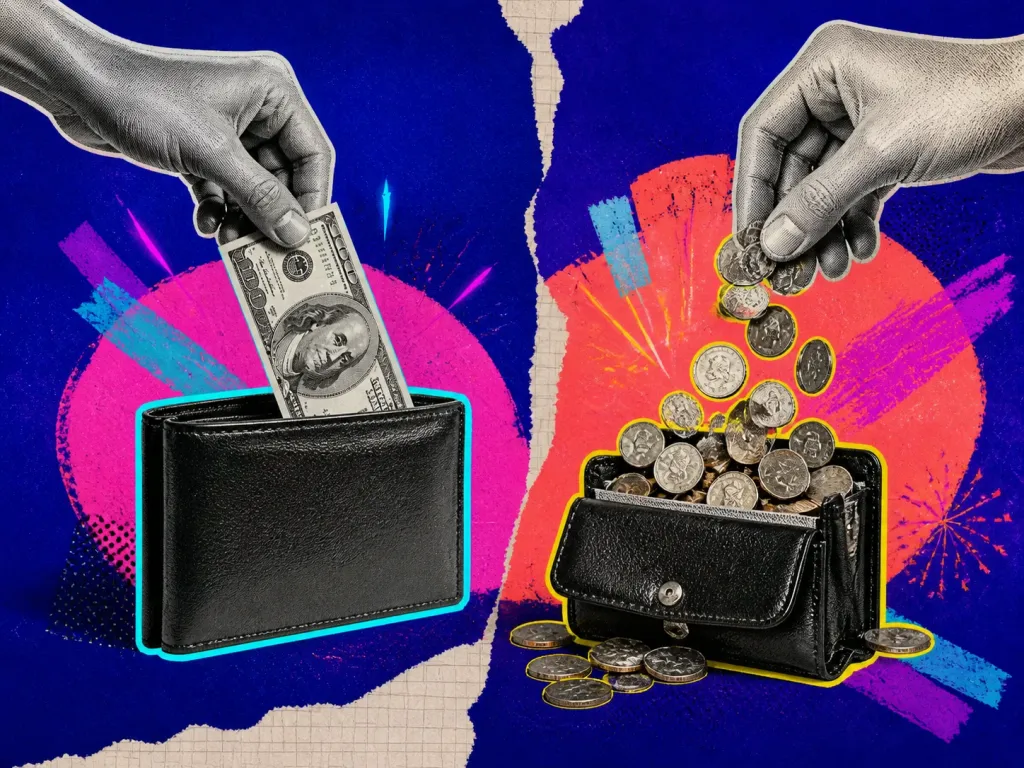
The denomination effect is a tendency to spend equivalent amounts differently depending on how the money is divided. A single large note can feel harder to break than several smaller notes with the same total value. The arithmetic is identical; our spending behaviour has not signed that agreement.
Examples and situations
- Cash spending – we may protect one larger note while smaller notes or coins disappear more easily.
- Budgeting – separating money into psychologically meaningful units can change how available it feels for spending.
- Travel and foreign currency – unfamiliar denominations can make value harder to feel intuitively.
- Product design and payments – the way a balance is represented may influence whether it feels like one protected amount or many spendable pieces.
Questions to check
- Convert every option to the same total before deciding.
- Ask whether you would make the same purchase if the same money were represented in different denominations.
- Track the total spent, not just the number or physical size of units left.
- Remember that context matters. Later work shows that denomination effects can interact with memory, monitoring, payment context, and even reverse in situations such as tipping.
Money is fungible in the spreadsheet. In our heads, it often arrives with packaging, labels, friction, and a small amount of theatre.
Long-form guide
The Vanishing Fives: Why Small Bills Slip Through Our Fingers
You pop into a corner shop for a seltzer. Your wallet holds a crisp $50 and four fives. You reach for the fives without thinking. On the walk home, you grab a street taco. Another five disappears. By evening, you’ve “somehow” spent $30 while the $50 is still pristine, tucked away like a museum piece. The small bills evaporate. The big ones stick.
On this page
What is the Denomination Effect — when small bills disappear faster and why it matters
That’s the Denomination Effect: we spend small denominations more freely than large ones, even when the total value is the same (Raghubir & Srivastava, 2009). The Denomination Effect is a behavioral quirk where the form of money changes how we treat it. A $20 bill and four $5 bills add up to the same value, but not in our minds. Smaller denominations feel easier to spend. Large denominations feel too “chunky” to break. The shape of our money becomes a nudge, a brake, or a slippery slope.
Psychologists tie this to the “pain of paying.” Large denominations trigger more pain when you hand them over; they’re a single, visible loss. Small denominations allow you to dilute that pain into nibbles. The brain frames a $5 loss as trivial and reversible. Breaking a $50 feels like slicing into a roast—you don’t do it lightly. This matters because: It quietly erodes budgets. You don’t plan to spend $45 on “bits and bobs.” It just happens five dollars at a time; It distorts decisions. You might avoid a necessary expense that requires breaking a big bill, yet thoughtlessly burn through small ones on low-value buys; It shapes digital behavior. Microtransactions, in-game gems, and gift cards aren’t accidents of design; they harness the same effect in zeros and ones. Understanding the Denomination Effect gives you a lever. You can increase friction when you want to save, and remove friction when you need to spend with intention.
The research backbone, and the effect in the wild
People resist breaking large bills and spend small denominations more freely, even when options are identical (Raghubir & Srivastava, 2009); Partitioning money into smaller envelopes can sometimes reduce overspending. But paradoxically, smaller denominations within those envelopes can increase the tendency to “nibble” (Cheema & Soman, 2006); The “unit bias” compounds the effect: we prefer whole units—one bill feels complete, while handing over multiple bills feels like multiples of a decision (Geier et al., 2006).
The outcome: denominations act as psychological speed bumps or greased rails. You can move them around. Let’s make this real. If you’ve caught yourself in any of these scenes, you’ve met the Denomination Effect in the wild. Tara and Eli head to a weekend festival. Tara brings a crisp $100 bill; Eli brings the same amount in fives and tens. By Sunday, Eli’s small bills are gone and Tara’s hundred is untouched. A barista drops a few ones into the tip jar at shift start to “seed it.” Customers then tip in ones or coins almost reflexively—“I’ve got a single.” Ask the same customers for a $5 tip on a $4 drink with a card and you’ll see hesitation. The shape of the ask—a neat, small bill—fits the shape of an “easy yes.”
The “do not break” superstition
Marcus keeps two $50s in his leather money clip. He swears they’re his savings hack. He’ll use his card if needed, but the $50s stay intact for weeks. He calls it superstition, but underneath lives the Denomination Effect. Breaking a $50 feels like crossing a threshold. The pain of paying is loud enough to keep the bills safe.
This trick is common among cash-based savers in street markets around the world. Merchants tuck “big bills” behind a counter. They’ll give change from smaller notes and resist breaking the high denominators—to preserve a boundary. You weren’t clever. The site used small unit sizes to lower your spending friction, while the shipping fee sat as a “big chunk” you wanted to avoid.
In-game gems and the envelope budget
Mobile games don’t sell “$3 packs.” They sell 300 gems. Upgrades cost 25 gems here, 40 gems there, 10 gems for a spin. The game splits your money into tiny denominations inside a fictional currency, so each decision feels trivial. And you rarely convert gems back to dollars in your head. Denomination Effect meets money illusion. It’s potent.
Jules budgets with envelopes. The rent envelope holds thick fifties and twenties. The “fun” envelope is packed with fives and coins. Two weeks later, the “fun” envelope is confetti. Rent envelopes remain full. In this case, the Denomination Effect works in their favor: large denominations protect rent. Small ones evaporate where it’s safe to evaporate.
Fundraisers, petty cash and crypto dust
At a school fundraiser, donors are offered preset options: $5, $10, $20, $50. The small preset buttons get tapped most; the big “sponsor” button mostly sits there looking serious. A startup keeps $200 in petty cash, mostly in fives and tens. It disappears on snacks, last-minute cords, taxi tips, and batteries. Meanwhile, buying a $400 monitor needs a manager’s signature. Small leaks pass; big chunks get scrutiny. You’re at a market stall. Your total is $7. All you have left is a $50. You hesitate, then tell the vendor you’ll come back later. The big bill survives; the snack doesn’t happen.
Crypto adds an interesting twist. Some wallets end up with “dust”—tiny denominated amounts that aren’t worth the network fee to move. People mentally write them off. Later they accumulate. If fees drop, the dust becomes spendable and tends to go first—another digital echo of small denomination leakage.
Notice the leak points
A transit card shows $38.25. Rides cost $2.75. Micro-spends don’t feel like money. You tap. Tap again. Load another $20 without thinking. You don’t need to outsmart your brain every minute. You can shape your environment so it nudges the right way. Below are practical moves that don’t rely on willpower. Start with a three-day scan. Don’t change your behavior; just audit the shape of your spending.
How many purchases are sub-$10?; How often do you choose small denominations over big ones?; Where do micro-spends pile up: food apps, café stops, in-game purchases, vending machines, ride shares? For digital, look at transactions under $20. Write them down. Patterns show up fast.
Build friction where it helps
Denominations are dials, not destiny. Turn them. Saving mode: Carry larger bills or keep money in accounts that batch transactions. Use weekly auto-transfer to a “big-bill” savings pot with no easy debit card; Spending mode (but with control): For categories you actually want to spend on—like groceries or kids’ activities—stock appropriate bills to reduce friction and avoid impulse substitutes; Intentional splurges: Convert the target spend to one or two large bills and dedicate them. It increases the “ceremony” and reduces random add-ons.
Avoid keeping lots of small bills on hand. Keep a single $20 or $50 for unplanned buys. Force a small decision: “Do I break it for this?”; Batch low-value purchases. Pick two evenings a week when small add-ons are allowed. Outside those windows, capture them on a list; Remove single-click pay from your impulse apps. Switch to “ask every time.” It’s a digital version of “I don’t carry singles.”
Don’t punish yourself; design helps more
Give your big bills a job. People hesitate to break a $100 bill for a trinket—so give that hesitation a purpose and assign each big bill a mission. You can flip the script. Take your gaming or hobby budget and convert it into one weekly large gift card or wallet load. Avoid topping up in small bites; For food delivery, set a monthly cap and load it once. Once spent, that’s it. No micro-charges; For subscriptions, pay annually when reasonable. One painful chunk > twelve painless leaks—if you truly use the service.
If small bills always vaporize, stop carrying them unless you intend to spend. If you keep breaking big bills on junk, separate them physically: one compartment for “untouchable,” one for “spendable.” Your future self is not stronger; your setup must be smarter.
Mental accounting and unit bias
Biases rhyme. A few neighbors of the Denomination Effect can blur the picture. We put money into mental buckets—rent, coffee, vacation—then treat each bucket differently. Denominations are physical versions of buckets. A $50 in the “rent” envelope feels different from the same $50 loose in your pocket. We prefer whole units: one cookie over half a cookie, one bill over a piece of a bill.
A single $50 feels like a whole. Six $5s look like six decisions. This bias makes breaking a big bill feel like a bigger deal than parting with small ones, even if the value is identical (Geier et al., 2006).
Sunk cost, partitioning and pre-commitment
Once you break the big bill, you might spend the rest more easily—“in for a penny, in for a pound.” The sunk cost fallacy piggybacks: “I already broke it; might as well use it.” Recognize this shift. After the first break, reset your rule: the remainder is not “spent,” it’s still money.
Partitioning money into envelopes can reduce overspending because each envelope has a cap (Thaler, 1999). But within an envelope, smaller bills can increase “harmless” nibbles. Pair partitioning with intentional denomination choice. Big bills for protected envelopes; smaller bills where quick use is intentional.
How to recognize your personal pattern
Everyone has a signature spending rhythm. Some people won’t break a hundred for a month but will tap a card hourly. Others despise using change and will spend three singles to avoid coins. A few prompts to find your tell: If you open your wallet at noon and see a $50 and four fives, which do you feel okay spending first?;
Do you feel more “spent” after five small buys or one big buy of the same total?; Which purchases do you avoid because they require breaking a large bill?; Which purchases do you make because a small bill is “burning a hole” in your pocket? You’re building a map of your own friction points. That map is better than any generic rule.
Petty cash, procurement and per diem
This bias doesn’t stop at cafés. Keep petty cash, but set it up. Stock it with medium denominations and write a minimum transaction (e.g., $25) so the cash box isn’t a snack fund. If every large expense requires three approvals, teams will route around it with many small expenses. Then the total is larger and less visible. Fix it by setting sane thresholds and faster lanes for justified big purchases. Better to break one $500 decision with eyes open than to bleed twelve $45 buys with no scrutiny.
Per diem in small cash leads to snack leakage and souvenir regret. Per diem on a card with category limits keeps necessities accessible while protecting against random drift. If you must do cash, hand travelers a mix heavy in larger bills and clear guidance on cash handling.
Kids, teens, and teaching the shape of money
Children learn by touching. Denominations teach lessons you can’t get from a card. For allowance, pay in denominations that match the lesson. Big bill for saving. Small bills for spending. A clear split they can hold; For a specific goal—say, a $30 toy—hand a $20 and a $10 and watch which one survives the week;
Play “store” with change. Let kids feel what three fives versus one fifteen-unit card “mean.” The sensation matters. When teens move to debit cards, keep a weekly “cash experience”: a budget in real bills for certain categories. Let them feel the big-bill friction before it disappears into tap-to-pay adulthood.
Cultural twists and cashless futures
Not every country treats denominations the same. In some places, large bills are scarce or used only for savings, while daily commerce runs on small notes and coins. In high-inflation environments, denominations inflate and the effect shifts. As payments go cashless, denominations morph into: Top-up sizes: $5, $10, $20 buttons that nudge how much you load;
Digital currency packs: gems, credits, coins; Subscription periods: monthly versus annual; Tip presets: $1, $2, $5 buttons instead of open-ended amounts. Designers pick denominations to guide behavior. You can reverse-engineer their intent and choose your response.
Tactical scripts you can use tomorrow
Try these on a normal week. Grocery run: Bring one big bill and a precise list. If a tempting extra would force breaking the big bill, put it on the “next week” list; Coffee habit: Load a prepaid card with a weekly cap every Monday. When it’s empty, no refills. You’ve created a denomination boundary; Gaming: Decide your monthly spend. Buy a single gift card for that amount. Enter the code and delete the payment method from the store.
The top-up becomes a ceremony, not a reflex; Nights out: Split cash—one envelope with large bills for dinner and rides, one with a few small bills for tips and water. When the small-bill envelope empties, switch to intentional decisions only; Work snacks: Pitch a weekly snack run instead of ad hoc buys. Rotating volunteer. One receipt. Less nibbling, more actual food. These are small design choices. They tap the bias instead of fighting it.
Wrap-up: keep the big pieces whole
The Denomination Effect isn’t an enemy to defeat. It’s gravity. You can fight it with muscle—or you can build ramps. Small bills usually feel lighter. Big bills usually feel heavier. That’s fine. Give your big bills a purpose. Let your small bills serve plans, not appetites. This week, try one change—one. Maybe it’s a single large bill in your wallet with a job. Maybe it’s deleting a card from your favorite impulse app. Maybe it’s a jar that turns lost coins into a real deposit. Then watch. Your money will start to hold its shape.
Because the difference between “Where did my money go?” and “I did exactly what I meant to do” is often just the shape of the bills. References (selective): Raghubir, P., & Srivastava, J. (2009). The Denomination Effect; Cheema, A., & Soman, D. (2006). Malleable mental accounting; Prelec, D., & Loewenstein, G. (1998). The red and the black: Mental accounting of savings and debt; Geier, A., Rozin, P., & Doros, G. (2006). Unit bias.
Decision checklist
- Decide which category you want to protect this month (e.g., savings, rent)
- Remove small bills from your daily carry; keep one larger bill as a deliberate hurdle
- Label big-bill envelopes or accounts with specific purposes
- Batch small purchases into two weekly windows; keep a running list between
- Turn off one-tap payments on your three most tempting apps
- Use a single top-up for microtransactions per month; no mid-month refills
- Review a three-day micro-spend log each week and adjust the setup, not your willpower
- When you must break a big bill, do it for pre-decided priorities, not whims
- If a purchase is “small,” ask: Would I still buy it if it required breaking my last $50?
- Put unspent small bills at week’s end into a jar labeled with a goal; deposit monthly
Evidence review
What the evidence supports
Raghubir and Srivastava reported field and laboratory studies showing lower spending likelihood when the same amount of money was held as one larger denomination rather than several smaller denominations. Later work by Raghubir, Capizzani and Srivastava connected denomination and numerosity to how accurately people remember and monitor money in a wallet. More recent research also shows that the direction can differ in special contexts such as tipping, so denomination is not a context-free switch that always changes spending in one direction.
How researchers describe the pattern
Large denominations may feel less fungible or more costly to break, while many smaller units can be harder to monitor and easier to spend piece by piece. Pain of paying, memory, transaction friction, social meaning and the specific payment context can all matter. The total economic value remains the same, but the psychological representation of that value changes.
Practical interpretation
Normalize alternatives to the same total value before deciding. Track total spending rather than the number of notes, coins, credits, or balance units remaining. If a payment format changes your willingness to spend, ask whether it changes real costs or only the mental packaging of the same amount.
Reviewed sources
- The Denomination Effect field and laboratory consumer studies · 2009 · DOI 10.1086/599222
- What’s in Your Wallet? Psychophysical Biases in the Estimation of Money four studies of denomination, numerosity, memory and spending · 2017 · DOI 10.1086/689867
Editorial review: 2026-09-10. The controlled evidence class is an editorial reading aid, not a numeric truth score; the descriptive status above carries the entry-specific qualification.
Continue from here