
Cross-Race Effect – when faces of other races seem harder to tell apart
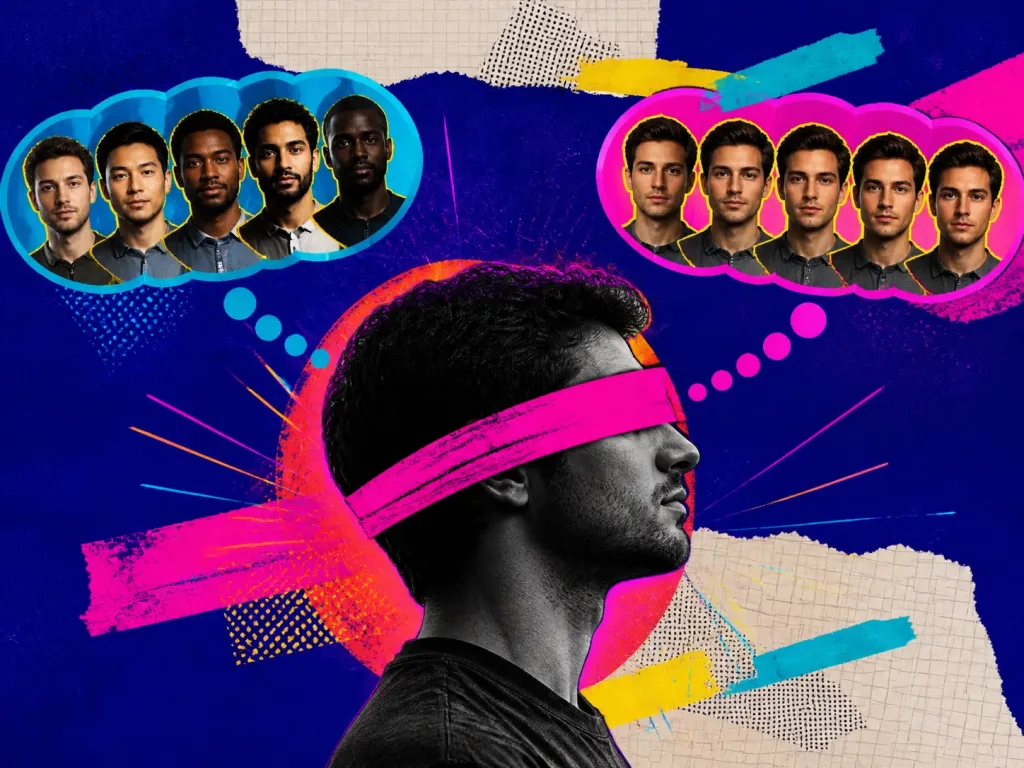
Do faces of people from other races seem more similar to you, while faces within your own group are easier to distinguish? That’s Cross-Race Effect – the tendency to have difficulty recognizing and differentiating faces of other racial or ethnic groups.
Examples and situations
- Eyewitness identification – people are more likely to misidentify suspects of a different race.
- Work & socializing – it’s harder to remember and recognize colleagues or acquaintances from other ethnic backgrounds.
- Media & perception – actors or celebrities from other racial groups may seem to ‘look alike.’
Questions to check
- Focus on details consciously – train yourself to notice distinguishing features rather than generalizing.
- Increase exposure to diversity – the more you interact, the better your recognition improves.
- Acknowledge it as a bias – your brain isn’t lazy, it’s just more practiced at recognizing familiar groups.
Long-form guide
Faces, Familiarity, and the Blur: Understanding the Cross-Race Effect
You’re at a family wedding, introduced to a cousin’s new partner. You shake hands, chat, and move on. Thirty minutes later, you pass them by the dessert table and swear you’ve never seen them before. Later you discover they have a twin? Nope. Just a different friend with the same haircut and a similar dress. You feel a bit foolish—and maybe a bit defensive—because this mix-up happens a lot when the faces aren’t from your own racial group.
On this page
What is Cross-Race Effect — when faces of other races seem harder to tell apart and why it matters
That recurring fuzzy feeling has a name. The cross-race effect (also called the own-race bias) is the tendency to find faces of other racial groups harder to tell apart than faces from one’s own group. The cross-race effect sits at the intersection of perception and experience. Most of us spend more time around people who look like us. Our brains get good at telling those familiar faces apart, and less good at others. This isn’t a moral failing; it’s a tuning issue. But tuning issues in perception can fuel mistakes—some social, some serious.
Psychologists have studied this for decades. People generally recognize same-race faces more accurately and quickly than cross-race faces (Malpass & Kravitz, 1969; Meissner & Brigham, 2001). This happens across many group boundaries and directions: white participants confuse Black and Asian faces more than white faces, Black participants show the inverse, and so on. Several forces push this effect: Attention and detail: With own-race faces, we pick up individuating features—subtle eye shape, cheekbone contour, micro-expressions. With other-race faces, we default to broader categories—skin tone, hair texture, a few global cues (Hancock, Bruce & Burton, 2000).
Categorization first, individuation later: When we see a face, our brain often categorizes it (race, age, gender) before it individuates it. If we stop at the category, we never get to the unique features (Levin, 2000). Experience and “face space”: The face-expertise model suggests we build a mental “map” of faces we see often—dense for familiar groups, sparse for others. Denser maps mean finer discrimination (Valentine, 1991). Motivation and expectations: When we expect to need detailed memory—say we know we’ll have to pick someone out later—we encode more individuating cues, and the cross-race gap shrinks (Hugenberg, Young, Bernstein & Sacco, 2010).
Why it matters: Eyewitness errors: Misidentifications in cross-race situations have contributed to wrongful convictions; in the U.S., a striking share of DNA exonerations involved cross-race misidentifications (Innocence Project). One mistaken face can derail a life. Hiring and classrooms: Candidates, students, or colleagues can blur together. You misremember who said what in a meeting. You reward or penalize the wrong person. Trust frays. Product design and safety: Face datasets, security checks, and user testing skewed to one group produce unfair systems that fail for others. Misrecognition makes tech brittle and biased.
Everyday belonging: Mixing up names repeatedly signals “I don’t see you.” Small harms pile up. People disengage. The cross-race effect doesn’t mean you’re biased in the “bad person” sense; it means your perception leans where you’ve practiced. The good news: practice is trainable.
1) The coffee cart apology loop
Nadia runs a coffee cart at a university. She prides herself on remembering regulars. One week, a new cohort of graduate students arrives. Nadia greets two students—Maya and Lila—on Monday. On Wednesday, she smiles at Maya and says, “Oat milk latte again, Lila?” Maya freezes. Lila laughs awkwardly. Nadia blushes, apologizes, and writes both names on sticky notes. By Friday, it’s happened twice more. Maya and Lila stop making small talk.
What’s happening: Nadia’s brain filed two faces under a fuzzy “new students” folder, then leaned on hair length and jacket color to tell them apart. Those global cues changed day to day. A week later, she re-anchored on distinctive details—Maya’s dimple, Lila’s septum ring, and their preferred drinks. The mistakes drop off. Lesson: Repetition without individuation leads to loops of apology. Intentionally extract “signature” features and bind them to a name and a story.
2) The team that kept losing interviews
A startup interviewed seven software engineers in two weeks, all from a coding bootcamp. In the debriefs, three candidates blurred together. “Was Sam the one with the NVIDIA project or the logistics chatbot?” Someone said, “I think that was Tian.” Another said, “No, that was Jia.” The notes were thin. The team passed on everyone because “no one stood out.” Two months later, they re-read their recordings and realized Tian had nailed the system design and culture fit. They brought him back and hired him. He had moved on.
What’s happening: The interviewers took minimal notes, didn’t capture identifiers beyond “brown sweater” or “glasses,” and didn’t assign roles. They paid attention to category (“bootcamp grads”) more than individuating skills. Cross-race effect elevated the blur. Lesson: Structured note-taking—role-based, same questions, concrete artifacts—prevents “vibe-based” memory where similar faces collapse into one.
3) The witness who meant well
A convenience store robbery lasted 40 seconds. The cashier described the suspect as “medium build, early 20s.” The police compiled a photo lineup of six faces. The witness picked one quickly and confidently. Months later, new evidence cleared the suspect. The actual robber, shown later, looked “familiar” but the witness couldn’t pinpoint why.
What’s happening: Under stress, memory encoding prioritizes threat and action over fine detail. Combined with cross-race effect, the witness relied on general similarity in the lineup. Confidence doesn’t equal accuracy. Lesson: Lineup best practices—double-blind administration, fair fillers, sequential presentation, confidence statements—reduce the risk, but the cross-race effect still needs explicit attention (Meissner & Brigham, 2001).
4) Classroom moments that echo
A music teacher, Mr. Hall, calls attendance. He mixes up Dev and Neel four times in a month. They sit on opposite sides of the room. They play different instruments. Mr. Hall feels bad and tries harder, but he still looks past the details he hasn’t encoded. He shifts to a new habit: for the first week, he writes one distinct feature next to each name, plus a musical fact. “Dev—blue clarinet case; Neel—perfect pitch, black hoodie.” He says the names aloud while looking directly at the student. He stops mixing them up.
What’s happening: The teacher used binding—name + feature + fact—plus attention to individuating cues. He forced discrimination where his default was category. Lesson: You can choose to collect better data with eyes and ears, not just “try harder.”
5) The product demo that broke on stage
A facial login demo at a conference worked great in rehearsals with the internal team. On stage, it failed for two out of three volunteers of a different racial group than the training data. The team tried to mask it with humor. The clip went viral.
What’s happening: The cross-race effect isn’t only a human phenomenon; machine learning models trained on skewed data encode similar gaps. Humans collected and labeled the data and declared the model “ready” without cross-group validation. Lesson: Don’t ship a perception system that hasn’t been audited across groups. Cross-race validation isn’t optional; it’s a release criterion.
Start with intent, then use systems
You can’t will a lifetime of perceptual habits away in a week, but you can build routines that change what your eyes and memory collect. The cross-race effect shrinks with deliberate exposure, better encoding, and structured decisions. “Try harder to remember faces” is a weak plan. You need triggers, steps, and tools.
Set a pre-commitment: “In the first week with a new cohort/client group, I will write two individuating cues per person.”. Use environmental scaffolds: name tags that face others, meeting docs with photos, annotated seating charts. Build review loops: end-of-day two-minute recall, then check against reality and fill gaps.
Train your attention to individuate
Shift from category to specifics. When you meet someone new, capture unique cues that don’t change with a jacket or hairstyle. Facial geometry: brow shape, eye spacing, cheekbone prominence, dimple locations, smile asymmetry. Voice and mannerisms: laugh rhythm, pace, hand gestures. Contextual anchors: shared project, a phrase they used, a hobby mentioned.
Say the name plus the cue aloud in your head: “Rina, sharp brow ridge and gold stud earrings, works on data pipelines.” Keep it simple. Two details is better than none. Research backs this up: individuation training improves recognition across races (Tanaka & Pierce, 2009).
Use names early and often (without making it weird)
Experience matters, but not just any exposure helps. Passive exposure keeps you at the category level. Active, meaningful contact builds individuation (Rhodes et al., 2009). Consume diverse media where characters have depth and distinct arcs. Pause and name the differences. Join mixed groups where you collaborate, not just co-exist. Solve problems, not just share a room. When you notice “they all look alike” creep in, treat it as a signal to slow down and collect better features.
Names are handles for individuation. Use them respectfully. Repeat the name once in conversation: “Great point, Aaron.”. Link the name to a distinct cue you observed: “Aaron—soft-spoken, square-frame glasses, brings diagrams.”. If you forget, don’t bluff. Ask once, apologize briefly, and fix it. Then write it down.
Structure decisions where memory matters
Whenever an outcome depends on who said or did what—hiring, grading, feedback, eyewitness identification—reduce reliance on raw memory. In hiring: ask the same core questions, take structured notes, capture one quote per question, and include a photo in the candidate packet. Review notes, not vibes. In performance reviews: collect specific observable behaviors with dates. Pair names with concrete outputs.
In classrooms: use seating charts with photos and an early-term memorization sprint. In research and product testing: recruit diverse participants and tag insights by participant with photo and quote. Don’t summarize “the three Asian testers liked X”—attribute by individual.
Audit your tech and teams
Stress and speed magnify the cross-race effect. If accuracy matters, slow down. In a security check, ask neutral clarifying questions and compare multiple ID points (birthdate, address) rather than relying on a quick face match. In busy service environments, give yourself a system: write orders with names, confirm aloud, and use voice or accessory cues as backup.
For machine learning teams: measure error rates across demographic groups. If a model underperforms on group X, fix the data, architecture, or thresholding. If you can’t, don’t deploy the feature. For any team: in retros, ask “Where did we blur people together?” and “What process change will prevent that next time?”.
Own the awkward
You’ll mess up. Correct cleanly, not defensively. “I’m sorry, I mixed you up with Jia. That’s on me. Jia’s the one who worked on the logistics bot; you built the recommender. Thank you for correcting me.”. Then do the work to avoid repeating it. People forgive occasional slips; they resent patterns. During; Use the person’s name once early, once mid-conversation; Observe and record two individuating features that won’t change tomorrow; Capture one direct quote or exact phrasing they used; If you feel a “category” thought (they, group), pause and add specifics.
After; Do a two-minute recall: list the people you met and one thing each said or did; Check and correct against notes or a roster; For recurring settings (class, team), review photos and cues once before the next session. System health; For hiring or grading, standardize questions and note fields across people; For products using faces, audit performance by demographic slice before launch.
Related or confusable ideas
The cross-race effect lives near other biases and effects. It helps to separate them. Stereotypes vs. cross-race effect: Stereotypes are beliefs about groups. The cross-race effect is a perceptual recognition gap. They can interact—stereotypes can steer attention away from individuating features—but they’re distinct (Eberhardt et al., 2004). In-group favoritism: Preference for your own group. You might like someone more because they’re “one of us” even if you can tell them apart equally well. In contrast, cross-race effect is about recognition accuracy, not liking.
Own-age bias: People often better recognize faces near their own age (younger adults confuse older adults more, and vice versa). Same mechanism: less individuation practice (Wright & Stroud, 2002). Out-group homogeneity effect: The perception that out-group members are “all alike.” Cross-race effect is one concrete manifestation of this in face perception, but out-group homogeneity can apply to interests, attitudes, and behaviors too. Prosopagnosia: Face blindness—a neurological condition where face recognition is broadly impaired. The cross-race effect is a typical cognitive bias, not a disorder. If you struggle to recognize even close friends, consider professional evaluation.
Confirmation bias: Once you label two people as similar, you may notice evidence that confirms the label and ignore disconfirming cues. This can lock in cross-race mistakes. Category-based processing: The brain’s habit of slotting stimuli into buckets first. This is the “front door” of the cross-race effect. Individuation pushes you past the front hall into the house.
Wrap-up: Cross-Race Effect
You don’t choose what your eyes were trained on when you were five. You do choose what you train them on now. The cross-race effect is not a verdict on your character. It’s a prompt: pay better attention, build better systems, and give people the dignity of being seen as themselves.
Here’s the bigger picture: your memory is a noisy instrument. Tuning it is work, but the rewards land everywhere—fairer hiring, safer lineups, smoother classes, kinder conversations. The world’s faces aren’t a blur. They’re a gallery. Keep looking until you can see the portraits.
Decision checklist
- Before
- Preview names and faces if available. Note two cues per person
- Prepare a simple note template: Name | Two cues | One quote/detail
- Decide where photos will live in your notes to avoid confusion
- Before a meeting: review names and faces; note two stable cues per person
- During: use each person’s name once; capture one quote or specific action
- After: do a two-minute recall; correct gaps against your notes
- Weekly: reflect on any mix-ups; adjust your cues (choose more stable features)
- Systems: standardize note templates; include photos with consent in records
- Self-training: once a week, do a 10-minute individuation drill with unfamiliar faces
- When stakes are high: slow down, ask clarifying questions, and rely on evidence, not memory