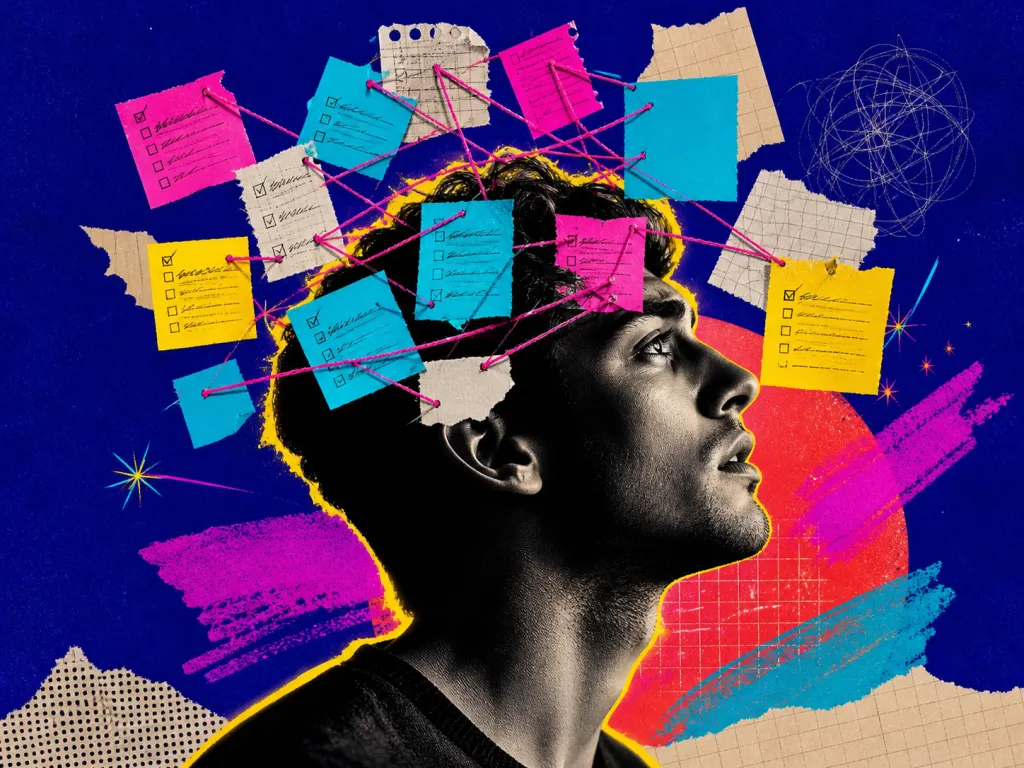
Cryptomnesia – when you think you came up with something new, but it’s actually an old memory
Did you come up with a brilliant idea, only to realize you’d heard it before? That’s Cryptomnesia – when a forgotten memory resurfaces as an original thought because you don’t recognize it as a memory.
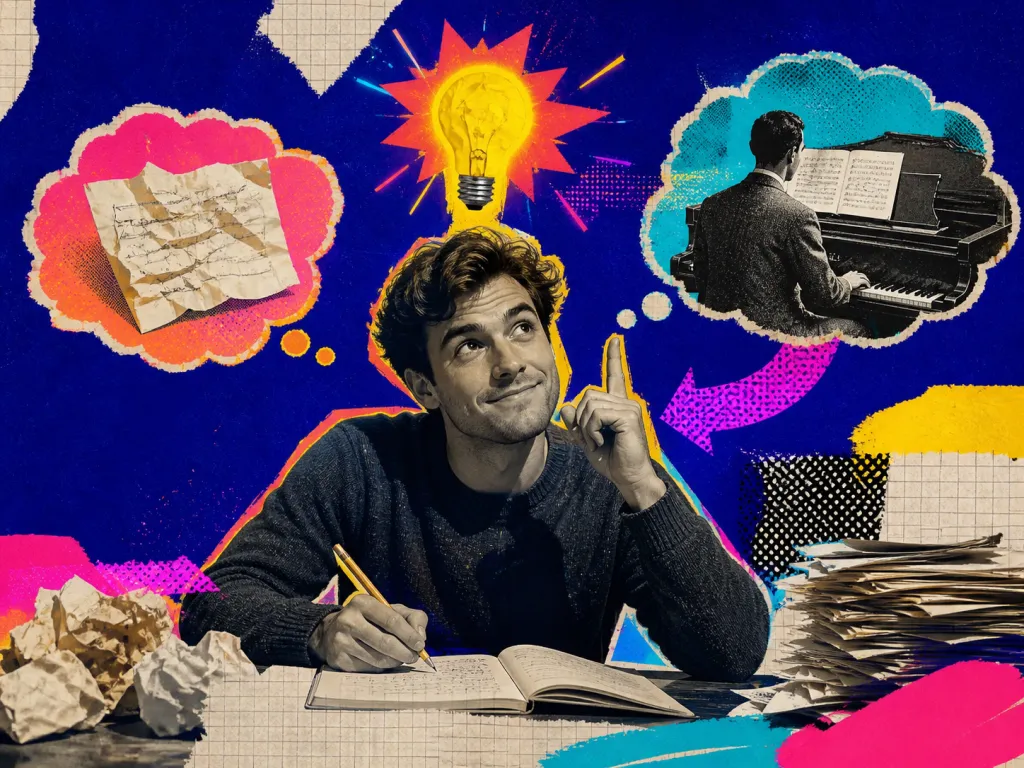
Examples and situations
- Creativity & innovation – you believe you wrote an original song or article, but it closely resembles something you heard before.
- Work & brainstorming – you propose a ‘new’ solution, only for colleagues to remind you it was suggested before.
- Conversations & debates – you unknowingly repeat someone else’s argument, convinced it was your own thought.
Questions to check
- Fact-check yourself – before claiming an idea as yours, try to recall if you’ve encountered it before.
- Track your sources of inspiration – this helps keep record of where your ideas originate.
- Be open to correction – if someone points out your idea isn’t new, take it as an opportunity to learn rather than a setback.
Long-form guide
The Familiar New: How Cryptomnesia Tricks Creators, Teams, and All of Us
A songwriter wakes up humming a melody and feels the thrill of discovery. Weeks later, a lawyer says the song already exists. A founder sketches a “brand-new” product idea and ships it fast—only to learn a small startup built the same thing last year and blogged every detail. A student drafts a brilliant paragraph that flowed too easily. Their professor recognizes it from an article assigned in week two.
On this page
What is Cryptomnesia – when you think you came up with something new, but it’s actually an old memory and why it matters
We’ve all been there: the rush of novelty that curdles into doubt. Did I make this, or did I just remember it? Cryptomnesia is the experience of believing an idea is original when it actually comes from memory. You think you created it, but you’re resurrecting something you’ve encountered before—often without any intent to copy. Cryptomnesia sounds like a supervillain. In a way, it is—quiet, stealthy, and powered by your own memory. The word comes from Greek roots meaning “hidden memory,” and it was popularized in psychology by Théodore Flournoy to explain how people could “channel” messages they had actually read earlier (Flournoy, 1905). Carl Jung wrote about it too, calling it “unconscious plagiarism.”
What’s happening under the hood? Your brain is good at retrieving content and bad at labeling where it came from. That labeling is called “source monitoring.” When source monitoring fails, you get the idea without the tag. It plays in your head and feels new because your brain’s “this is mine” light switches on by default (Johnson, Hashtroudi, & Lindsay, 1993). Memory had the decency to knock; we just missed the knock. Integrity and trust: Your reputation rides on how you handle ideas. Even if you never intend to copy, people experience the outcome, not your intention; Time and money: Shipping second is expensive. A cryptomnesia trap can steer projects into dead ends or legal grey zones you could have avoided with early checks; Creativity and collaboration: Teams that can detect cryptomnesia share and build ideas faster, because they avoid the friction of accidental theft; Personal growth: Accurate memory about where your ideas come from helps you learn what actually fuels your creativity.
Why it matters: Important nuance: cryptomnesia isn’t the same as smacking a logo on someone else’s work on purpose. It’s an honest error—and still your responsibility. The practical part: you can design your process and environment so the error happens less often, and you can handle it gracefully when it does.
The song that rang a bell in court
Stories stick. Here are the ones that stay with us and the ones we’ve seen up close. In 1976, a U.S. court found that George Harrison’s “My Sweet Lord” had unconsciously copied the melody of The Chiffons’ “He’s So Fine.”
The judge believed Harrison didn’t intend to copy but still ruled it was “subconscious plagiarism.” The case cost money, headlines, and a footnote in music history: you can sincerely believe you made something and still owe attribution. The gut-punch isn’t the ruling; it’s the realization that your memory can mimic originality convincingly enough to fool you.
“New” UX pattern, old conference talk
A product designer we know sketched a clever multi-step onboarding sequence that reduced choice overload with delayed reveals. The team loved it. In sprint review, an engineer said, “Didn’t we see this in that Pattern Library talk two summers ago?” The designer dug through notebooks, found a scribble: “Onboarding: staggered steps, prefill?
– talk by T.E.” They had accidentally internalized the pattern, then retrieved it as “their” idea. No harm—once acknowledged. They reached out to the original presenter and asked to share credit in their case study. The presenter was thrilled. Energy returned to the room. The difference between scandal and story was documentation and humility.
The academic slip
An early-stage founder pitched a “first-of-its-kind” creator tool that automated content batches using prompt templates. A mentor nodded slowly and forwarded a newsletter from last quarter that described nearly the same workflow. The founder was mortified; they had skimmed that exact newsletter on a plane. Cryptomnesia masked the source, and confirmation bias did the rest. Luckily, the discovery happened pre-launch. The team turned the “new idea” into a partnership, not a lawsuit.
A grad student drafted an intro on cognitive maps and was surprised by how the prose “flowed.” Their advisor ran a quick search, found sentences echoing a classic review. The student didn’t cheat; they’d read and re-read the paper and internalized its structure. They rewrote with explicit citations and their own synthesis. Painful, but a lesson: smooth prose often signals borrowed structure. That’s not a sin. It’s a cue to slow down and name your sources.
The team brainstorm trap
Even simple things: you “invent” a way to keep herbs fresh—wrap them in a damp towel and store in a jar. Your partner laughs. “Your grandma did that in the 90s.” That sting? Cryptomnesia. It reminds us this cognitive quirk operates at every scale.
In group brainstorms, people consistently “generate” ideas that others already said five minutes ago, then claim them later as their own without realizing it. Classic lab studies show participants plagiarize more under load, especially when ideas are similar (Brown & Murphy, 1989). Meetings create prime conditions: speed, noise, overlapping content, weak note-taking. That’s not a character flaw. That’s a predictable memory bug.
Notice the feel of “too easy”
You can’t rip the cryptomnesia circuit out of your head. But you can make it harder for it to fool you and softer when it lands. What follows is more than tips. It’s a way to carry your curiosity and your ethics into every draft, demo, and meeting. Pop out fully formed; Feel familiar-yet-bright, like déjà vu with extra sugar; Come with oddly crisp phrases or melodies.
The first diagnostic is vibe. When an idea arrives frictionless, already polished, it’s often because your brain did a quiet retrieval job, not a novel leap. Pay attention to ideas that: Treat these as “memory-first” candidates until proven otherwise. That doesn’t make them bad. It means you look for their roots.
Build a source-aware workflow
A light system beats a heavy one. Here’s a way to do it without killing your momentum: Track the sparks: Keep a simple “Idea Log” with timestamps. One page per idea. Jot where you were, what you were doing, and who you were with. Add a quick “Possible sources” line: podcasts, talks, articles, people, and examples that might have fed it; Tag ideas by confidence: Use tags like “fresh,” “remix,” or “seen-somewhere.” Be generous with “remix.” It changes how you search and present;
Journal towards the edges: When something feels novel, write a paragraph arguing it’s not. Where have you seen similar? What problem does it reuse? Often the counter-argument unearths the source; Run a novelty check: Before shipping or publishing, spend 20–40 minutes searching overlapping phrases, patterns, and names. Swap search engines. Try exact phrases in quotes. Check old bookmarks, notes, conference agendas, and Slack threads. You’re not trying to prove invention. You’re trying to avoid surprising yourself later.
Design meetings to reduce source errors
Name it in your doc or deck. “Inspired by X.” The lightness of the habit lowers resistance; Chase more sources. If there are three people doing a similar thing, the idea belongs to a lineage. You can contribute by mapping the space, not pretending it’s empty. Punishing yourself doesn’t help. Catalog your influences as treasure, not contraband. When a source surfaces: This mindset also helps you see your unique angle. Maybe your contribution is a constraint, a sequence, a metaphor, or a population. Naming the lineage clarifies your layer.
Teams can be cryptomnesia factories—or filters. Choose filter. Rotate scribes in real time. Attribute ideas as they emerge. “Ada suggested X; Chris added Y.” That visible trail reduces later misattribution; Pause for “source check” moments. After a flurry, ask: “Who’s seen prior art like this?” Make it normal, not accusatory; Split ideation and evaluation. Brainstorm fast, then do a separate pass where you mark “likely prior art” and collect examples; Stop the blame reflex. If someone surfaces prior art, thank them. The more shame in the room, the more people hide the very info that saves you later. Workflows fight biases. Polite intentions don’t.
Play with constraints to surface novelty
When you wake with a “new” idea, write it, then add a “seed list” of what you consumed the last three days: conversations, feeds, songs, articles. Those are likely culprits. If nothing obvious pops, check later. Source awareness often lags behind content recall. Memory just loves to jumble sources after sleep. That can be good (creative recombination) and risky (source fade). A small trick: What if I remove this part?; What if I swap this input?; What if I apply it to a weird edge case?.
If an idea truly is fresh, you should be able to vary it without losing its core. Ask: If the idea collapses, it’s likely a tight copy of a specific prior, not a generative pattern. If it flexes, you might be homing in on your real contribution.
Use lightweight tools, not heavy compliance
In posts and talks, over-credit rather than under-credit. Name people, not just “researchers say.” It’s contagious. People mirror clarity; Treat “inspired by” as status, not caveat. It signals you operate in a commons and you respect the craft. Build the muscle before you need it: It also attracts mentors. People who feel seen are more likely to collaborate. That’s insurance against future cryptomnesia drama.
A notes app with tags for sources and “likely prior art.”; Browser bookmarks with a “lineage” folder for each project; A simple template for new ideas: What is it? What problem? What’s the lineage? What’s new?. You don’t need enterprise software to avoid cryptomnesia. Use: If you collaborate, standardize the template. Culture beats tools, but templates help culture stick.
What to do when you realize it happened
Acknowledge fast. “I just realized this is close to X. I think I absorbed it earlier. Thanks to X for the groundwork.” Speed matters. It protects trust; Calibrate your response. If it’s a close structural copy, credit prominently and revise. If it’s a nudge-level echo, credit lightly and move on;
Learn the tripwire. Ask: what in my process masked the source? Then add a small fix. This is how you get better. It will happen. Handle it like a pro: Teams remember your recovery, not your error. That’s it. Not perfect, but it changes outcomes.
Source-monitoring error: Cryptomnesia
Cryptomnesia overlaps with other memory oddities and creative realities. Here’s how to tell them apart and why you should care. Plagiarism is knowingly presenting someone else’s work as your own. Cryptomnesia is mistakenly doing so because you misremember the source. The difference is intent. The consequence can be similar. In both cases, you owe correction and credit. The best defense is process, not purity.
This is the broader term in cognitive psychology for misattributing where a memory came from—internal or external, self or other (Johnson et al., 1993). Cryptomnesia is a specific flavor: you believe a memory is a fresh idea you produced. It’s not just misremembering a citation; it’s mislabeling retrieval as invention.
Convergent evolution and multiple discovery
Déjà vu is “I’ve been here before.” Déjà pensé is “I’ve thought this before.” Both are sensations of familiarity without clear source. Cryptomnesia often lacks even that sensation. The idea feels new. The familiarity arrives later—usually when someone else points it out. Sometimes people independently invent similar things because the problem and available tools push them there.
The history of science is full of it: calculus (Newton and Leibniz), natural selection (Darwin and Wallace). That’s not cryptomnesia; it’s parallel invention. But from the outside, it can look similar. Process notes help distinguish them. If you can show your independent path, you earn your place in the lineage.
How to recognize and avoid it: deeper drills and tiny experiments
Most creativity is recombination. Great artists steal well, but they also credit well. Influence becomes cryptomnesia when you erase the bridge. Leaving the bridge visible turns a risk into a virtue. Remix openly. It’s more fun that way. False memory is remembering events that didn’t happen or details that didn’t exist.
Cryptomnesia involves real content remembered under the wrong label. In practice, they can blend: you might “remember” inventing something you actually read, with invented details to justify it. Humility and notes save you here. If you want to go beyond the checklist, try these field-tested drills. They take minutes and shift the odds.
The “old friend” search
Shelf A: “Likely retrieval.” These ideas arrive smooth. You treat them as remixes until you place the source; Shelf B: “Likely divergence.” These ideas arrive awkward and incomplete. You treat them as fragile prototypes and beat on them. Keep two mental shelves for ideas: By labeling shelves, you avoid arguing with yourself. You can move ideas between shelves as evidence emerges. The point is not to be right fast, but to protect your projects from mislabeled inputs.
When you draft a thing that feels crisp, run a quick search on signature phrases that came with the idea. Exact phrases in quotes; add synonyms and specific nouns. If nothing shows up, try your own notes, then browse your reading history for last month. Ten minutes is often enough to surface the original talk, post, or paper that seeded you. This isn’t about paperwork. It’s about respecting the real journey of your mind.
The “origins paragraph”
In group sessions, cryptomnesia thrives when ideas overlap. Solve this with a simple move: after the first pass of ideas, assign provisional ownership for refinement. “Linh owns Idea 3; Jorge owns Idea 7.” Ownership doesn’t mean credit forever; it means a person responsible for tracking sources, examples, and variants. It also turns fuzzy group memory into specific notes. What problem made this idea necessary?; What prior art did you find persuasive or limited?; What is your actual contribution?.
For any piece of writing or product, draft an “origins paragraph” early: This paragraph doesn’t have to be public. It trains you to connect the dots cleanly. When in doubt later, you bring it forward and edit, not invent a backstory under pressure.
A small note on load and fatigue
What is the kernel?; What does it rhyme with?; Who would disagree it’s new, and why?. Flow is dangerous and glorious. In the middle of a strong flow session, force a 90-second meta break. Ask: Write the answers in the margin, then dive back in. The interruption barely dents momentum and catches many cryptomnesia moments in the act. Research on inadvertent plagiarism shows memory misattribution rises with cognitive load and time pressure (Brown & Murphy, 1989). Translation: if your sprint is hot, your source tags fall off. Use checklists during crunch, not just at leisure. You need them most when you have least time.
We promised sparing citations, so here’s the short list we actually use: Théodore Flournoy coined cryptomnesia to explain hidden memory in spiritualist contexts; the term anchors the idea historically (Flournoy, 1905); The source-monitoring framework explains how we tag the origin of memories and how those tags fail (Johnson, Hashtroudi, & Lindsay, 1993); In lab tasks, people “recreate” others’ ideas and think they’re original, especially under load and with similar stimuli (Brown & Murphy, 1989). That’s all you need for a practical backbone: a name, a mechanism, and a predictable pattern.
Wrap-up: you are not a fraud, but you are responsible
Here’s the secret: creators swim in a sea of other people’s thoughts. You can’t avoid influence. You don’t have to. The goal isn’t purity. It’s stewardship. Cryptomnesia will visit. Some days it will hand you a melody you wish you wrote. Other days it will nudge you into a risky move. When it does, don’t panic. Slow down. Ask, “What’s the lineage?” Then honor it. With a few small habits—notes, a quick search, a culture that rewards prior art—you protect your reputation, respect your peers, and make better work faster. You also sleep better. That matters.
We’re building a Cognitive Biases app because we want these tiny, daily wins to be easier. A quick “source check” nudge at the right moment can transform a near-miss into a better draft, a better product, a better relationship. If you want in, we’d love to build with you. Make honest things. Credit loudly. Keep going.
Decision checklist
- When an idea feels “too easy,” flag it as “seen-somewhere.”
- Write a 1–3 sentence lineage note for every project or piece
- Do a 20-minute novelty check before publishing or shipping
- Use a shared brainstorm doc with names next to ideas
- Add “source check” to your review agendas
- Default to “inspired by” credit on slides, docs, and posts
- Keep an Idea Log with timestamps and possible sources
- If you trip, acknowledge quickly and adjust the work
- Reward teammates who surface prior art. Make it visible
- Revisit your process after each near-miss; add one small fix
- Flag “too easy” ideas as “seen-somewhere.”
- Write a one-paragraph origins note per project