
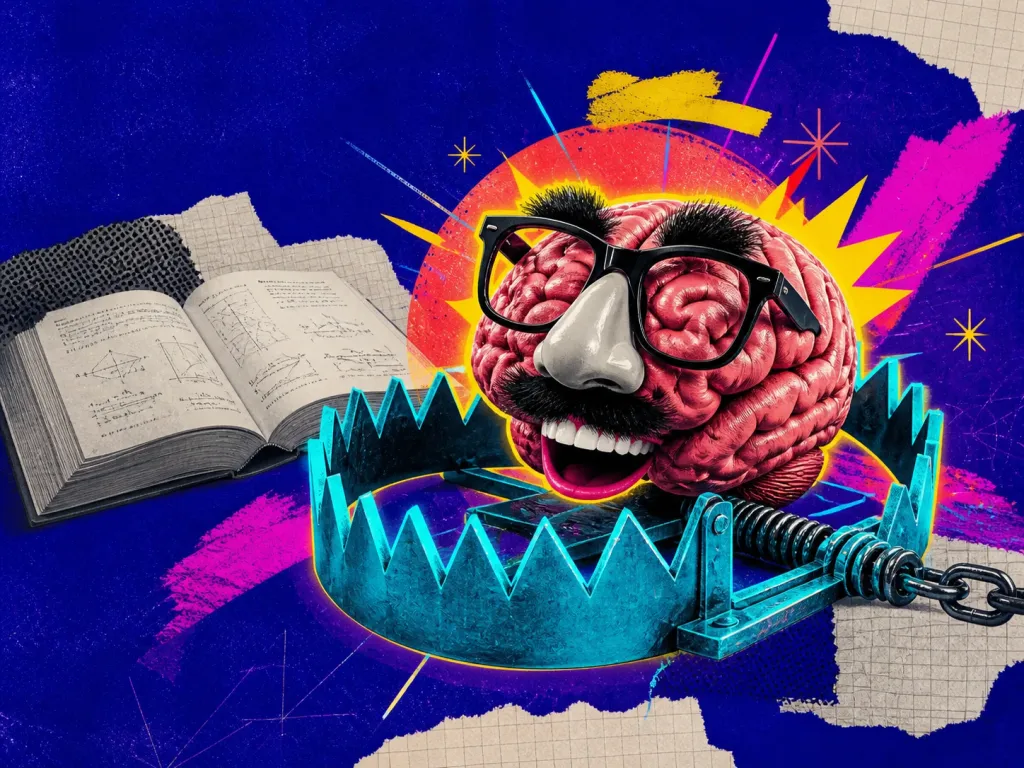
Humor Effect – when funny things stick in your memory
Do you remember the professor’s joke but not the lesson itself? That’s Humor Effect – the tendency to remember funny things better than neutral or boring ones.
Examples and situations
- Learning & presentations – a teacher’s joke sticks, but the textbook formula doesn’t.
- Marketing & advertising – funny slogans and memes are easier to recall than dry facts.
- Conversations & socializing – people remember those who made them laugh.
Practical considerations
- Add humor to studying – linking information to something funny helps with retention.
- Use jokes in speeches – people will remember your message if it makes them laugh.
- Make information stand out – humor helps highlight important points among dull ones.
Long-form guide
Why the Joke Stuck: The Humor Effect and Sticky Memory
You’re in the grocery aisle, scanning fifty brands of salsa, and your brain is mush. Then you spot a label with a cartoon tomato wearing shades: “We like it chunky because smooth is boring.” You laugh—just a little—and days later, you remember that brand and nothing else.
On this page
What is the Humor Effect and why it matters
That’s the Humor Effect at work: when something funny is more likely to be noticed, recalled, and retold than similar non-funny stuff. Humor Effect means funny content sticks in memory better than serious content, often because it grabs attention, feels distinctive, creates a burst of emotion, and encourages deeper processing. Why this matters: Memory drives choices. If we only remember the joke in a pitch, we may overvalue the product. If we recall a humorous safety tip, we might avoid an injury; Laughter lowers defenses. When humor hits, we’re more open to a message—but also more likely to overlook details, risks, or gaps; Humor can “sharpen the edges.” It adds contrast to dull material. Teachers, managers, designers, and campaigners use it to make ideas stick; It’s double-edged. A joke can uplift, clarify, and anchor memory—or distract, trivialize, and bias decisions.
People tend to remember humorous sentences and ads better over time compared to non-humorous equivalents (Schmidt, 1994); Emotional arousal—laughter is a mild positive arousal—can enhance memory consolidation (Cahill & McGaugh, 1998); Distinctiveness boosts recall; humor often works by making the item stand out (Von Restorff, 1933); Humor typically plays off incongruity—things that don’t fit—and our brains work to resolve the mismatch, a deeper processing that strengthens memory (Suls, 1972; Craik & Lockhart, 1972). A few helpful notes from research, kept short and useful: We’ll keep the theory light. You mainly need two tools: when to use humor to make something unforgettable, and when to spot it bending your judgment.
The banana case: a real classroom moment
Tanya teaches seventh-grade biology. Mitosis bored her students into desk-staring statues—until she taught it with a banana and a Sharpie face. The banana “cell” split into two bananas, each with a goofy grin. Kids laughed, but more importantly, they retold the banana split story on a quiz.
Test scores jumped on the mitosis steps, not just the definition. Months later, when multicell diagrams faded from memory, “banana mitosis” still lived on. The banana was a ridiculous anchor; the process rode along. Lesson: A small, surprising joke gives you a hook. The concept ties itself to the hook and travels.
The ad you can’t un-remember
A university tried to cut water use in dorms. Version one of their signs said: “Reduce water usage by 20%.” No one cared. The next week they posted: “Shorter showers save water. Sing the chorus, not the whole album.” Students laughed, timed showers to their favorite chorus, and usage dropped. The joke made the habit concrete and memorable. The sign didn’t just request—it gave a hack with a smile. Lesson: Humor works hardest when it steers behavior, not just attention.
You don’t drink sparkling water, yet you recall one brand’s ad: a goldfish wearing a monocle whispering, “Finally, bubbles with standards.” You find yourself staring at that brand at checkout. The line was clever; now the brand feels classy, and your memory nods along. You still might not buy it—but you can’t say you forgot it. Lesson: Humor can mix with halo effects; it warms up impressions that aren’t purely logical.
The microcopy that prevents a panic click
Dani leads a sprint planning session notorious for running long. She opens with a single slide: a pile of spaghetti labeled “our backlog.” Everyone laughs. She follows with, “This week, we untangle just five noodles.” Cheesy? Yes. But she uses the metaphor in standups, review, and the retrospective. The team remembers what mattered: five noodles, not the whole pot. Scope creep drops. Lesson: A humorous image sets a shared language. Repetition cements it.
A financial app has a scary red “Confirm transfer” screen. They test two versions. One says, “Confirm transfer.” The other says, “Send it! (We triple-checked the math.)” Users smile, breathe, and review details rather than abandon. The humor is tiny, but it breaks tension and slows the click enough to prevent errors. Lesson: Micro-humor doesn’t need belly laughs. A friendly aside can improve decisions.
The tweet that moves donations
Studying the cranial nerves is a rite of passage. You hear a PG-rated rhyme and immediately remember the list on exam day. It’s silly. It also works. The wrong version can stick too well, though, and some students misorder the last two nerves because the joke’s beat fits a wrong pattern. They remember the fun, not the map. Lesson: Humor anchors memory; the anchor must align with the structure you actually want to recall.
A shelter posts two appeals. One: “We need $5,000 for food.” The second shows a cat scowling at a salad: “We tried kale. It did not go well.” Donation link follows. The second post gets shared and funded. Humor invites sharing. Sharing multiplies memory and action. Lesson: Jokes travel. If your goal is spread, humor’s a booster rocket.
Tell-tale signs the Humor Effect is steering you
An airline crew tries a new safety video with sight gags. Passengers laugh. Compliance? Mixed. Some remember the “oxygen mask mustache” bit but misremember the sequence of “mask first, then help others.” The joke overshadowed steps. Cute, but it risked confusion. Lesson: Humor can overshadow procedural accuracy if timing and emphasis err. Humor isn’t neutral. It can pull attention toward what the joke spotlights, and away from what it hides. Here’s how to see it, use it, and avoid being steered wrong. You remember the tagline, not the product’s specs;
A presentation felt great because you laughed—yet you can’t explain the method or the trade-offs; You recall a single joke from a meeting more vividly than the decision itself; You retell the funny part, then realize your facts are fuzzy; A brand or idea “feels right,” but your reasons are basically “I liked that ad.” When you notice these, pause. Write the three key facts you’d bet money on. If you can’t list them, humor is carrying the memory, not the message.
Practical ways to use humor responsibly
Tie the joke to the core logic. Make the gag do the cognitive heavy lifting. If you remove the joke and the point collapses, the humor was doing real work; Keep timing tight. Joke first to invite attention; clarity immediately after. Don’t end on the joke—end on the instruction; Use the same humorous hook across touchpoints. Repetition turns a laugh into a memory anchor; Keep it human-sized. A wink beats a stand-up routine when the stakes are high; Test for overshadowing. Ask five people what they recall 24 hours later. If they remember the joke but not the message, refactor; Mind cultural fit. If the joke requires niche context, it won’t stick universally.
After the laugh, re-summarize: “What are the three takeaways?”; Ask, “What did they not say?” Humor can fill the space where the hard questions live; Separate likeability from truth. Good vibe ≠ good evidence; Write down numbers. Jokes blur details; ink sharpens them; Sleep on it, then revisit. If only the joke remains, seek facts.
Why humor sticks: the short, useful science
You don’t need a lab to use this, but a little science helps you craft smarter humor and sniff out when you’re being nudged. Distinctiveness. Our brains flag what breaks pattern. Humor often breaks pattern—a pun, a wildly wrong image, an unexpected twist—so it stands apart (Von Restorff, 1933); Arousal and emotion. Laughter nudges the nervous system; emotion can tag memories for better storage (Cahill & McGaugh, 1998); Incongruity and resolution.
Jokes pose a puzzle and invite us to solve it. That effort deepens encoding (Suls, 1972; Craik & Lockhart, 1972); Elaboration. Funny lines often add new associations. More hooks, more ways to retrieve the memory later; Social rehearsal. We retell funny things. Every retell rehearses the memory, strengthening it. This is also why humor can mislead. If the funny part is slightly wrong, we practice the wrong piece. That’s great for a comedy set, bad for a chemistry exam.
Related or confusable ideas
Humor Effect doesn’t live alone. It shares a neighborhood with other mental shortcuts. Distinctiveness Effect (Von Restorff). A single odd item is remembered better because it stands out. Humor is a powerful way to create that oddness, but distinctiveness doesn’t require laughter. A bright pink slide in a gray deck does it too; Positivity Effect. We recall positive events more as we age. Humor often hits positive emotions, but the positivity effect is broader and age-related; Mood-Congruent Memory. Your current mood biases what you recall. After a fun talk, you may remember fun examples better, even if they’re minor (Bower, 1981); Halo Effect. If something makes us feel good (funny ad), we project goodness onto unrelated features (the product must be good).
Watch for the spillover; Illusory Truth Effect. Repetition increases perceived truth. Humor gets repeated more—so a witty falsehood can feel true faster (Hasher et al., 1977); Seductive Details Effect. Interesting but irrelevant tidbits improve engagement while harming learning of the core content (Harp & Mayer, 1998). Jokes can become “seductive details” if not tethered to the main idea; Benign Violation Theory. Humor happens when a norm is violated but still safe (McGraw & Warren, 2010). Good guide for boundary setting, unrelated to memory per se, but helpful: push the line, don’t cross it. Knowing these helps you diagnose the moment: Is the joke helping distinctiveness, or is it a seductive detail stealing attention’s wallet?
Anchor the structure in the humor
Use this when you write emails, explain products, teach, or lead. It’s not about being a comedian; it’s about being memorable. Write your main message in the simplest sentence possible. Now search for a metaphor or twist that fits that sentence like a glove. Message: “Back up your files weekly.”; Funny hook: “Future You loves surprises. Lost files aren’t one of them. Friday = Backup Day.”; Why it works: Personifies the future self, exaggerates surprise, lands a concrete habit.
If you need a sequence remembered, use humor to mirror the sequence. Message: “Turn off gas, open window, exit.”; Humor: “Gas spill? Off, Out, and Away—like a bad date.”; Why it works: The playful alliteration and image guide the order.
Use imagery sparingly but deliberately
Pick a level on the scale: smile, wink, giggle, belly laugh. Riskier contexts demand “smile” or “wink.” Health, finance, and safety prefer polite levity, not absurdity. Clinic reminder: “Flu shots: free, quick, and much less dramatic than actual flu.”; Banking alert: “Heads up: your card ended a long-distance relationship with your wallet.”. Both are light without trivializing the stakes. A single weird image can glue memory. “Our support queue used to be an octopus. Now it’s a cat: fewer arms, more purr.”; Why it sticks: Octopus is chaotic; cat is controlled and cozy. Your team now has a shorthand.
Immediately follow humor with the conversion step. “Password too short. We love haiku, but hackers do too. Make it 12+ characters.”; The instruction lands right where the smile ends. Send your draft to a friend. Ask next day: “What do you remember? What would you do?” If they recall the joke but miss the action, tighten. Teams need consistency. Keep a short style note: topics to avoid, tone ranges, examples. Humor without boundaries becomes chaos.
When humor sabotages learning—and what to do
You’ll know humor is failing you when: People remember the wrong detail or order; Sensitive audiences feel trivialized; The joke ages poorly or excludes people; It increases clicks but not comprehension. Fix it with: Function-first rewriting. Strip the joke. Make the core stronger. Add humor back only where it scaffolds the point; Slower cadence. Let the instruction breathe. One joke per key message, not three; Relevance tests. Ask: “Is this funny because it’s true about the content?” If not, it’s a seductive detail. Cut it.
If you’re studying: Make your own absurd mnemonics tied to the exact structure. If you need order, your joke must encode order; Swap mnemonics every few chapters to avoid interference. Too many silly rhymes start to blur; Use retrieval practice without the crutch. Test yourself cold. If only the joke comes back, you don’t know it yet.
Product and UX
Use a recurring metaphor. Let it evolve over the course. Students will reference it later; Add humor to examples, not to assessment items. Tests should be clear, not cute; Use student-made humor carefully. Great for engagement; check for accuracy before it spreads. Microcopy can lighten friction.
Always pair with a clear next step; Error states are perfect for gentle humor—paired with a fix. “We lost the page, not your work. Refresh to resume.” In onboarding, humor should reduce fear, not hide complexity. “We ask for permissions so your photos look great, not because we’re nosy.”.
Healthcare and finance
Let humor highlight a real differentiator. If the differentiator is weak, the joke will become the product; Humor increases shareability—so add a line people feel good repeating; Avoid punching down. Audiences carry the memory of who you mock. Use humor to name elephants: “Our roadmap looks like a buffet plate. Let’s pick just three items.” Then pick them; Ritualize the joke. Start standups with the same witty prompt. Familiarity helps people open up. Keep humor gentle and functional. Respect is part of trust; Double-verify procedures for accuracy if humor appears anywhere nearby; Use patient- or client-friendly metaphors. Humor should reduce fear without masking risk.
Cognitive load. If the joke forces extra mental steps before the point lands, your audience wastes effort (Sweller, 1988). Use clear metaphors; Frequency. Constant quips dull attention and signal you’re avoiding substance; Appropriateness. Benign violation theory: safe violations are funny; unsafe ones are offensive (McGraw & Warren, 2010). Calibrate to context. A good rule: Humor should lighten the cognitive lift, not add weight.
Wrap-up: make the right things unforgettable
Here’s the quiet truth behind Humor Effect: our brains aren’t filing cabinets; they’re campfires. We remember what sparks. A good joke is a spark. If we align it with the right logs—facts, steps, decisions—we get warmth and light. If we toss sparks at dry leaves—gossip, fluff, bias—we get smoke and distraction. Use humor to help people do the thing you actually want them to do. Use it to be kind to your readers’ brains. Use it to keep your own memory honest: laugh, then list the facts.
If you want to spot Humor Effect in your day-to-day and track how it tilts your choices, our Cognitive Biases app is for you. We’re building it for moments like the salsa aisle, the safety briefing, the pitch deck, and the study grind. Notice the joke. Keep the truth. — If you want a nudge to notice when humor is pulling you toward or away from the truth, try logging those moments in our Cognitive Biases app. It’s the small, honest habit that turns laughs into better choices.
Decision checklist
- Is the joke aligned with the key point or procedure?
- Would the message make sense if the joke vanished?
- Does the humor punch up, not down?
- Have I highlighted the call to action after the laugh?
- Did at least three outsiders recall the main point a day later?
- Is the tone appropriate for the risk, audience, and moment?
- Write the point first in one clear sentence
- Add a single humorous hook that directly supports that point
- Place the instruction or call-to-action immediately after the joke
- Keep tone to a smile or wink in high-stakes contexts
- Test 24-hour recall with at least three people
- Remove any joke that doesn’t carry meaning (seductive details)