
Negativity Bias – when bad memories stick stronger than good ones
Can you recall one hurtful comment from years ago but forget all the compliments you’ve received? That’s Negativity Bias – the brain reacts more strongly to negative experiences and stores them longer in memory.
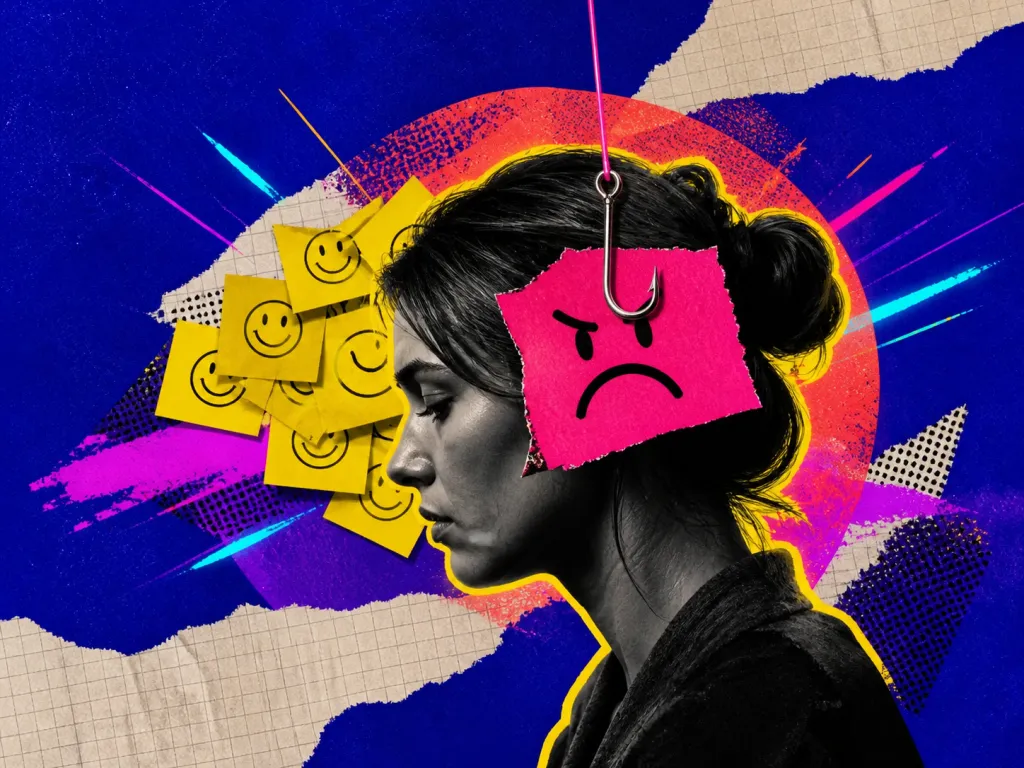
Examples and situations
- Work & feedback – you forget praise from your boss but remember one piece of criticism.
- Relationships & social life – one negative comment can ruin your day, even if it was surrounded by kind words.
- News & social media – negative stories grab more attention and stick longer than positive ones.
Practical considerations
- Consciously focus on the good – remember compliments, achievements, and happy moments.
- Filter news & social media – just because negativity dominates doesn’t mean the world is worse than before.
- Shift your perspective – if stuck on something negative, recall three good things from your day.
Long-form guide
When the Thorn Outlives the Rose: Making Peace with Negativity Bias
We’ve all had it happen. You spend a beautiful Sunday with someone you love—coffee, a slow walk, a shared joke that makes your ribs ache. Then, one stray comment cuts the wrong way. By Monday, somehow that single prickly moment crowds out the rest. The rose is still there. But your mind keeps running its thumb over the thorn.
On this page
What is Negativity Bias — when bad memories stick stronger than good ones and why it matters
That sticky thorn is negativity bias: our tendency to notice, remember, and weigh negative experiences more than positive ones. Negativity bias isn’t a flaw. It’s a survival feature. For most of human history, missing one threat could mean you were done. Our attention systems evolved to flag possible danger first, think later. Psychologists have summarized it bluntly: bad is stronger than good (Baumeister, 2001). Give a person one harsh critique and nine compliments, and the critique wins the afterparty in their head. Remembering the one traffic insult, not the 30 graceful lane merges; Revisiting the awkward moment at dinner, ignoring hours of easy conversation; Measuring your performance by your worst minute, not your mean.
When you feel it, negativity bias looks like: Decisions skew conservative or avoidant. You buy peace of mind rather than possibilities; Relationships carry a heavier ledger of slights than sweetness; You burn out faster because the few tough moments outweigh the many ordinary wins; Teams spiral around risk-aversion and blame, with less creativity and trust. Why it matters: This isn’t just vibes. The amygdala, which helps evaluate emotional salience, fires more readily at negative cues, and negative emotional arousal can lock in memories more strongly (McGaugh, 2004). Losses also loom larger than gains when we make choices—a cousin called loss aversion (Kahneman & Tversky, 1979). Put it together and you get a mind that keeps tiny museum rooms for every sharp pebble you’ve walked on. You can’t remove negativity bias—nor should you. But you can spot it, soften it, and give the good enough room to count.
1) The performance review that ruined Tuesday
Stories do more than prove a point. They show you where this bias hides. Here are a handful we’ve collected from work, home, and the awkward middle place called life. An engineer walks out of their annual review with a raise, a clear promotion path, and strong praise from two execs. On the last page, there’s one line: “Consider speaking up more in cross-functional meetings.”
That line becomes the only memory. On Wednesday, they stop sharing ideas. By Friday, they “proofread” their own Slack messages for 20 minutes, posting nothing. The company didn’t shush them. Negativity bias did. What to notice: the mind’s zoom lens. A single critical note swells until it defines the entire picture. This narrows future behavior and strangles growth.
3) Early-stage founder vs. user feedback
A couple returns from a long-awaited vacation. There were sunsets, lazy swims, a perfect bakery. On the second night, there was a loud argument about a late ferry. Months later, that argument is the headline when they think “Italy.” They tell friends, “It was beautiful, except that one night.” The one fight becomes the story’s narrator. What to notice: you can make dozens of good memories and still let one bad one file the paperwork. Negativity bias loves to write the captions.
A founder overhears a beta user say, “The onboarding is confusing.” Nine other testers say they breezed through. The founder spends a week rebuilding the funnel from the ground up. Afterwards, churn rises. Why? The outlier became the blueprint. What to notice: in product decisions, negativity bias can confuse a warning with a trend. It hates false negatives so much it marries false positives.
5) Scrolling the news vs. living in your city
At kindergarten pickup, your kid hands you a paper crown. The teacher says she helped a classmate. Then you see a frowny face sticker for “talking during quiet time.” On the drive home you lecture about quiet time. Later, in bed, your kid whispers, “I did good things today too.” You did notice. But the sticker got more airtime. What to notice: negativity bias hijacks reinforcement. It puts the megaphone on correction and turns down the volume on growth.
You love your neighborhood. You also doomscroll. The news stream drips “crime surge,” “economic cliff,” “new variant.” Night walks feel less safe. You grumble more, cancel more, and trust less. Meanwhile, city data shows steady crime rates. News outlets present more negative stories because they capture attention more reliably (Soroka, 2014). Your brain agrees. It can’t not look. What to notice: negativity bias, amplified by media incentives and algorithms, colors your daily map. Your feet follow where the map points.
7) The single botched meeting
You share a short film with a cohort. Two people rave about a scene. One suggests the ending “falls flat.” You toss the ending, reshoot, and lose the quiet, uncertain feeling that made the piece work. The next festival passes. What to notice: negative comments are often specific and feel “useful,” but they can pull the piece off its axis. Curate them. Don’t crown them.
A manager leads 12 strong meetings in a row. One goes off the rails—late agenda, a tense cross-team tiff. Their manager notes “leadership growth” overall, yet the manager leaves convinced they can’t facilitate. Two months later, they avoid big rooms. Their team stops getting invited to strategy tables. What to notice: one bad outcome narrows identity. Negativity bias turns events into labels: “I’m not good at X.” It’s fast, sticky, and wrong.
9) Team retrospectives that only mine for failure
You twist an ankle in a trail race. You heal. For months after, a single twinge on stairs reads like a five-alarm. Your gait changes. Your hips ache. You stop running. Pain gets more attention for good reason. But the remembered pain and fear of re-injury can assign today’s entire experience to yesterday’s danger. What to notice: your nervous system expects the worst. To protect you, it sometimes cages you.
Your team runs weekly retros. Every agenda is “what went wrong” and “how do we prevent it.” You log 40 “action items.” No one logs “this worked—do more of it.” Over time, morale curdles. You prevent repeat failures, sure, but also fail to water the strengths you already have. What to notice: negativity bias aims to eliminate pain, not grow excellence. That’s only half of management.
How to recognize negativity bias—and how to stop it from driving
You share a day’s story: the late bus, the spilled coffee, the weird coworker comment. You skip the stranger who held the door, the code that compiled on the first try, the unexpected laugh at lunch. Not because you’re ungrateful, but because those moments register as “fine,” i.e., invisible. What to notice: “fine” doesn’t write itself into memory. It needs a narrator. Otherwise, the thorn becomes the plot.
You can’t exile a bias that helped your ancestors survive tigers and cliffs. But you can unseat it as the default pilot. This is behavioral, not theoretical. Try these practices. Notice how they feel in your body: lighter, steadier, sometimes annoyingly simple.
Step 2: Reweigh the ledger, don’t rewrite history
When you feel the one-bad-thing swell, name it: “This is negativity bias.” It’s like flipping on a light in a tricky stairwell. Naming interrupts the automatic “this is truth” feeling. It gives you a beat to choose. There’s research behind labeling emotions and reactions, sometimes called affect labeling, which dampens amygdala activity and brings prefrontal areas online (Lieberman, 2007). You don’t need to cite it in your kitchen. Just say it.
You don’t need to pretend the negative didn’t happen. Instead, add context and weight. Timebox the negative: “Five minutes to write what went wrong. Then five for what went right.”; Count positives precisely: “Three concrete things that worked,” not “it was fine.” Specificity is oxygen. This balances memory encoding. Negatives tend to get vivid detail and rehearsal; positives need deliberate rehearsal to stick (Baumeister, 2001).
Step 5: Build habits that bias you back toward balance
Counterfactuals (“At least X didn’t happen”) can reduce regret but can also smuggle in more negativity. Try “also-factuals”: “Yes, that was rough. Also, I handled the Q&A calmly and shipped the follow-up.” This keeps the narrative honest and roomy. Cognitive reappraisal means reframing a situation’s meaning: “That critique is a map of where I can get stronger,” not “It’s a verdict on my worth.” Reappraisal reduces negative emotions and physiological stress responses (Gross, 1998). It takes practice. Do it in writing to make it tangible.
Savoring: Spend 20 seconds soaking in a good micro-moment—the hot mug in your hands, a solved bug. Let your eyes soften. Breathe. This lengthens positive encoding time (Bryant & Veroff, 2007); Gratitude with specificity: Write three specific things daily. Not “friends.” Try “Priya sent me a ridiculous meme after my bad call” (Emmons & McCullough, 2003); Peak-end tweak: If the end of a day is heavy, add a deliberate positive end—5-minute walk, stretch, call. We remember peaks and endings disproportionately (Kahneman, 2011). Give your day a better ending.
Step 7: Write faster than your feelings
If your feeds tilt negative, your mind will echo it. Audit your inputs: news apps, newsletters, social accounts. Keep enough signal to stay informed, but blunt the firehose. Even small reductions in negative media exposure shift mood and perceived threat. Situation: “Boss frowned during my update.” Automatic thought: “I’m failing.”
Evidence for: “I stumbled on a metric.” Evidence against: “She smiled at the start, said ‘good work,’ asked for more detail.” Balanced thought: “I stumbled and still delivered value. I’ll clarify the metric next time.” Use a simple thought record when spirals start: This is CBT 101, old but gold (Beck, 1979).
Step 9: Separate severity from frequency
Agree on a structure: 1) What went well, 2) What felt rough, 3) What to repeat, 4) What to repair. Put the repeat list next to the repair list. When you only fix, you teach your brain that survival is the goal. When you also repeat, you teach it that growth matters too. A single high-severity event (a breach, a betrayal) needs attention proportional to its risk. But don’t let it hijack your estimates of daily risk. Keep two lists: “one-off high severity events” and “daily patterns.” Treat them differently.
Implementation intentions turn fuzzy hope into small gears: “When I receive feedback, then I will summarize two positives and one action item before deciding anything” (Gollwitzer, 1999). Make the plan automatic so your bias has less space to drive. Use five of these, not all ten, if that’s what you can carry. Consistency beats perfection.
Related or easily confusable ideas
Negativity bias keeps its cousins close. Here’s the short tour to keep your mental map clean. Loss aversion: In decisions under risk, potential losses weigh more than equivalent gains (Kahneman & Tversky, 1979). It’s a specific form of negativity bias applied to choices, not memories. If you reject a fair bet because losing # When the Thorn Outlives the Rose: Making Peace with Negativity Bias. Availability heuristic: Events feel more likely if they’re easier to recall. Negative events are more memorable, so availability and negativity bias often team up. A news story about a plane crash can make flying feel more dangerous than it is.
Confirmation bias: We seek and favor evidence that supports our beliefs. If you believe you’re “bad at public speaking,” you’ll collect every shaky moment as proof. Negativity bias adds weight; confirmation bias chooses the stones. Catastrophizing: A cognitive distortion where you leap to worst-case predictions. Negativity bias isn’t necessarily predictive; it’s about attention and memory. Catastrophizing is the vivid forward morph of it. Recency effect: Recent events weigh more heavily in memory. Pair this with negativity bias and last night’s argument can feel like the whole relationship.
Rumination: Repetitive, passive focus on distress and its causes (Nolen-Hoeksema, 2000). Negativity bias gives rumination its raw material; rumination builds the prison. Negativity dominance vs. negativity bias: Dominance refers to how mixed experiences skew negative overall; bias refers to attention and memory mechanics (Rozin & Royzman, 2001). They’re related threads. Positivity offset: In neutral contexts, we show a slight tilt toward positive exploration (Cacioppo & Berntson, 1999). This can counterbalance negativity bias, especially when we feel safe and curious. Knowing which creature you’re dealing with helps you pick the right tool. You don’t negotiate with a tiger using a fishhook.
Drill 2: Feedback deconstruction
Recognition comes from reps. Don’t wait for a life crisis. Practice in low-stakes situations so the skill is there when your heart rate spikes. Left column: hassles (late bus, rude email); Right column: glimmers (seat by the window, sun on the table, a joke). On your commute home, file this report: Aim for a 1:1 ratio. If you struggle, shrink the glimmer size. “My pen worked” counts. Over time, your eye learns to catch good micro-moments before they slip through.
Observation: “Your slides had lots of text.”; Impact: “I found it hard to follow.”; Ask: “Use fewer words next time.”. When you get feedback, write exactly what was said, then separate it into: Now write a plan: “One idea per slide; presenter notes carry detail.” You keep the informative part, ditch the sting. That sting is the bias’s candy. You don’t need it.
Drill 4: Short exposure to the feared thing
After a project, run a “pre-mortem” in reverse. Ask, “If this had failed, what would we say caused it?” Then check which causes didn’t happen and why. Name the avoided risks. This credits successful decisions and raises them to memory status so they can be repeated. If you avoid a task because of a prior negative moment, do a tiny exposure: set a 5-minute timer and start. End before it gets ugly. Repeated small exposures reset your threat meter. They teach your nervous system that this thing doesn’t always bite.
When your inner monologue on an event gets cruel, write it as if a friend told you the same story. What would you say back? Speak it out loud. It often becomes practical: “Okay, you stumbled. Email a clearer summary. Move on.” Before bed, do one small ending act: lay out clothes, prep coffee, queue a song for the morning. Design a positive ending to influence your memory of the day’s story (Kahneman, 2011). The brain puts heavy weight on endings. Hand it a firm, kind one.
When the bias is useful and how to harness it
You can recruit negativity bias for good. Risk review sessions: Ask, “What could hurt us?” Let negativity bias generate the list fast. Then switch hats. Each risk gains an owner, a probability, and a mitigation. You make worry do labor. Security and safety: In domains where one failure can be catastrophic, keep negativity bias on payroll—checklists, redundancies, drills. Just confine it to the domain. Don’t let it spill into every decision style. Quality control: Invite sharp-eyed reviewers at specific milestones. Gate their influence to that checkpoint. This prevents the “all-day critic” effect.
Learning from past pain: Archive mistakes with crisp roots and fixes. Revisit on a schedule, not a rumination loop. A clean scar teaches; an open wound disables. Negativity bias becomes a mentor when you give it a desk, a calendar, and scope. When you let it roam, it turns into a critic who shows up to every meeting uninvited.
Quick science pit stops (without jargon overdose)
Bad sticks faster: Negative information is processed with more urgency and often gets richer encoding in memory (Baumeister, 2001; Rozin & Royzman, 2001). The brain has alarm wiring: The amygdala quickly flags potential threats; emotional arousal modulates memory consolidation, making negative events memorable (McGaugh, 2004). Behavior bends around losses: In choices with risk, we overweight losses relative to gains—loss aversion (Kahneman & Tversky, 1979). Media leans negative because we lean toward it: News with negative tone attracts more attention and is more memorable (Soroka, 2014).
Reappraisal helps: Reframing an event’s meaning reduces negative emotional intensity and improves regulation (Gross, 1998). Gratitude and savoring aren’t fluff: They nudge attention to encode positives, making them easier to recall later (Emmons & McCullough, 2003; Bryant & Veroff, 2007). You don’t need to memorize names. Keep the gist: your brain is not broken; it’s old. Respect it. Then coach it.
Two field notes from our team
We’re builders as much as writers. We use these every week. 1) “Read the whole thread” rule: In Slack or email, we don’t react until we’ve scrolled to the end and summarized the ask in our own words. It prevents prematurely anchoring on the most negative hot take.
2) “Airtime ratio” in retros: We time the “what worked” portion to match the “what didn’t.” It feels awkward at first. Then it feels like oxygen. These aren’t slogans. They’re small levers we pull so our work doesn’t feel like constant fire watch.
A short field kit for managers, parents, and makers
Managers: After a tough demo, capture two things to repeat before listing fixes. Pair new risks with owners immediately. Celebrate mitigations publicly. Parents: End the day with “one hard thing, one proud thing.” Ask your kid for both. Model balanced attention. Makers: Keep a “bright spots” doc. Paste screenshots of wins, notes from users, solved problems. When a bug steals your mood, spend two minutes in the doc before diving back in.
Couples: Do a weekly “rose, thorn, bud”—a highlight, a hard thing, a thing to look forward to. Give each equal time. Students: After exams, log not just errors but also questions you nailed and why. Build a study kit from both lists.
The core mistake negativity bias makes
It assumes a safe world requires you to hold only the bad. That math doesn’t work. If you carry only the thorns, you forget why the rosebush is there at all. You refine away risk and also joy. You prevent failure and also originality. You become safe and also small. Every day, your mind edits your story.
Negativity bias is a fast editor with a heavy hand. Your job isn’t to fire them. It’s to hire a second editor who loves craft, who asks, “What’s true and useful?” and “What deserves to be remembered?” That second editor is your deliberate practice: naming, reweighing, savoring, planning. It takes minutes. It changes the book.
Wrap-up: Give the good a fighting chance
Picture your day as a jar you fill with stones. Negativity bias throws in the heavy ones first—mistakes, slights, scares. They clunk. They echo. If that’s all that goes in, the jar looks full. But there’s room between the stones.
That’s where the water goes—the warm text, the solved problem, the smile from the barista, the stretch that eased your back. Pour it in on purpose. Watch the level rise. Bad sticks. Let’s make good stick too. Tape this where you make decisions. Use it messy. Use it often.
Decision checklist
- Name it: “This is negativity bias.”
- Pause 90 seconds before reacting
- Write two sentences: what happened; what I made it mean
- List three specifics that went right; one that went wrong; one next step
- Ask: “Is this frequent or just memorable?”
- Ask: “If a friend told me this story, what would I say back?”
- Reappraise: What might be a useful interpretation?
- End the day with a 2-minute highlight note
- If it’s feedback: extract the ask; ignore the sting
- If it’s news/social: close the tab; put the phone in another room for 10 minutes
- Say it: “This is negativity bias.”
- Breathe for 6 slow counts; wait 90 seconds