
Reminiscence Bump – your youth stands out in memory
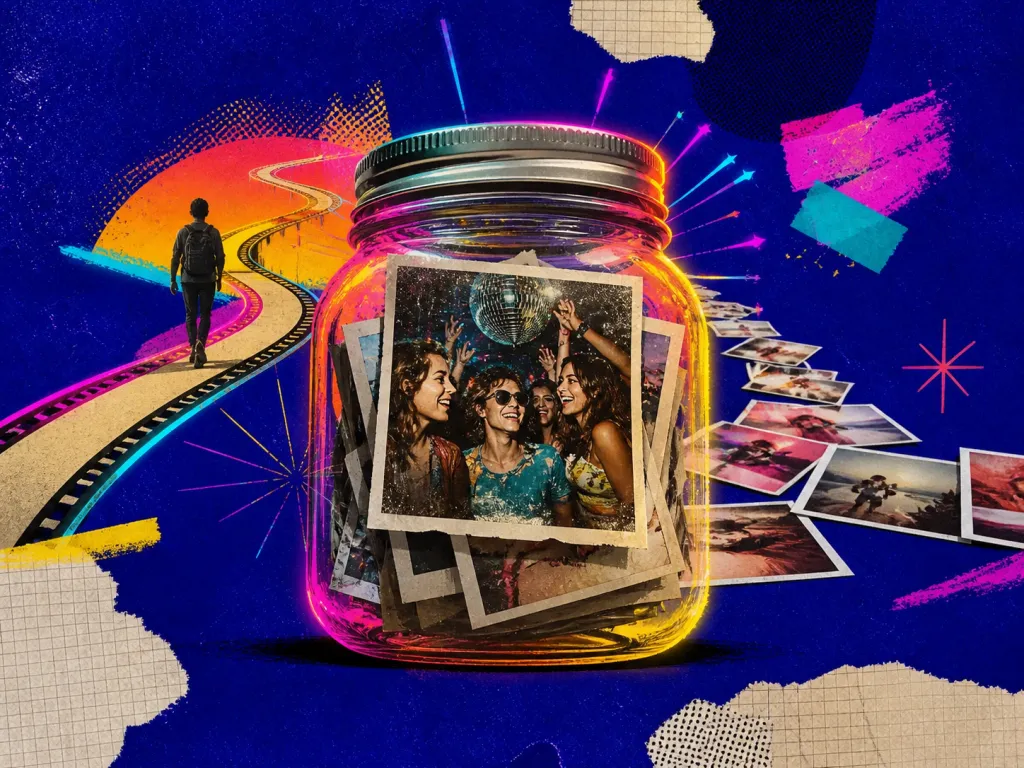
Why do you vividly recall your first parties, first job, or first love but not recent events? That’s Reminiscence Bump – we remember adolescence and early adulthood more clearly than any other period of life.
Examples and situations
- Perception of the past – it feels like “things were better back then” simply because these memories are sharper.
- Nostalgia & emotions – teenage years are full of “firsts,” and strong emotions lock those moments into memory.
- Decision-making – people often make choices based on their best youthful experiences rather than present-day reality.
Practical considerations
- Create new vivid memories – strong emotions help form lasting memories beyond youth.
- Be mindful of nostalgia – memories of youth are subjective, and the past wasn’t always better.
- Use this effect in storytelling – if you want something to stick, connect it to people’s teenage memories.
Long-form guide
The Year Everything Sparkled: Why Your Youth Stands Out in Memory
Some nights I open an old shoebox and out falls a concert ticket that still smells like cheap smoke and cola. Suddenly I’m back in a summer where every car radio knew what I felt before I did. The city is small and bright. My best friend’s elbow sticks out the passenger window, and we swear we’ll remember this forever. And somehow, we do.
On this page
What Is Reminiscence Bump – Your Youth Stands Out in Memory and Why It Matters
Those years—say, roughly 15 to 30—hoard our memories like magpies. Psychologists have a name for this: the reminiscence bump. It’s the pattern where people recall a disproportionate number of vivid, emotional, and meaningful memories from adolescence and early adulthood, compared to childhood or later adulthood. When researchers ask adults to recall events across their lives, the curve is oddly uneven. People remember lots from the last few years (a recency effect), very little from early childhood (childhood amnesia), and an outsized number from their teens and twenties—the reminiscence bump (Rubin, Wetzler, & Nebes, 1986). That bump shows up in autobiographical memory tests, favorite songs, firsts, and “most important life events.” It’s not nostalgia marketing; it’s something deeper in how memory and identity grow.
Why it matters: Decision-making: You might overvalue strategies, tastes, and technologies that worked when you were 20 because they feel “right.” They’re stamped as identity; Hiring and mentoring: You may misjudge “grit,” “initiative,” or “fit” by comparing others to your younger self, forgetting how much context lifted you back then; Relationships: You can underweight current experiences because your highlight reel is stuck on early adult highs; Culture and politics: You might rate music, values, or “the way things should be” through the lens of your formative years, mistaking familiarity for objective quality.
The bump is not a single cause but a convergence of forces: Firsts and novelty: First love, first job, first apartment—novelty hooks memory; Identity formation: We narrate who we are in those years (“I’m the kind of person who…”) and store memories that serve the story (Conway & Pleydell-Pearce, 2000); Cognitive peak: Processing speed, memory capacity, and emotion-regulation are strong in early adulthood; Cultural scripts: Societies structure major life events into that window—graduations, careers, marriage, migrations—making memory dense (Berntsen & Rubin, 2002); Emotional intensity: High arousal bites deeper grooves in memory. The reminiscence bump is a feature of being human. It helps you remember what built you. But it can shade your present if you don’t spot it.
The manager who kept hiring 23-year-olds like his former self
Raj built his first startup in his mid-twenties, sleeping under his desk and shipping features at 3 a.m. Fifteen years later, he was a director hiring “hustlers.” His bias? He measured talent by how much someone resembled his 24-year-old self—late-night coding, disdain for process, a twitchy energy.
He passed on a 35-year-old engineer who could automate half the team’s toil, simply because she didn’t “seem hungry.” When they finally hired her, she quietly raised output and cut burnout. Raj’s reminiscence bump had been confusing identity with effectiveness. The memories were true; the inference was off.
The reunion that rewrote a marriage
Leah’s first album hit when she was 21. Fans wrote long emails about how it saved their freshman fall. Every time she tried something new, she felt like she was betraying her origin story. Her most vivid memories—the basement shows, the thrifted amp, the friend sleeping on the floor—kept pulling her back toward that sound. It took a side project and a producer ten years younger to shake her loose. Nostalgia wasn’t the villain; it was gravity.
On a Sunday road trip, Jamie detoured past their college town. They walked old paths and split a greasy slice, and for weeks afterward Jamie couldn’t stop comparing “then” to “now.” It wasn’t that the past was objectively better; it was more storied. The couple talked. They didn’t need to move back, but they did need more shared novelty in the present—less screen glow, more plans to ruin their shoes in. Memory was a mirror; it reflected who they missed being.
The immigrant with two bumps
A retail exec loved the playbook that made her career during the early e-commerce boom: ruthless banner ads, email blasts at 11 a.m. on Tuesdays, free shipping as a wedge. The tactics rode with her through three promotions. Fifteen years later, she insisted on the same moves—gut over data—because “that’s how you build loyalty.” Loyalty had moved; her memory hadn’t. The reminiscence bump flattered her past into a template.
Miguel moved from Lima to Madrid at 29. He reported two clusters of glowing memories: his Peruvian twenties and his first five years in Spain—two eras of firsts, two identity scripts, two sets of songs that smelled like subway steel and unripe pears. Adults can get a second bump when life restarts—migration, career change, late parenthood—because novelty and narrative light the brain again (Schrauf & Rubin, 1998).
Recognize/Avoid It
Ask someone to name their “all-time” songs, and many picks land between 13 and 25 (Krumhansl & Zupnick, 2013). Our brains marinate songs in feelings and friends and summers we thought would never end. That’s why you’ll swear that era’s music is objectively better. Maybe it is;
more likely, you imprinted on it during your cognitive and emotional sweet spot. You can’t and shouldn’t “avoid” the reminiscence bump. It guards the story of your life. But you can learn when it’s steering your choices and how to widen your field of view.
A quick mental model: three circles
When your past feels like a gold standard, ask: was it the tactic or the timing? Separate context from craft; When you feel stuck in “we used to”—add novelty by design: new projects, new places, new collaborators; When hiring or mentoring, look for effectiveness today, not resemblance to your younger self; When making big bets, couple your gut with fresh data; treat your highlight reel as a hypothesis, not a rule.
Imagine three circles that overlap: 1) Then: formative memories—what worked, what hurt, who you were. 2) Now: current constraints—market, relationships, energy, responsibilities. 3) Next: near-future goals and experiments. Good decisions sit in the overlap. The reminiscence bump yanks you toward “Then.” Pull it back by asking: What part of “Then” is portable and useful now? What part only worked because I had no mortgage, no team, or a different market?
Avoiding the trap without losing the treasure
Keep the music; update the playlist. Don’t amputate your past to force novelty. Instead, add fresh inputs deliberately; Honor the story; rewrite the chapters. Journal one page a week: What did “past me” believe about success? What do I believe now? Where did I change my mind—and why?; Build “novelty appointments.” Put one new experience on your calendar weekly.
Small and cheap wins: a different commute, a new café, a skill swap with a friend; Audit your “greatest hits” annually. Pick three tactics you used in your twenties. For each, ask: What assumptions made it work? Which no longer hold? Adjust or archive; Mentor across eras. Pair with someone earlier or later in career. Exchange methods, not just stories. Borrow each other’s eyes.
Related or Confusable Ideas
Nostalgia: Warm, often bittersweet affection for the past. The reminiscence bump often fuels nostalgia, but the bump is the pattern; nostalgia is the feeling; Peak-end rule: We judge experiences by their peak and ending, not the average. Different from the bump, but together they explain why a wild summer and a poignant breakup loom large; Rosy retrospection: Tendency to remember past events as better than they were. The bump provides raw material; rosy retrospection polishes it; Availability heuristic: We estimate likelihood based on how easily examples come to mind. Memories from youth come easily and can skew risk and value judgments;
Confirmation bias: We keep memories that support our identity and beliefs. The bump often stores identity-confirming moments, making it easy to cherry-pick; Childhood amnesia: We recall little before age 3–4. The bump is the opposite slope—where memory blooms; Cultural life scripts: Shared expectations about age-graded events—graduation, first job, family—shape which memories stick (Berntsen & Rubin, 2002); Flashbulb memories: Vivid memories of surprising, emotional events (e.g., where you were during big news). They can live inside the bump but are a different mechanism; Migration or “second bump”: Major life transitions can create a new cluster of formative memories in adulthood (Schrauf & Rubin, 1998).
The Mechanics Underneath (Short and Useful)
You don’t need a lab coat, but a few facts help: Identity scaffolding: Adolescence and early adulthood are where self-defining memories consolidate. The brain tags these as “story-important,” making them easy to retrieve later (Conway & Pleydell-Pearce, 2000); Emotion and novelty: Emotional arousal and first-time novelty boost encoding and consolidation. Your brain learns “this matters—save it.” Retrieval practice: We retell early adult stories often—to loved ones, to ourselves—strengthening those pathways;
Cognitive sweet spot: Processing speed and working memory are strong; sleep patterns and social networks push experiences into long-term storage; Cultural timing: Societies concentrate rites of passage into those years, artificially amplifying the memory density. This is why favorite songs, foods, and brand loyalties often freeze in that window (Krumhansl & Zupnick, 2013). Not because we stopped growing, but because we keep retrieving that era and polishing it.
Using the Bump at Work
Strategy: Map assumptions embedded in your early wins. For each key decision, ask “What if the context that made this work has evaporated?” Hiring: Write a scorecard that measures outcomes and skills, not vibes. If a candidate reminds you of young-you, count that as noise, not signal; Innovation: Add “counter-memory” time to brainstorms.
Ask a teammate from a different generation to critique your favorite tactic; Leadership: Share your origin story as a story, not a blueprint. Name the luck. Invite everyone to build their own firsts inside the team; Learning: Schedule deliberate cross-training. New skills create mini firsts; firsts extend memory and motivation.
Using the Bump in Life
Relationships: Plan shared firsts. Don’t wait for grand gestures. Try new recipes, new walking routes, new community events. Tiny novelties accumulate into a fresh chapter; Well-being: Use memory deliberately. Revisit a powerful early memory not to get stuck, but to extract a value you still love—curiosity, bravery, play—and practice it now; Creativity: Make a “then-to-now mixtape.”
Pair one old influence with one new one per week. Create with both in the room; Aging: Expect your highlights to cluster early; that’s normal. Create “late bumps” by learning an instrument, joining a club, moving neighborhoods, or traveling off-script; Parenting: Kids anchor their bump later. Give them varied firsts and let them own the story. Your coolest story won’t be theirs. That’s fine.
Avoid Missteps: Four Traps
The golden era trap: “The best days are behind me.” False and corrosive. Novelty and meaning can be scheduled. The brain is hungry for them at any age; The origin story trap: “Real me only exists in that old city with those old friends.” Real you is portable. Your values travel better than your venues;
The tech fossil trap: “This tool worked when I learned it; new tools are hype.” Tools age. Skills like learning, testing, and humility don’t; The culture war trap: “Music/values were better in my day.” They were yours in your day. That’s enough reason to love them, not to denounce everything else.
Research Corner (Kept Light)
People recall more from ages ~10–30 than neighboring periods—the classic bump (Rubin, Wetzler, & Nebes, 1986); Identity and self-defining memories consolidate in adolescence/early adulthood (Conway & Pleydell-Pearce, 2000); Cultural life scripts shape which events get encoded and retold (Berntsen & Rubin, 2002);
Migration can produce a second bump due to intense novelty and identity renegotiation (Schrauf & Rubin, 1998); Music preferences and “best songs” cluster around adolescence and early adulthood (Krumhansl & Zupnick, 2013). We share these not to flex citations but to convince your inner skeptic: your memory’s shape is not a personal quirk. It’s how minds grow stories.
A Note on Grief and Memory
Try this tonight: 1) Pick one vivid memory from 15–30. Write it for five minutes—sensory detail, no moral. 2) Underline three values it shows—curiosity, courage, mischief, community. 3) Note one method from that story that no longer fits—sleep deprivation, winging it, ignoring feedback. 4) Plan one present-tense act that serves those values with better methods. Put it on your calendar this week. You’re not erasing the past. You’re letting it teach without trapping you.
Sometimes the bump holds losses: a friendship that exploded, a parent who didn’t show, a mistake that still shames you. Memory’s job is to keep you whole, not happy. If certain stories sting, work with them gently. Talk to someone. Write them with compassion. Then create counter-memories intentionally—not to replace the old ones, but to braid them into a kinder narrative.
The MetalHatsCats Wrap
We built this with our own shoeboxes open—concert stubs, coffee shop receipts, screenshots from chat apps that don’t exist anymore. We want you to keep your souvenirs without letting them drive the car. That’s why we’re building the Cognitive Biases app: gentle, practical nudges that catch patterns like the reminiscence bump in the moment you’re making a choice. It won’t erase your past; it will help you use it wisely.
Your youth can be a lighthouse without being a leash. Let it shine. Then walk forward. References (light): Berntsen, D., & Rubin, D. C. (2002); Conway, M. A., & Pleydell-Pearce, C. W. (2000); Krumhansl, C. L., & Zupnick, J. A. (2013); Rubin, D. C., Wetzler, S. E., & Nebes, R. D. (1986); Schrauf, R. W., & Rubin, D. C. (1998).
Decision checklist
- Am I comparing today to a 10-year-old high?
- Am I valuing familiarity over evidence?
- Am I assuming my way is the universal way?
- Am I resisting change because it makes my origin story feel less special?
- Has my environment changed more than my methods?
- Do I have recent wins outside my comfort zone?
- Have I asked someone 10 years younger and 10 years older how they’d approach this?
- Can I run a small experiment instead of defending a memory?
- Name it: “Is the reminiscence bump steering this decision?”
- Separate values from methods: keep the why, update the how
- Test your past: run a small, current experiment before committing
- Seek cross-era input: ask someone 10 years younger and older