
Prospect Theory · Entry 79
System Justification – when you defend the system, even if it harms you
Article options
Do you believe that if something has been around for a long time, it must be good? That’s System Justification – the tendency to defend the status quo, even when it’s unfair or personally harmful.
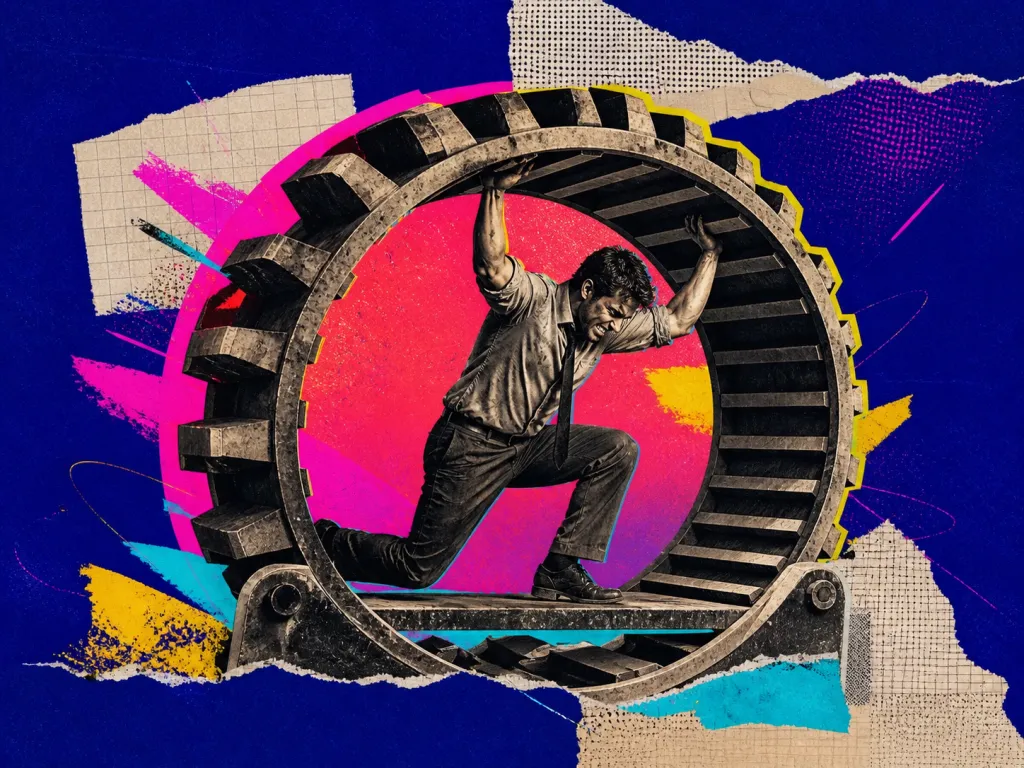
Examples and situations
- Economy – people justify low wages and harsh working conditions because “that’s how it has always been.”
- Politics – voters support the same leaders, even if they bring no change, out of fear that alternatives might be worse.
- Social norms – discrimination or injustice gets defended simply because “that’s just how the world works.”
Questions to check
- Ask: “Who benefits from this?” – could the system be improved?
- Don’t fear change – just because something is old doesn’t mean it’s right.
- Look at facts, not traditions – systems often sustain themselves even when they no longer serve people well.
Long-form guide
Defending the Cage: System Justification and Why We Stand Up for What Holds Us Down
You probably know someone who defends a rule, a boss, or a tradition that clearly works against them. Maybe you’ve done it. I once watched a friend apologize to a broken vending machine for “expecting too much” after it ate his last dollar. He blamed himself instead of the machine. That tiny shrug—“That’s how it works”—sticks with me. Now scale that to politics, workplaces, schools, and families.
On this page
What Is System Justification—and Why It Matters
System justification is our tendency to defend and rationalize existing systems—institutions, hierarchies, traditions—even when those systems harm us. It’s a quiet glue that keeps the status quo stuck. System justification says, “The current way is the right way,” even when it isn’t. At heart, it’s a coping move. If the system is fair, then life makes sense. That belief relieves anxiety and reduces dissonance in chaotic times (Jost & Banaji, 1994; Jost et al., 2004).
We crave order and predictability. Chaos is exhausting. Order promises safety; We want to belong. Challenging shared rules can feel like social exile; We hate cognitive dissonance. If the world is unfair, how do we keep going? It’s easier to reshape belief than reality (Festinger, 1957); Threat wakes it up. When we feel unsafe or uncertain, we defend the system more fiercely (Kay et al., 2009). Why we do it: It slows needed change. We defend policies that hurt us because “they must be there for a reason.”; It shifts blame downward. People harmed by systems blame themselves instead of structures; It confuses loyalty with wisdom. “Team player” becomes code for “don’t question anything.”; It exhausts reformers. They waste time arguing with the invisible guard—our own minds. Why it matters: The punchline: System justification protects our sense of stability but can cost us health, fairness, and opportunity.
1) The “Good Soldier” at Work
We learn the shape of our cages by bumping into them. Here are a few textured, everyday examples. Olivia’s company promised “pay for performance.” In reality, promotions went to whoever stayed late near the VP’s office. Olivia stayed past midnight for weeks. Her output didn’t rise. Her stress did.
When a colleague asked why she didn’t push back, she said, “Leadership probably knows more than I do. The system works overall. I just need to optimize my vibe.” That’s system justification: if you can’t beat it, submit—and rewrite the story so submission sounds like strategy. The company hemorrhaged talent. HR called it “market churn.”
3) “I Earned It” on a Tilted Field
At a public school, parents had to win a lottery for aftercare. There weren’t enough slots. One mother drew a losing number and said, “Honestly, it weeds out the unserious families.” She worked two jobs. She was the “unserious” family. Accepting a bad system felt easier than admitting it hurt her kid. If the system is fair, then she’s okay, her kid’s okay, the world is okay. Saying otherwise threatens everything.
Darius grew up poor, won scholarships, and became an executive. He believed his story proved anyone can make it by grit alone. When his company lobbied against transit funding that his old neighborhood relied on, he supported it. “People need to take responsibility.” He didn’t notice the ladder he climbed had missing rungs for others. His success became a shield around the system.
5) “We’re a Family” Means Your Raise Is Love
A hospital used an old triage algorithm that under-treated certain communities. A new study flagged it. Instead of revising, a senior physician said, “Our outcomes are decent; the model reflects reality.” He trusted the model because it had seniority—years in production. A bug, renamed “best practice,” becomes sacred.
A startup paid below market but wrapped it in warmth: “We’re a family.” When inflation rose, people asked for raises. Leadership replied, “Family looks out for each other. Let’s tighten belts together.” Several employees defended leadership in Slack: “They’ve always had our backs.” Within months, attrition soared. The ones who stayed insisted the culture was “special.” Loyalty turned into blindfolds.
7) The “Fair” Disaster Policy
In some groups, stereotypes get folded into identity. Women in a team said they “preferred” coordinating work and avoided the most technical projects. Promotions tracked with those technical wins. When asked why they didn’t apply, some said, “I’m just not that kind of person.” The system whispers the lines. People repeat them. “Choice” and “structure” become tangled (Glick & Fiske, 1996; Jost & Kay, 2005).
After a flood, aid required lengthy documents many residents had lost. The rules looked neutral. A local official shrugged: “We have to prevent fraud.” Families took on debt rather than reapply. The policy treated documentation as fairness. It treated real need as a nuisance. Residents blamed themselves for “not being organized.”
10) The Calm Story After the Fire
An employee flagged a supplier using questionable labor practices. A manager said, “We follow the law.” Another: “If it’s really that bad, regulators would stop it.” Legal equals ethical in the system-justifying mind. That’s not law; that’s comfort math. A bank advertised credit-builder loans with high fees. A client celebrated approval: “They wouldn’t offer it if it wasn’t good for me.” The product was legal. It wasn’t kind. The existence of a product became proof of its virtue.
A city had repeated wildfires. Funding for controlled burns stalled because “residents don’t like smoke” and “we can’t change policy this fast.” After the next fire, a council member said, “Our response was appropriate under the circumstances.” No one wanted to admit the circumstances were shaped by their own rules. Each story has a common spine: a painful fact; a system that benefits from staying the same; a person smoothing the edges with a story that protects the system, not themselves.
Track the Discomfort Spike
We won’t shame this bias out of ourselves. We’ll give it less room to rule. Here’s a pragmatic way to spot it and steer around it. “If it exists, it’s probably right.” We reverse engineer goodness from presence. “It’s the rule; therefore it’s good.”; “If I suffered through it, others should too.” We defend pain as a rite of passage. It’s sunk-cost meets hazing. Our brains whisper sweet nothings when the world feels sharp. Two favorites:
When you hear these, tag them. “That’s my system-soothing story.” Did you just receive bad news?; Are you worried about status or belonging?; Is a cherished identity in the crosshairs?. System justification rises with threat—uncertainty, loss, embarrassment. Before you defend, check your state: If yes, your defense might be about comfort, not correctness.
Swap “Fair” for “Fit”
Pick one policy you always defend. Then ask: “Under what conditions would this backfire on someone like me?” Invent that person if you need to. If you can imagine the harm, the issue isn’t black-and-white. You’ve loosened the bias a millimeter. Opinions harden in rooms without the people who pay the cost.
Before you praise a system, ask someone living with its downsides. Don’t debate. Listen for friction: time, money, dignity. If the cost is invisible to you, it still counts. “Fair” can be a slogan. “Fit” forces detail. Instead of “The policy is fair,” try “This policy fits our goals because X; it misfits because Y.” Fit is specific. It invites alternatives.
Build Tiny Experiments
Pick a rule you defend. Gather three pieces of credible evidence against it. Don’t argue yet. Just stack the cards. Then ask: “What would I need to see to change my mind?” If the answer is “nothing,” you’re not evaluating; you’re worshiping. “Best practice”; “Industry standard”; “How we’ve always done it”; “It’s not perfect, but it works”. Be wary of phrases that launder status quo: Ask: “Best for whom? Standard where? Works how?” If the answer is a vibe, not a reason, you’ve found fluff. Change feels like ripping the parachute. So test in inches. Pilot a new scheduling policy on one team for two weeks. Shadow-decouple performance reviews from hours worked. Use a reversible commitment. When change has a return policy, people argue less.
Say: “I care about safety and fairness,” not “I’m a loyal company person.” Values travel. Systems don’t. When your identity sticks to values, you can change the system without changing who you are. Tape this to your monitor. Or hey—use our Cognitive Biases app soon; we’re building a way to nudge you with these prompts right when you need them.
Related or Confusable Ideas
System justification shares DNA with other mental habits. Here’s how they differ—loosely, plainly. Status Quo Bias: Preferring the current state just because it’s current (Samuelson & Zeckhauser, 1988). System justification goes further: it blesses the current state as morally right or inevitable; Just-World Belief: People get what they deserve (Lerner, 1980). It props up system justification by blaming victims and praising winners as evidence the system is fair; Cognitive Dissonance: Discomfort from holding conflicting beliefs (Festinger, 1957). System justification is one way to reduce that discomfort: adjust your beliefs so the system seems right; Sunk Cost Fallacy: Continue a bad project because of past investment (Arkes & Blumer, 1985). With system justification, we invest identity and loyalty into institutions;
walking away feels like losing ourselves; Terror Management: When mortality or chaos looms, we cling to stable worldviews and authorities (Greenberg et al., 1986). This clinginess powers system defense under threat; Benevolent Stereotypes: “Nice” beliefs that keep roles in place, like “Women are naturally nurturing” (Glick & Fiske, 1996). They soften inequality while cementing it, feeding system justification (Jost & Kay, 2005); Internalized Oppression: Members of a marginalized group accept negative narratives about their group. System justification can be the container; internalized oppression is one painful content. Together, these tendencies create a web. Cut one strand, others hold the net. That’s why change requires multiple angles: evidence, identity, policy, and patience.
In Policies: Make Review Dates and Kill Switches
You don’t fix system justification with a single memo. You chip at it with structures that make truth-telling safe and change doable. Reserve the last 10 minutes for arguments against the proposal. Rotate ownership. If people don’t dissent, it’s a red flag—not a green light; Reward questions that reveal new costs. “Great catch” earns as many points as “great idea.” Track them in retro notes; Ask for pre-reads and silent writing before debate. It dilutes charisma and seniority power.
Every policy gets an expiration. If no one defends it with fresh data, it dies. Don’t let old rules squat for free; Create a rollback plan for any major change. Reversible bets calm the nervous system.
In Yourself: Script the Moment Before You Defend
Publicly thank people who challenge you. Tie it to values: “We care about safety; thanks for pointing to the gap.”; State the decision-making rule: “We don’t obey precedent. We obey goals.” Repeat it until it becomes lore. Map the actual path to promotion. If “visibility” beats results, say it. If that’s not what you want, change the structure. Hidden rules breed justification stories; Do blind reviews where possible. Reduce the halo of familiarity that props up “how we do it here.”.
“What’s the goal this rule protects?”; “How else could we protect it?”. Keep a tiny mantra: “Fairness first, then familiarity.” When your mouth forms “That’s just how it works,” switch to: It’s surprising how often that tiny pivot unlocks a better move.
When System Justification Makes Sense (Kind Of)
Let’s be real: not every status quo is evil. Some habits earned their place. Traffic lights exist for a reason. In crisis, clinging to procedure can keep planes in the sky and patients alive. We don’t need to become edgy for sport.
Habit is a good first draft, not a final truth; Systems can be good at one time scale and bad at another. A strict process speeds today’s operations but blocks tomorrow’s innovation. Two points keep us honest: The job isn’t to rebel constantly. It’s to keep design privileges over drift.
The Emotional Undertow
System justification isn’t just an idea. It’s a feeling—warmth, relief, belonging. It’s the exhale after someone says, “Don’t worry, this is normal.” That comfort is delicious. It’s also how we ignore a leak until the ceiling caves in. If you’ve defended a system that hurt you or others, you’re in human company.
Shame isn’t useful. Curiosity is. Ask: “What was I trying to protect?” Safety? Identity? Calm? Then find a better way to protect it. We’re building the Cognitive Biases app to catch these moments with a nudge, a question, a reframing. Not to scold. To help you choose on purpose.
Wrap-Up: Open the Door You Keep Guarding
There’s a story we tell ourselves: if we defend the system hard enough, it will defend us back. Sometimes it does. Too often, it asks for our silence and gives little in return. We stand guard at a door that locks from the inside. You don’t have to kick it down. Just try the handle. Ask better questions. Run small tests. Tie your loyalty to values, not to habits that forgot their purpose. We’re building the Cognitive Biases app to sit on your shoulder during these moments—light, practical, kind. Not to make you cynical, but to help you reserve your faith for systems that deserve it. The world needs your voice, not your autopilot.
Arkes & Blumer (1985); Festinger (1957); Glick & Fiske (1996); Greenberg et al. (1986); Jost & Banaji (1994); Jost et al. (2004); Jost & Kay (2005); Kay et al. (2009); Lerner (1980); Samuelson & Zeckhauser (1988). References (for the curious, not the cudgel): You can defend what works and change what doesn’t. That’s not betrayal. That’s stewardship.
Decision checklist
- What pain does this system cause, and to whom? Name two concrete harms
- If this rule didn’t exist, would I invent it today? Why?
- Am I defending this more when I feel threatened, rushed, or watched?
- What evidence would change my mind? Be specific
- Who benefits most, and who pays? Could that be reversed?
- Have I heard from people most affected? If not, schedule it
- Is there a small, reversible experiment we could run within 2 weeks?
- Does my language explain or just endorse? Replace slogans with reasons
- If my friend were harmed by this rule, would I defend it the same way?
- What value do I actually want to protect? Can I protect it with a better design?
- Name one system you defended recently. Write why in one sentence
- Identify who pays the biggest cost. Talk to one person this week