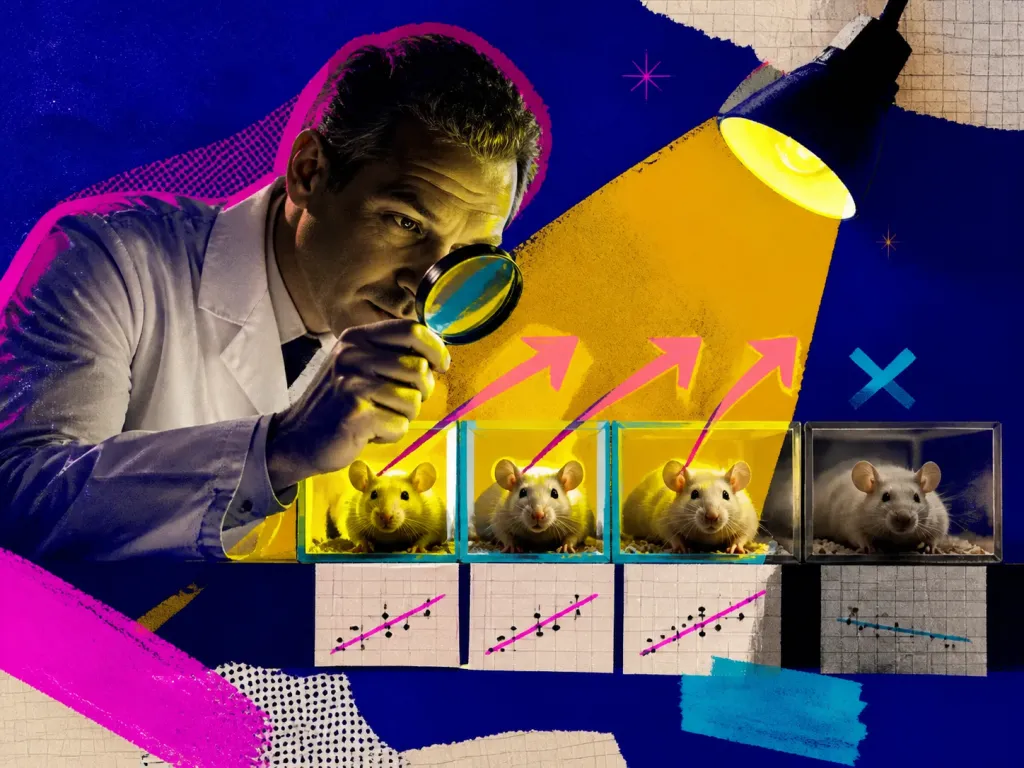
Congruence Bias – when the test fits one hypothesis but does not separate alternatives
Congruence Bias is a narrower hypothesis-testing pattern. A person can prefer a test that is likely to produce a positive result if the favored hypothesis is true, even when that result would also be expected under competing explanations. The problem is not simply looking for a positive result. It is choosing a test with weak diagnostic value between alternatives.

Examples and situations
- Troubleshooting: you test whether one suspected cause can produce the symptom but do not test another cause that predicts the same symptom.
- Experiments: a study asks whether the preferred theory predicts the result without designing observations that separate it from rival theories.
- Business: a team asks whether customers like a feature but not whether the same responses would appear because of price, novelty, selection, or another explanation.
Questions to check
- List at least one plausible alternative hypothesis before choosing the test.
- Predict what each possible result would look like under both explanations.
- Prefer tests where the hypotheses make different predictions.
- Do not treat every positive-test strategy as an error. In some environments, testing likely cases can be informative; diagnosticity is the key question.
- Use Confirmation Bias for the broader evidence-processing problem and Congruence Bias when the failure is specifically in the design or choice of a hypothesis test.
Long-form guide
The Trap of Only Testing What You Want To Confirm: Congruence Bias In The Wild
We had a sprint where we were sure a new onboarding tweak would lift activation. We’d seen a competitor use a similar flow. The mockups felt clean. The team was excited. We shipped it behind a flag and ran an A/B test. Then we made our first mistake: we only checked one metric—activation rate—and only in the segments where we were sure it would shine. We didn’t look at repeat usage, support tickets, or the places it could backfire. The uplift looked great… for a week. Then churn ticked up and support flagged a pattern: new users were skipping a vital tutorial.
On this page
What is Congruence Bias and Why It Matters
Congruence bias is the habit of testing only the hypothesis you prefer, instead of deliberately trying to disprove or rival it. Congruence bias is a cousin of confirmation bias. Instead of asking, “What test would best discriminate between competing hypotheses?”, we ask, “What test would show my idea works?” We focus on “yes” tests—ones that are congruent with our favored hypothesis—and avoid tests that could falsify it or elevate a rival explanation.
In psychology, this shows up as the “positive test strategy” (Klayman & Ha, 1987): people select tests they expect to yield positive results for their theory. In the classic Wason 2-4-6 task, participants guess the rule behind a number sequence. Most propose sequences like 8-10-12 to confirm their rule. They rarely try 3-9-27 or 2-2-2 to break it. They miss that the true rule is just “any ascending numbers” (Wason, 1960).
Why it matters: You overfit to your favorite story. You collect supportive data and get blind to alternatives; You launch features, medicines, policies, and strategies that pass biased tests but fail in reality; You waste time. Testing only “yes” paths makes you slower, not faster, because surprises bite later and harder; You lose trust. When teammates, users, or investors see your work fails under basic scrutiny, they get cautious. They start re-testing your tests. The fix isn’t to become cynical or to never get excited. It’s to practice aggressive curiosity: design tests that could prove you wrong, and let the best idea win.
The Feature That “Obviously” Helps
We’ve been there. You’ve been there. Here are a few snapshots where congruence bias hides behind good intentions. A product team believes a “Skip sign-up” option will increase activation. They define success as: “If click-through to first action improves, the hypothesis is true.” They A/B test and yes, click-through rises. They celebrate. They didn’t predefine guardrail metrics like support tickets, time-to-value, or week-4 retention. The feature boosts superficial clicks but reduces deep engagement. Because they never tested a rival hypothesis—“This might confuse users and increase churn”—they designed none of the tests that could catch it.
What they could have done: pre-register success and guardrail metrics; run a rival hypothesis day—assume it harms retention; what data would show that fast?; monitor leading indicators of harm (support friction, rage taps, tutorial skip rates).
The Diagnosis and the Hiring Mirror
A physician sees fatigue, weight loss, and thirst; suspects diabetes. They order a fasting glucose test. It comes back borderline high. Diagnosis leans diabetes. A rival cause could be hyperthyroidism, depression, or medication side effects. If you only order congruent tests, you ignore discriminating tests—ones that target alternatives. Medicine fights this with differential diagnosis checklists for a reason. What they could have done: construct a short list of differential diagnoses; order or review tests that would disconfirm the top pick or confirm rivals.
A team loves “scrappy generalists” and designs interviews that reward fast-talking, demo-heavy candidates. They hire people who shine in that arena. Six months later, they’re light on systematic thinkers who build durable systems. What they could have done: include exercises that reward slower, deep reasoning; create parallel interview tracks (rapid prototyping vs. systems thinking); tie evaluation to job outcomes, not vibes.
The Startup That “Validates” Demand and the Engineer Who Fixes the Symptom
A founder asks friends, “Would you use an AI grocery planner?” Many say yes. They count those yesses as validation. They don’t test key falsifiers: will people connect their actual shopping accounts? Will they pay? Will they trust sharing household data? What they could have done: run a dry-well test—set up a landing page with pricing and watch real click-to-buy behavior; offer a refundable pre-order; recruit strangers, not friends. The right “no” is more valuable than ten “yesses.” A service crashes under peak load. The engineer suspects memory pressure and adds a cache. The system stabilizes in staging. Done?
They didn’t load-test for long tails, perform chaos scenarios, or add logs to catch an elusive file descriptor leak. The congruent test—“Does a cache help?”—is too narrow. Two days later, the system fails during a traffic spike. What they could have done: run property-based tests and stress tests with progressive load; add hypothesis pit stops—after each fix, ask “What would fail if I’m wrong?”; log discriminators (e.g., FD counts, GC pauses) before and after.
The Trader’s Cherry-Picked Backtest and the Teacher’s Raised Hands
A trader backtests a strategy only on markets where it looks good, uses post-hoc parameters, and avoids transaction costs. Paper returns look stellar. Live returns disappoint. What they could have done: predefine the strategy and lock parameters; include transaction costs and slippage; test out-of-sample periods and markets. A teacher believes her lecture style engages students. She asks, “Is everyone following?” Several nod. She feels validated. But many students who are confused won’t raise hands. The test is congruent with the teacher’s comfort, not the truth.
What she could have done: anonymous minute papers—“What was unclear?”; cold-calls with kindness and small-group checks; brief quizzes that catch misunderstanding early. If these scenes feel familiar, good. Congruence bias isn’t a moral failing. It’s a default setting. The trick is to install new defaults.
The Psychology, In Brief
Wason’s 2-4-6 task shows how people propose confirming tests instead of disconfirming ones (Wason, 1960); The “positive test strategy” describes our tendency to pick tests expected to yield a positive result for the favored hypothesis (Klayman & Ha, 1987); Confirmation bias is widespread: we prefer, remember, and search for information that aligns with our beliefs (Nickerson, 1998);
Popper argued science advances by bold conjectures and severe attempts at refutation, not by collecting confirmations (Popper, 1959); Strong Inference proposes a cycle: devise alternative hypotheses; devise crucial experiments; carry out experiments to eliminate; repeat (Platt, 1964). You don’t need to become a philosopher of science at work. You just need habits that force friction against your favorite idea.
Recognize Congruence Bias When It’s Happening
You can feel congruence bias physically. A tug toward data that says “yes.” A reluctance to look in the corners where “no” might live. Some clues: You define success only with uplift metrics and no guardrails; You select samples where your idea is likeliest to work (“power users only”); You change scope mid-experiment to chase significance; You stop tests early when results look favorable, but let them run longer when they don’t; You avoid asking the one question that could tank the idea in front of stakeholders; You say “Let’s not overcomplicate” right when a rival hypothesis is raised; You count anecdotal praise as validation and dismiss complaints as “edge cases.”
Notice these, and you’ll catch yourself before the costly lapse. ✅ Define discriminating tests, not just confirming ones; Ask: “What test would make my favorite hypothesis lose to a rival if it’s wrong?” ✅ Predefine success, guardrails, and stop rules; Success metrics: What must improve? By how much?; Guardrails: What must not get worse (e.g., complaint rate, churn)?; Stop rules: Minimum sample size/duration. Pre-commit to avoid peeking artifacts. ✅ Use a prediction grid; Before the test, write expected outcomes for each hypothesis; If reality matches a rival’s prediction better, let the rival win.
✅ Split your sample wisely; Include segments where your hypothesis might fail; Avoid sampling only from fans or early adopters. ✅ Assign a “red team”; Choose someone to argue for disconfirmation; Give them time and psychological safety to challenge. ✅ Run a pre-mortem; Imagine your test failed. List reasons. Add tests to detect those reasons fast. ✅ Design a falsification path; What result would make you abandon or pivot?; Make it specific. If this happens, we stop. ✅ Add negative controls or placebo checks when possible; E.g., a variant that should not affect the outcome helps detect measurement noise. ✅ Record decisions in a log; Note hypotheses, metrics, changes. Revisit when results arrive; It prevents narrative drift and retrofitting. These steps slow you down a bit on day one and save you weeks later.
Engineering and Data
Pre-commit your experiment plan. Use a short pre-registration doc; Create guardrails for activation, retention, NPS, support load, and unit economics; Define a maximum duration and minimum power. No peeking roulette; Don’t just test A vs. your favorite. Test A vs. B vs. C that represent different theories; Include qualitative “breakers”: watch sessions where users look lost; Interview churned users. The “no” crowd carries unique signal.
Adopt property-based testing to try to break assumptions, not just confirm paths; Use chaos testing to simulate failures your fix shouldn’t pass; Track discriminating logs and metrics. If you suspect memory, track memory; if network, track latency histograms, not just averages; Keep a hypothesis board in incident response: list alternatives; cross them out as evidence accumulates; In ML, split holdout sets, use cross-validation, and avoid test leakage. Don’t only report metrics that make the model look good.
Personal Life: Congruence Bias
Mix methods: surveys, usability tests, and diary studies; Use counterfactual prompts: “If this design didn’t exist, how would you solve it today?”; Run two opposite prototypes to test opposing design hypotheses; Blind label options when testing with stakeholders to reduce anchoring. Appoint a “designated skeptic” in planning meetings; Pilot strategies in hostile environments, not only friendly ones; Stress-test plans with premortems and “What would change our mind?” clauses; Track base rates. Ask: “What happens, typically, to companies that tried this?”
When interpreting a partner’s text, imagine three rival explanations and test gently; If you think a new routine will boost your energy, track a counter-metric (e.g., sleep quality); If you believe a food is causing issues, run elimination and reintroduction properly. Don’t just check on “bad” days.
Related or Confusable Concepts
Confirmation bias: The big umbrella—seeking and favoring supportive evidence. Congruence bias is a testing behavior within it (Nickerson, 1998). Positive test strategy: The mechanism of choosing tests that are likely to confirm your preferred hypothesis (Klayman & Ha, 1987). It can be rational sometimes but misleads when the world is complex or when rivals exist. Hypothesis myopia: Falling in love with the first hypothesis and ignoring others. Congruence bias is one way myopia acts.
Texas sharpshooter fallacy: Firing bullets at a barn, then drawing a target around the tightest cluster. Post-hoc pattern fitting. Congruence bias shows up when you test the cluster as “proof.” P-hacking: Tweaking analyses until you get a significant result. A statistical flavor of congruence bias. Selection bias: Testing only on convenient samples. Congruence bias often drives the selection. Survivorship bias: Studying winners and forgetting the dead. Your “test” forgot to include the fallen.
Base rate neglect: Ignoring how common an event is. You run congruent tests without checking if your idea beats baseline reality (Tversky & Kahneman, 1974). Plan continuation bias: Sticking with a course despite signals to change. Once you’ve invested in a hypothesis, you lean harder into congruent tests. Strong Inference and Popperian falsification: Antidotes. They ask for severe tests and for alternatives to fight for airtime (Popper, 1959; Platt, 1964).
A Short Field Guide: Designing Discriminating Tests
The key move is to design tests that make different hypotheses predict different outcomes. Start with at least three hypotheses, not one. Example for low retention: 1) Onboarding is too long. 2) Users don’t see core value fast enough. 3) The real value isn’t what we think; the wrong audience arrives. Create tests that split them apart:; Shorter onboarding should help only if fatigue is real; it will harm if lost context is the issue; A fast-path to one “magic moment” should help if value visibility is the issue; it will not help if value is misaligned; Targeted channel tests will help if audience mismatch is real; they won’t if onboarding is the sole issue.
Predefine predictions:; If H1, then activation up but week-4 retention flat or down; If H2, both activation and week-4 retention up modestly; If H3, activation flat, retention up in the new channel only. Run the smallest test that can break your favorite. Don’t boil the ocean. Accept that “no effect” is precious data. It narrows the search. This is the practical translation of “falsification.” It earns speed.
Five-Minute Premortem: Congruence Bias
Use these snippets in your team docs. Hypothesis: We believe [change] will [impact] for [segment] because [reason]; Rival Hypotheses:; Predictions:; If H1 is true: [metrics] will [direction/size]; If H2 is true: …; If H3 is true: …; Success Metrics: [primary]; Guardrails: [no worse than X% on Y]; Sample/Segments: [include skeptics or high-risk segments]; Stop Rule: [duration or N], [early-stopping only for harm]; Discriminators: [what would differentiate H1 from H2/H3]; Owner + Red Team: [names].
1) … 2) … 3) … It’s three months later. The initiative failed. Why?; Top 3 causes:; Early signals for each cause:; For 1): …; For 2): …; For 3): …; New tests to add:; …. 1) … 2) … 3) … Date:; Decision:; Hypotheses considered:; Evidence for/against each:; Risks acknowledged:; Next review date:; What would change our mind:. These aren’t bureaucracy. They’re speed bumps that prevent cliffs.
When Congruence Bias Is Tempting (And What To Do)
Under time pressure: You want a quick proof. Instead, pick a single discriminating test with a hard stop, not a vanity test. When politics are hot: You fear negative results. Give the red team cover. Frame disconfirmation as saving runway, not killing careers. When the idea is your baby: You identify with it. Separate identity from hypothesis. Say out loud: “This is a bet. I want the truth more than the win.”
After sunk costs: You’ve invested. Ask: “If we were starting today, would we still do this?” If no, cut or redesign. During early wins: Early green lights can seduce you. Extend tests into the risky segments before rolling out. When the KPI is singular: If you only watch one dial, you will game it. Choose a small dashboard with one success dial and two guardrail dials.
Research Corner: The Few Studies That Matter Here
Wason (1960): People prefer proposing confirming sequences in the 2-4-6 task, missing broader rules; Klayman & Ha (1987): Positive test strategy explains why we search for evidence expected to be positive under our hypothesis; can be rational in some domains but often misleads; Popper (1959): Scientific progress relies on bold conjectures and refutations, not accumulation of confirmations;
Platt (1964): Strong Inference: generate multiple hypotheses, design crucial experiments, and iterate; Nickerson (1998): Review of confirmation bias across domains; highlights pervasiveness and costs; Tversky & Kahneman (1974): Heuristics and biases; shows how intuitive judgments misfire, especially in probabilistic reasoning. That’s enough to justify the habit changes. You don’t need to read more to act differently.
Wrap-Up: Let Your Ideas Earn Their Wins
We love our ideas. We should. They get us out of bed. But love them like a good coach would love a player: challenge them, push them, make them earn the starting spot. Congruence bias whispers that a friendly scrimmage is enough. Reality demands playoffs. Design tests that could break your favorite theory.
Write down rival stories. Tie yourself to the mast with pre-commitments and guardrails. Ask the uncomfortable question you’ve been avoiding. You don’t need perfect certainty; you need robust bets that survive contact. The world doesn’t reward the idea you like. It rewards the idea that works. Let’s find those faster, together.
Decision checklist
- ✅ Name at least two plausible rival hypotheses
- Write them down. If your hypothesis is “X improves Y,” rivals include “X reduces Y,” “X doesn’t affect Y,” and “Z is the real driver.”
- ✅ Define discriminating tests, not just confirming ones
- Ask: “What test would make my favorite hypothesis lose to a rival if it’s wrong?”
- ✅ Predefine success, guardrails, and stop rules
Evidence review
What the evidence supports
Congruence Bias is a narrower hypothesis-testing pattern than the broad umbrella of confirmation bias. In classic work, people overvalued tests that were likely to return a positive result if their leading hypothesis were true, even when other tests were more diagnostic among competing hypotheses. The useful claim is not that every positive test is irrational: a positive test strategy can be efficient in some environments, and the problem depends on whether the chosen test can actually distinguish the focal hypothesis from alternatives.
How researchers describe the pattern
Baron, Beattie, and Hershey described congruence bias as overvaluing tests whose expected positive result matches the currently favored hypothesis. Klayman and Ha showed why the closely related positive test strategy should not automatically be treated as a logical error: sampling cases expected under a hypothesis can be informative depending on the structure of the environment. The practical failure occurs when a test is congruent with the focal hypothesis but has low diagnostic value because alternative hypotheses predict the same result.
Practical interpretation
Before choosing a test, list at least one plausible alternative hypothesis and predict the result under both explanations. Prefer observations whose possible outcomes separate the hypotheses rather than merely giving your preferred explanation another chance to say 'yes.' If the same result is expected under several explanations, it is weak evidence even when it matches the preferred hypothesis.
Reviewed sources
- Diagnosticity of evidence and congruence bias in hypothesis testing hypothesis-testing experiments · 1988 · DOI 10.1016/0749-5978(88)90012-2
- Confirmation, disconfirmation, and information in hypothesis testing theory + experimental evidence · 1987 · DOI 10.1037/0033-295X.94.2.211
Editorial review: 2026-08-18. The controlled evidence class is an editorial reading aid, not a numeric truth score; the descriptive status above carries the entry-specific qualification.
Continue from here