Agent Detection Bias – when you see intention behind randomness
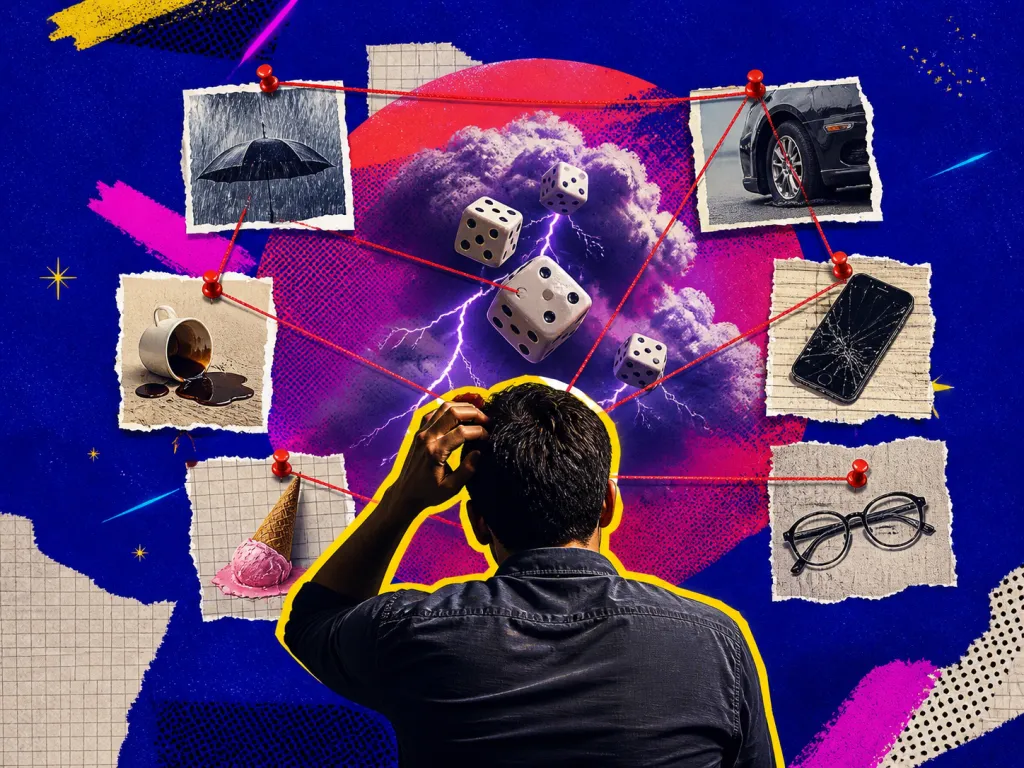
Do you feel like strange events happen for a reason, as if someone is behind them? That’s Agent Detection Bias – the tendency to see intent and intelligence behind random events, even when there’s no real agent involved.
Examples and situations
- Religion & mysticism – unexpected events feel like signs from fate or divine intervention.
- Conspiracy theories – if something goes wrong, it seems like part of a master plan rather than a simple mistake.
- Technology – when your phone freezes or software crashes, you assume it was ‘designed that way’ rather than just a glitch.
Questions to check
- Remember that coincidences happen – not every strange event has a hidden meaning.
- Look for simple explanations – if something can be explained by randomness or error, it probably should be.
- Be skeptical of theories requiring complex conspiracies – the world is often chaotic rather than controlled by unseen forces.
Long-form guide
The Shadow in the Noise: Agent Detection Bias and the Stories We Tell Ourselves
You’re walking home. A branch snaps behind you. Instantly, your body writes a script: someone’s following you. Heart up, breath locked, every hair on alert. You whirl around. Nothing. Just wind and a clumsy squirrel. Ten minutes later you’re laughing, but part of you still feels watched.
On this page
What Is Agent Detection Bias—When You See Intention Behind Randomness—and Why It Matters
That jump from rustle to “someone’s there” is Agent Detection Bias—the mind’s habit of seeing intention behind random or natural events. We evolved to assume a “who” behind the “what.” Most of the time it kept our ancestors alive. Today it can pull us into superstition, bad decisions, and needless conflict. Agent Detection Bias is the tendency to infer an intentional agent—someone choosing, planning, aiming—when events could just as well be accidental, random, or mechanical. Think of it as the brain’s “living thing detector,” set to a hair-trigger. Researchers sometimes call it a hyperactive agency detection device, or HADD (Barrett, 2000).
Why so twitchy? Because the cost of missing a real agent—a predator, rival, or thief—was historically higher than the cost of overreacting to wind in the grass. Better to jump at rustles than get eaten. This “error management” idea shows up across evolution: when mistakes have asymmetric costs, we evolve biases that minimize the most expensive error (Haselton & Buss, 2000). That bias still serves us. We avoid dark alleys. We notice when a car slows too long next to us. We catch subtle cues from coworkers. But modern life is full of noise: markets, metrics, algorithms, weather, body sensations. In that noise, Agent Detection Bias can:
Turn chance patterns into tales of villains or masterminds; Inflate everyday frictions into personal attacks; Entangle us in conspiracies when simpler explanations exist; Waste time chasing phantom saboteurs instead of fixing systems. We don’t want to kill the detector. We want a dial. When stakes are high and evidence thin, we turn it down until facts arrive.
The printer conspiracy
Marisol’s team submits a grant at 4:55 p.m. The office printer jams three times, each at the worst moment. “IT hates us,” someone mutters. “They never fix this floor.” Cue a chorus of sighs, a Slack thread of blame, a plan to buy a private desktop printer.
A week later, an intern finds the issue: a curled paper stack stored under a window, warping in afternoon heat. Random physical reality, not institutional malice. The team spent three hours inventing an agent while the fix took two minutes: put the paper in a drawer. Lesson: when a thing fails sporadically, look for drift or environment first. Agents can sabotage; humidity is faster.
The backend “enemy”
Jae texts their partner a thoughtful message in the morning. No reply all day. Jae’s mind rolls: “You’re avoiding me. You’re punishing me for last night. You want me to suffer.” By dinner, Jae is icy. The partner walks in with dead phone battery, sweaty from a broken train car, apologizing. Jae isn’t irrational. The brain hates ambiguous silence. It fills with intentions, often the worst. But the story was a guess. Delaying action—sending “Hey, I’m anxious and assume you’re mad. All good?”—could have stopped a spiral.
A product manager notices failed deployments happen on Fridays. Obviously, ops is hostile to product launches. She crafts a pitch: ban Friday merges; escalate to leadership. The ops lead runs numbers: a random distribution across days, except a slight uptick when tickets pile up after midweek roadmap changes. The fix: earlier cutoffs, clearer reviews, and a midweek release window. No saboteur. Just queuing theory and human procrastination. We love “who did this” more than “what set this up.” Systems are dull offenders; people are juicy culprits.
The investing whisper
An investor sees a small-cap stock spike after a CEO’s cryptic tweet. “Insider manipulation,” the investor says, buying in late to ride the “scheme.” Days later the price reverts, the investor exits with a loss. The tweet? Routine PR-speak. The spike?
A few automated strategies reacting to sentiment keywords, then momentum traders, then the air leaving the balloon. Attributing every squiggle to puppeteers often drains portfolios. Markets have noise, liquidity gaps, correlated bots, and herding. That stew can look like a plan. Usually, it’s a pot boiling, not a chef plating.
The sports slump
Priya wakes with heart flutters. It happens after coffee. Her mind: “Someone poisoned me.” Her stomach: “Acid reflux, thanks to spicy ramen at midnight.” She avoids that café for a month. A doctor later explains: caffeine, stress hormones, poor sleep. The patterns feel like messages from a hostile world. Often, they’re body physics.
A coach believes a rival is reading signs. Every fastball gets smacked. Panic. A panicked sideline will see spies in the crowd and cheating in every glance. After the game, film shows a tiny tell: the pitcher flares his glove only on fastballs. An agent can still cheat; this time the “who” was the pitcher’s own hand.
The campus rumor
A SaaS startup sees churn spike in March and assumes a competitor launched a killer feature. The founder blames a watchdog blog post and starts a Twitter war. Finance quietly notes that annual contracts renew in March. Poor onboarding last year created a delayed churn bomb. The team goes to war with a ghost while the fix sits in last spring’s docs.
Three fire alarms in one week. Students mutter: “Admin wants to punish us for protests.” Facilities finds a defective sensor in a single dorm wing. Mistrust makes patterns stick. When trust is low, Agent Detection Bias turns static into plots.
The inbox ambush
Users keep clicking “Cancel” instead of “Save.” The designer says, “They’re trolling.” Analytics later show on some Android devices, the button labels swap due to a rendering glitch. Random device variance, not malice. The fix: make actions explicit, add confirmation, and test across devices. Your boss replies curtly: “Got it.” You hear disdain. You spend the evening drafting an exit plan.
The next morning you learn she was on a red-eye flight with two kids. Terse doesn’t always mean hostile. Sometimes “Got it” means exactly “Got it.” These stories have a rhythm: ambiguity → threat feeling → agent story → action. Often, the cure is slow: gather more data, ask a simple question, test a null explanation. That’s boring. It also works.
Slow the script
Agent Detection Bias lives in fast, primal circuits. You won’t out-argue a flash of fear with a quote from a psychology paper. You can, however, build habits that catch the bias early and reduce harm. What emotion did I feel first?; What agent am I imagining?; What non-agent explanation could be true?; What cheap data can I get in the next 10 minutes?; What action would be safe if I’m wrong?.
If you do nothing else, do these five. They buy you time. Ambiguity is a story vacuum. Your brain will fill it with faces and motives. Instead: Replace “they” with “it” until you have evidence. “The system error” beats “someone broke our deploy.”; Freeze your verbs. “Happened” beats “caused” beats “forced.”; Journal one “agent-full” story and one “agent-free” story about the same event. Reading both side by side often drains certainty.
Pre-commit to explanations
Most of us are terrible at random. We underestimate streaks. We expect even spacing. If you work with anything that arrives over time—tickets, sales, failures—run a quick Monte Carlo simulation or stare at a shuffled deck. Ten heads in a row? Expected sometimes. It doesn’t need a puppet-master. Try this exercise: generate 1,000 random coin flips. Count streaks of 5+ heads. You’ll get some. Now imagine each streak had a headline. “The Heads Cartel Strikes Again.” Silly. That’s your daily newsfeed.
Before you examine a pattern, decide what evidence would count as intentional. Write it down. Example: “If deployment failures cluster exactly during one engineer’s shifts across three months and disappear when they’re off, I’ll investigate intent. Otherwise I’ll fix process.” Pre-committing cuts “moving goalposts” after emotional spikes.
Use base rates and priors
A single sentence can deflate a ghost: “I’m probably overreacting, but I’m reading X as intentional. Is there a simpler explanation?” You preserve dignity, reveal your bias, and invite data. For high-stakes calls, assign two roles: the Agent Advocate (argues for intent) and the Noise Advocate (argues for randomness/system). Give equal time.
Force each side to steelman the other’s argument. End with a list of tests that would break each view. Pick the cheapest tests and run them. How often is malice the cause in this domain? Email tone? Low. State-sponsored hacking in your knitting club? Low. Someone forgot to CC? High. Base rates aren’t sexy. They are guardrails.
Shift from blame to fix
Keep a notebook for two weeks. Each time you feel a “someone’s behind this” story, log it with three columns: Event, Agent Story, Outcome. Review at week’s end. You’ll spot your personal hot buttons—late replies, tone shifts, odd noises. Knowing them lets you preempt them.
Teams waste energy on “who” when useful fixes are in the “what.” If your first action after a failure is “find the person,” inject a step: “What two process or environment changes would reduce this pattern even if no one intended it?” Do those first. Then, if evidence remains, look for a person.
Burn this into language
A simple concept: if you set your detector to “catch every agent,” you will catch lots of not-agents too. False positives go up. Tuning matters. List the cost of each type of error before you set policy. If you’re guarding a nuclear plant, bias toward false positives. If you’re moderating community posts, maybe don’t ban people for harmless patterns.
When you share observations, soften the agent leap: “I notice we had three outages on nights with high humidity; my first instinct is to suspect sabotage, but climate control might be involved. Can someone pull the humidity logs?” This signals humility and opens a path for non-agent evidence.
Apophenia and patternicity
At the close of a sprint or project, run a 20-minute “Agents vs. Systems” retro: Pick the top three surprises; For each, write two headlines: “Someone did X” vs. “Something made X more likely.”; List one test for each headline; Assign the tests for next week. Like brushing teeth, frequency beats intensity. Tape it near your monitor. It pays rent. Agent Detection Bias travels with a posse. They overlap, sometimes blur, but each has a flavor.
Apophenia is seeing patterns in noise. Patternicity is Michael Shermer’s catchy version: the brain makes Type I errors—false positives—because believing a pattern costs less than missing one (Shermer, 2011). Agent Detection Bias adds a face to the pattern. A stock spike is a pattern; saying “hedge funds coordinated to hurt me” is an agent story.
Clustering illusion: Agent Detection Bias
Seeing faces in clouds, plugs that “look angry,” Jesus in toast. Pareidolia is ancient and delightful. It’s benign in art, less so when we imbue a car’s “smile” with intent and then feel betrayed when its lane-keeping nags us. You can enjoy the face and still remind yourself: plastic doesn’t plot.
Randomness clumps. We expect even spacing and get streaks. In classic studies, people saw “hot” and “cold” hands where none existed (Tversky & Kahneman, 1971). Agent Detection sneaks in after the clump: “Someone made this happen.” Sometimes they did; often, it’s how randomness looks.
Intentionality bias and the fundamental attribution error
Thinking past outcomes change future independent events. After five reds, “black is due.” When red hits again, we cry foul—or imagine the croupier is in on it. The fallacy kneads Agent Detection into fairness expectations. Casinos rely on our need to find a “who.”
We overweight intention and stable traits when explaining others’ behavior, and underweight situation. “He cut me off because he’s a jerk,” not “Because he’s late and the sun is in his eyes.” Agent Detection Bias sits on that same couch, tugging us toward personalities over contexts.
Superstitions and Skinner’s pigeons
Patternicity plus mistrust plus agency equals conspiracy. Some conspiracies are real; many are comfort stories that reduce the anxiety of chaos. They assign motive and control where none exists, which paradoxically soothes: if someone planned it, someone can be fought. Research links conspiracy beliefs to a need for certainty and control (van Prooijen & Douglas, 2018).
Skinner once showed pigeons developing rituals—twirls, pecks—when food arrived randomly, as if their dance caused the reward (Skinner, 1948). We do it with lucky socks, pre-meeting routines, or “the one font that wins clients.” Rituals calm; just don’t confuse calm with causation. Keep the ritual if it helps, but don’t build forecasts on it.
A Few Research Anchors (Sparingly Used)
We lean toward purpose-laden explanations: “Trees grow leaves to give us shade.” In small children, this shows up everywhere. In adults, teleology quietly shapes narratives: “The market punished greed.” Markets don’t punish; participants act. Teleology is a cousin—purpose without a person. Agent Detection plugs a person into the purpose. The hyperactive agency detection device suggests an evolved bias to over-detect agents under uncertainty (Barrett, 2000); Error Management Theory explains why, when errors asymmetrically cost, selection favors heuristics that avoid the worst errors (Haselton & Buss, 2000);
People misperceive randomness, over-reading clusters as patterns (Tversky & Kahneman, 1971); Patternicity and “agenticity” describe our love of finding patterns and agents even when none are there (Shermer, 2011); Pigeons formed superstitions when given random rewards, much like humans (Skinner, 1948); Conspiracy belief links to the desire for control and certainty (van Prooijen & Douglas, 2018). Use these as guardrails, not cudgels. Research should make us kinder to our quirks, not smug.
Wrap-Up: Turn Down the Ghost Story
When I was a kid, every creak in my grandparents’ old house was a ghost. I lay awake, building biographies for the ghosts—what they wanted, how they felt. As an adult, I’ve replaced ghosts with thermostats, wood settling, and a mischievous cat. Honestly? The house is still spooky sometimes. The difference now is what I do with the spook. Agent Detection Bias is a ghostwriter for our lives. It drafts villains in the margins. It gives us a sense of control—someone did this—when the truth is less dramatic. The aim isn’t to erase the writer; it’s to edit the draft before you publish it as gospel.
Tomorrow you’ll hear a bump: a missed email, a weird chart, a cold reply. Catch the first story your mind offers. Whisper, “Maybe it’s the wind.” Then do the small, boring thing—ask, check, test. When the agent is real, you’ll still find them. When it’s just the house settling, you’ll sleep. We’re building a Cognitive Biases app to help with moments like this: quick prompts, tiny drills, and everyday language that nudge you from “who’s out to get me?” to “what’s actually happening here?” If you want to try it, we’d love to have you along. Bring your ghosts. We’ll bring a flashlight. References: Barrett, 2000; Haselton & Buss, 2000; Tversky & Kahneman, 1971; Skinner, 1948; Shermer, 2011; van Prooijen & Douglas, 2018.
Decision checklist
- Name the feeling. If fear or anger spiked first, slow down
- Write two competing stories: with and without an agent
- Gather cheap data within 10 minutes
- Check base rates: how often is intent the cause here?
- Replace “who” with “what” language until evidence arrives
- Pre-commit to what would count as intentional
- Run a quick randomness simulation or look at historical variability
- Ask one person outside the situation to sanity-check
- Choose a reversible, low-cost action first
- Document what you learned, so next time you react faster
- Pause 10 seconds; name your first emotion
- Write two headlines: “A person did X” and “A thing/system did X.”