
Fading Affect Bias – when negative emotional intensity tends to fade faster
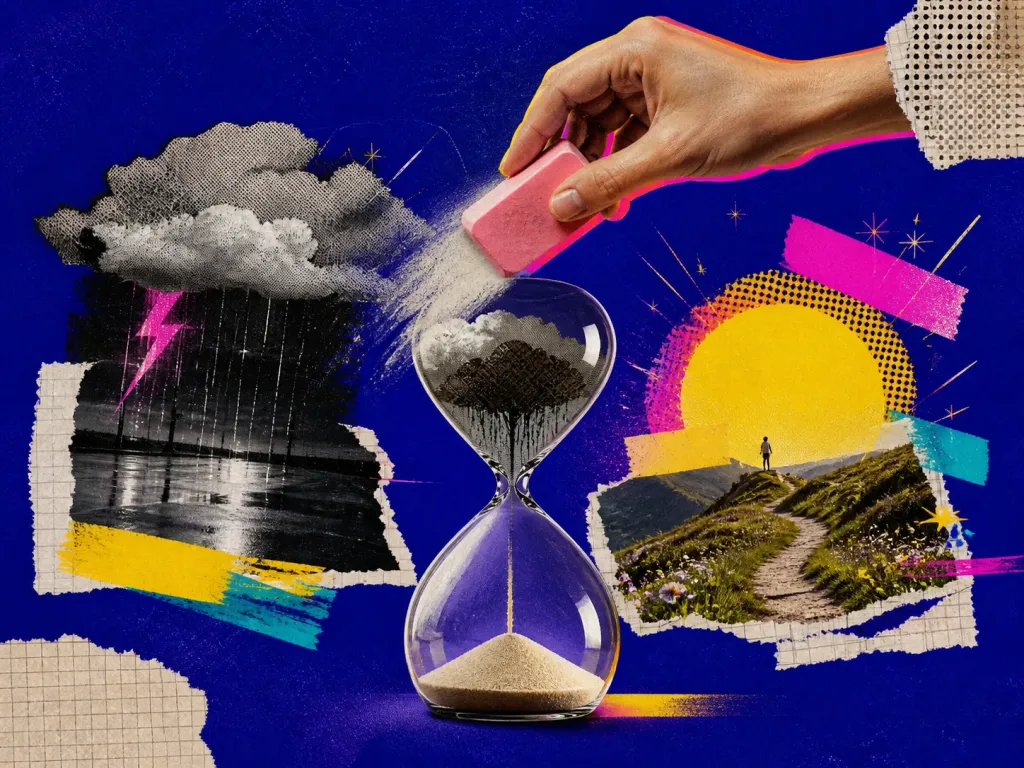
Fading Affect Bias is an average pattern in autobiographical memory: the emotional intensity linked to negative events tends to weaken faster over time than the emotional intensity linked to positive events. It does not mean that every negative memory fades, that painful experiences become positive, or that factual details are rewritten in the same way as emotional intensity.
Examples and situations
- Life comparisons: an earlier period can feel easier in memory partly because some of its negative emotional intensity has softened.
- Repeated experiences: today's frustration is compared with a past event whose emotional edge has faded.
- Stories about the past: people remember what happened and how they feel about it now, but those two things are not identical to how strongly they felt at the time.
Questions to check
- Separate factual memory from current emotional intensity.
- Use diaries, messages, repeated ratings, or other contemporaneous records when the original experience matters.
- Compare several past events instead of one emotionally important memory.
- Treat Fading Affect Bias as an average research pattern with moderators, not a prediction about every person or memory.
Long-form guide
The Kind Fade: Why Bad Memories Soften Faster Than Good Ones (and What To Do With That)
On a rainy Tuesday night, Jess found the receipt. A tiny slip from a diner three years ago. She remembered the night: a sad breakup talk in a red vinyl booth. It should have been a gut punch. But what appeared first were the cinnamon pancakes at midnight. The server who called everyone “friend.” The relief after the shock. The hurt was still there, but blurred at the edges, like it had passed through fog. The sweetness stayed in color.
On this page
What Is Fading Affect Bias and Why It Matters
That quiet tilt you just felt has a name: Fading Affect Bias. It’s the tendency for the emotional intensity of negative memories to decrease faster than the emotional intensity of positive ones. And it’s one of the brain’s odd little mercies. Fading Affect Bias (FAB) means that, with time, the feelings attached to negative events fade more quickly than those attached to positive events. The bad loses heat; the good keeps its glow.
Researchers have observed FAB in diary studies and memory recalls across ages and cultures. People journal daily events and then rate their feelings about those events months later. The pattern is stubborn: negativity cools faster than positivity lingers (Walker et al., 2003). You can argue about why—emotion regulation, storytelling, social sharing—but the effect holds. Why this matters: It helps you get up again. After breakups, layoffs, botched presentations, FAB keeps the sting from lasting forever. You still remember the facts, but the punch weakens. That lets you try again without bracing for the same blow; It can blur hard-won lessons. Pain fading can tempt you to repeat the same risk without the respect it deserves. If the bad fades too fast, you may miss patterns worth honoring; It shapes your nostalgia. FAB can make the past feel sweeter than it was. That can be fuel or fog, depending on how you use it; It influences decisions. We expect future outcomes based on remembered feelings. If the good stays strong and the bad softens, we might overestimate how great something will feel or underestimate its costs. FAB isn’t a moral force. It’s a memory rhythm. Your job isn’t to fight it. Your job is to learn the beat and dance better.
A quick zoom on the science
Memory isn’t a tape. It’s a reconstruction. When you recall, you rebuild. That rebuilding can dilute negative affect, especially when you’ve reappraised, shared the story, or moved on (Walker et al., 2003; Rimé, 2009); Aging tilts things even more positive. Older adults often focus on and recall positive material more than negative—“the positivity effect” (Mather & Carstensen, 2005);
We still have a negativity bias in the moment. Bad is stronger than good when you first perceive it (Baumeister et al., 2001). FAB shows up later, in memory. Put simply: early game, negativity bias. Mid-to-late game, FAB. Together, they keep you alive now and sane later. Stories beat explanations. Here are some you might recognize—composite and familiar, not clinical case studies.
The doomed road trip that everyone keeps praising
Four friends drive eight hours to a coastal cabin. The first day is paradise. Day two brings a flat tire, an argument, and a refrigerator that hums like a lawnmower. On the way home, they’re exhausted and a little bitter. A year later, they reminisce. They talk about the sunrise. The polaroid on the porch steps.
The ridiculous hum that became a running joke at dinner. The argument gets a cameo as “that silly fight.” The panic on the shoulder of I-5? It’s a story beat that sets up the laughter. The flat tire was awful then. FAB made it tolerable in memory. The shared laugh and the view stuck.
The first startup job
Nina joined a startup at 23. The pay was poor, the hours long, and the office chairs looked like they had opinions. She learned more in a year than in four years of school. At the time, many nights were tears-and-late-bus. She left tired. Five years later, those memories feel like rocket fuel. She remembers friendships, the first feature she shipped, the thrill of demo day. The exploitative parts fade a few degrees. FAB leaves her with a warm story about scrappiness.
Is that accurate? Yes and no. The learning and bonds are true. But the faded pain risks glossing over how that schedule hurt her health. If she builds a team someday, FAB alone would push her toward “we hustle hard” myths. She needs to keep the lesson sharp enough to design a humane place for her future team.
The marathon you swore you’d never run again — and the cringe speech
During mile 20, your legs negotiated a mutiny. You told your friend, “Never again.” Three months later, your memory highlights mile 24’s crowd and the medal’s cold weight. The cramps become “the wall,” a point of pride because you pushed through. FAB supports growth here—the pain fades to a badge, which helps you try again. It also risks pushing you into back-to-back races before your tendons forgive you. The middle path is to keep your training log, not just your finish-line selfie.
You bombed a presentation. At the time, your face flushed so red someone could have toasted marshmallows. Weeks later, you remember a few chuckles, the moment you recovered on slide 9, and the colleague who texted, “Proud of you.” FAB gentled the shame, which makes you willing to practice and speak again. Without an anchor, though, you might forget to fix the pacing that sank you. The brain’s kind edit needs a notes app buddy.
Breakup memories that turn cinematic — and the near-miss
A hard breakup felt like a storm. Later, you recall the park bench talks, the playlist, the quiet way you grew. The fights become softened montage beats. FAB shifts the ratio, not the truth. The love stays. The hurt releases its claws. This helps you trust love again. It also tempts a relapse if you forget the hard boundaries you learned. Keep those boundaries on paper.
You almost backed into a cyclist. In the moment, you shook. A month later, you remember the relief and the slow breath more than the fear. FAB here keeps you from driving in dread. Good. But pair it with a habit—like a rearview check checklist—so the lesson sticks where it matters.
Notice the smoothing
FAB is not a villain. But it can soothe you into glossing over important data. Here’s how to recognize when it’s helping and when it’s dulling your edges. If your past feels cleaner, kinder, or funnier than it did at the time, FAB may be doing its job.
That feeling can be a green light to try again. It can also be a yellow light to collect your lessons before the details dim. A simple test: when you think of that event, do you feel mostly warmth with a fuzzy outline where the hard parts were? That’s FAB’s signature.
Write while fresh, return later
Time can turn bad bosses into “characters,” disasters into “adventures,” and emotional injuries into “learning experiences.” Some of that is maturity. Some is FAB airbrushing. If the stakes are high—medical decisions, financial risk, relationship safety—don’t let the airbrush run the edit. Pull the raw footage: old journals, emails, numbers. Get an external view from someone who remembers the facts.
You can embrace FAB and outsmart it at the same time. Right after an event, write down facts and feelings without spin. Later, when things feel gentler, revisit your notes. You’ll retain warmth but keep the contour of the real cost.
Use routines as memory prosthetics
Social sharing of emotion helps regulate feelings. Telling others can reshape and soften negative affect (Rimé, 2009). That’s healing. It can also turn your story into a tight set of jokes that keep you from updating the lesson. Try two versions: a healing, humorous version for a party; and a private, sober version that keeps the signal.
FAB means feelings fade. Systems can carry what feelings shouldn’t. After a near miss, add a checklist to your prep. After a budget failure, set automated guardrails. After a relationship boundary lesson, draft a personal policy that you revisit.
Negativity bias and other close cousins
That’s our goal. Keep the positive glow—motivation, resilience, love of life. Pair it with concrete notes, habits, and safeguards so the next decision respects the full picture. FAB doesn’t live alone. It hangs out with a few other cognitive characters. You might mix them up.
Negativity bias means we react more strongly to negative stimuli in the moment—bad headlines get more clicks, bad feedback cuts deeper (Baumeister et al., 2001). FAB operates later, during recall, when the emotional charge of negative events fades faster. Think: hot now, cool later.
Peak-end rule and mood-congruent memory
We remember experiences by their peaks and their ends, not by the average across time (Kahneman et al., 1993). FAB can influence which peaks feel salient as time passes—the pleasant peaks may remain vivid; the unpleasant peaks dull faster. A miserable trip that ended well can be remembered as good, partly via peak-end, then further sweetened by FAB.
When you’re sad, you recall more sad memories; when happy, more happy ones (Bower, 1981). FAB is about how the emotional intensity attached to a memory changes over time, not which memories you retrieve based on current mood. Still, they interact: if you recall positive more when happy, and positive affect decays slower, you’ll often reinforce good memories.
Rosy retrospection, the positivity effect, and rumination
We recall past events as more positive than we felt at the time. That’s basically FAB with a dash of storytelling. Rosy retrospection is the narrative outcome; FAB is one mechanism behind the affect shift. Older adults tend to attend to and remember positive information more than negative (Mather & Carstensen, 2005). FAB appears across ages, but this aging tilt amplifies the pattern for older adults.
Rumination is repetitive focus on distress and its causes. People who ruminate can slow or disrupt FAB because they keep negative affect fresh (Nolen-Hoeksema, 1991). Managing rumination (journaling, therapy, movement) can let FAB do its gentle work.
Flashbulb memories, reconsolidation and reappraisal
Vivid, detailed memories of emotionally arousing events, like where you were during shocking news (Brown & Kulik, 1977). They feel clear, but their accuracy still degrades. FAB might be weaker for certain highly significant or repeatedly rehearsed negative events, especially when tied to identity or trauma. For trauma, different processes apply—this is not where FAB is a solution.
When you retrieve a memory, it becomes malleable and can be updated—a process called reconsolidation (Nader et al., 2000). Cognitive reappraisal changes the meaning attached to a memory. FAB is often the downstream effect of repeated reappraisal and time.
For healing: let the kind fade happen
You can’t control whether FAB exists. You can choose how to ride it. When something hard happens, give yourself time. Don’t force meaning instantly. Talk to safe people. Sleep is a repair crew. Moving your body helps. Write when you can. As days pass, notice which parts get softer.
That’s okay. You’re not “forgetting.” You’re redistributing weight so you can carry the memory without it crushing you. If the pain doesn’t fade, that may signal a stuck process or trauma loop. That’s not a failure of FAB. That’s a nudge toward therapy or structured support.
For growth and for joy: sharp lessons, savored good
Rely on logs, checklists, and calendar prompts. Put friction in place to guard against repeating mistakes. Replace the job of “pain as teacher” with “system as teacher.” An example: after an expensive impulse buy, don’t wait for shame to fade. Assume it will. Add a 48-hour waiting rule and a text to a friend before purchases over $200. The rule will be there when your regret is not.
FAB means good feelings last longer in memory. You can amplify that by savoring. Name the good moment out loud. Take a single photo that captures the feel, not a hundred that put you behind glass. Share the story with someone who’ll amplify your meaning, not undercut it. Jot down a “three good things” note before bed. Quality over quantity. You’re feeding your future rememberer.
For decisions and teams: quick checks and institutional memory
Before deciding, ask: am I relying on a memory that might be rosier than it was? Can I check the logs? Can I gather fresh data? Can I simulate the worst case without relying on old pain to warn me? If the stakes are low, go with the glow. If the stakes are high, anchor to facts.
In organizations, FAB can sanitize post-mortems. Six months after an outage, the story turns into “our heroic recovery” instead of “we ignored warnings.” Counter this by writing and revisiting blameless post-mortems with clear actions and owners. Schedule the revisit while the lessons are warm.
For relationships and learning: a short practical rhythm
After a hard conflict, your heart wants to heal. Great. Join it. But write down the boundary clarity you earned. If a partner or friend crossed a dealbreaker, don’t let FAB turn it into “not a big deal” without a conscious conversation about change and repair. FAB fades the emotional noise—the sting, the embarrassment.
Keep the signal—the feedback details. Practice extracting signal soon after the event: what was in my control? what wasn’t? what would I do next time? Put that in a note you’ll see later. Experience; Express and log; Rest; Revisit with kinder eyes; Extract a lesson into a system; Savor the good; Try again. It’s not magic. It’s maintenance.
Wrap-Up: Let It Soften, But Don’t Let It Slip
I like to imagine our memories as patches on a jacket. Some are bright, some are threadbare. Time rubs the fabric. The rough patches soften first. That’s Fading Affect Bias doing its slow mercy. It lets you keep walking without the jacket chafing your skin raw.
We don’t need to fight that. We need to sew well. Catch the lessons before they get too soft. Stitch them into small systems. Let the warmth stay bright. Keep trying things. Keep loving people. Keep adding patches that make the jacket worth wearing.
References cited by the original article
Baumeister, R. F., et al. (2001). Bad is stronger than good; Walker, W. R., et al. (2003). Fading affect bias in autobiographical memory; Mather, M., & Carstensen, L. L. (2005). Aging and the positivity effect; Rimé, B. (2009). Emotion sharing as a social process; Kahneman, D., et al. (1993). When more pain is preferred to less: Adding a better end.
Bower, G. H. (1981). Mood and memory; Nolen-Hoeksema, S. (1991). Responses to depression and rumination; Brown, R., & Kulik, J. (1977). Flashbulb memories; Nader, K., et al. (2000). Fear memories and reconsolidation. These are the sources the original article leaned on; the evidence review above decides what we claim from them today.
Decision checklist
- Write a quick fact-and-feelings note within 24 hours of big events
- Notice when a memory feels warmer now than it did then, and ask what you might be forgetting
- Name the lesson that would cost you if it faded
- Put a small system in place so the lesson sticks even as the pain fades
- Ask someone to reality-check your memory without dampening your hope
- Revisit your note after a week to extract one lesson and one celebration
- Turn the lesson into a tiny system: a checklist, rule, or reminder
- Share the story with a trustworthy person to process, not to perfect
- Schedule a 10-minute monthly “memory maintenance” session to review lessons
- Savor aloud when something good happens; snap one meaningful photo, not fifty
- Add friction to risky behaviors (waiting periods, accountability pings)
Evidence review
What the evidence supports
Fading Affect Bias describes an average asymmetry in autobiographical memory: affect linked to negative events tends to weaken faster over time than affect linked to positive events. It is a group-level pattern with important moderators, not a rule that every painful memory becomes mild or positive. Recent large-sample work also finds the pattern when people directly report how the affect of their memories changed, rather than relying only on calculated differences between retrospective ratings.
How researchers describe the pattern
The literature describes the pattern rather than one single settled mechanism. Social rehearsal, emotion regulation, meaning making, memory reconstruction, event characteristics, and individual differences can all matter. The useful distinction is that Fading Affect Bias concerns change in emotional intensity associated with autobiographical memories, not a general claim that factual details of the past become more positive.
Practical interpretation
When comparing how a past event felt with how a similar event feels now, separate remembered facts from remembered emotional intensity. If the comparison matters, use contemporaneous records or repeated ratings instead of assuming today's emotional reaction is an unchanged copy of the original experience. Do not use Fading Affect Bias to dismiss persistent negative memories or individual experiences that do not follow the average pattern.
Reviewed sources
- The Fading Affect Bias: Its History, Its Implications, and Its Future research review · 2014 · DOI 10.1016/B978-0-12-800052-6.00003-2
- Evidence for a fading affect bias in subjectively assessed affect changes in autobiographical memory large-sample autobiographical-memory study · 2025 · DOI 10.3389/fpsyg.2025.1608751
Editorial review: 2026-08-18. The controlled evidence class is an editorial reading aid, not a numeric truth score; the descriptive status above carries the entry-specific qualification.
Continue from here