
Impact Bias – when forecasts overstate future emotional reactions
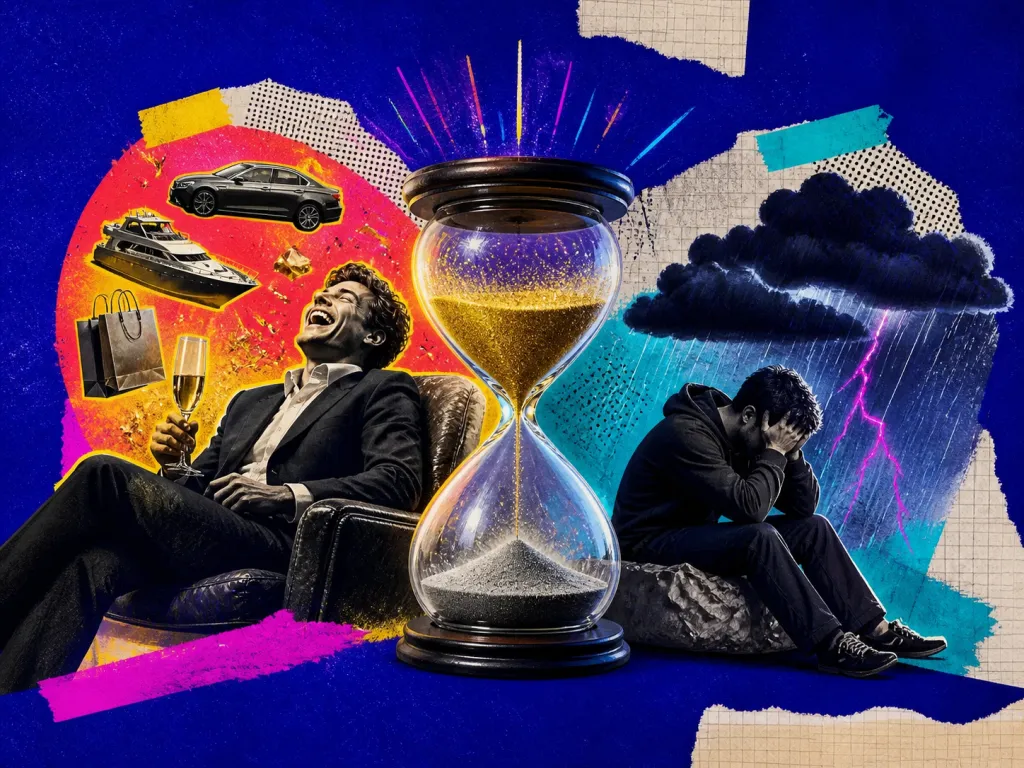
Impact bias is a forecasting error in which people overestimate the intensity or duration of a future emotional reaction. An imagined event can occupy the whole forecast while the rest of everyday life receives too little attention. Errors vary by event, emotion and time horizon; this is not a rule that distress will be brief or unimportant.
Examples and situations
- Illustrative example: someone imagines that one promotion will determine how every day feels. Their forecast says little about the routine, relationships and other events that will also fill those days.
- Predicting how strong a feeling will be and predicting how long it will last are different questions.
Questions to check
- Describe an ordinary week around the event, including what is likely to stay the same.
- Estimate intensity and duration separately instead of using a single judgement such as life-changing.
- When possible, compare the forecast with recorded experience or with people who have already experienced a similar event.
The reviewed research considers focalism, adaptation and the memories used to build forecasts. These are possible contributors, not a promise that people will adapt quickly to every difficult event.
Long-form guide
The Echo That Isn’t There: Living With (and Past) Impact Bias
We still remember sitting in a fluorescent-lit office, flipping a coin we didn’t need. Heads: take the job in a new city with good pay and a view of the river. Tails: stay with friends, familiar coffee, and the cat who visits our fire escape. We were sure whichever choice we made would script our feelings for years. Standing at the window, we pictured a stadium roar of joy—or a black hole of regret—stretching on and on. We were wrong. Six weeks later, we were mostly thinking about where to get dumplings and how to make the subway transfer without switching platforms.
On this page
What Is Impact Bias and Why It Matters
That miss is the heartbeat of impact bias: the tendency to overestimate how long and how intensely we’ll feel after a future event. Impact bias shows up when your mental movie about a future event—getting the offer, being rejected, moving cities, buying the car—plays in Dolby Atmos, then real life arrives in mono. You imagined your feelings as tidal waves. Instead, they pooled, surged a little, then settled. You still felt things (you’re human), just less, and not for as long as you expected.
Researchers call this cluster of misfires “affective forecasting errors.” We tend to misjudge the intensity and duration of future emotions (Gilbert & Wilson, 2000; Wilson & Gilbert, 2003). The engine has familiar parts: We focus too much on the looming event and too little on everything else we’ll experience—this is focalism; We forget how good our mind is at healing itself—this is immune neglect; We miss hedonic adaptation—the psychological settling we do after changes, both good and bad. Why it matters is simple, and heavy. Impact bias bends decisions that shape your days:
You decline a job because you picture endless stress, not routine and modest pride; You overspend on a kitchen because you imagine endless delight from a faucet, when delight decays to “meh” after a month; You avoid a breakup because you imagine a year of tears; your actual grief arc is real but shorter, and opens space you can’t yet see; You chase a win convinced it will fix every ache; six weeks later you still have Mondays. This bias wastes hours, money, and energy. It keeps you in loops you don’t choose. It also inflates dread, which means more stalling, more avoidance, and less practice with the small risks that grow you.
We don’t share this to scold. Impact bias is not a bug you can delete; it’s a setting you can work with. With a few habits, you can predict your feelings more accurately and choose better.
The Apartment With the Magical Balcony
We’ll keep these concrete. If you recognize yourself, good—you’re paying attention. Jas spends three weekends touring apartments. One has a tiny balcony that catches golden light at 6 p.m. Jas imagines dinners out there every night, basking forever. The rent is a stretch. They sign anyway. Two months later, the balcony is nice, but windy. Jas eats outside twice a week when the weather behaves. The glow still pops on good evenings, but most dinners happen on the couch. The rent? Every month, non-negotiable. Impact bias sweetened the balcony and blurred the fixed cost.
What would have helped: imagining rainy wind, summer heat, winter darkness, roommate noise, and the rest of life around the balcony. Also asking someone who lives with a great balcony how often they actually use it.
The Promotion That Would Make Everything Worth It
Min is a steady star. They map a future where the promotion lands, a clean wave of validation crushes imposter syndrome, and they finally relax. The promotion arrives. Min enjoys the email, a few congrats, a better title, and new meetings. Imposter syndrome shifts shape but sticks around. The lift is real and short. We tend to assume big wins erase old problems; they rarely do. They add new context. Min’s satisfaction is a weekly hum, not a permanent chorus.
What would have helped: writing two lists: “What this changes” and “What this does not change,” followed by, “Where have I been wrong about emotional duration before?” Also, a two-week experiment in the new role before formal acceptance, if possible.
The Breakup That Would Break You Forever
Dev and Arya know it’s not working. Dev imagines a long winter of despair. They keep postponing the talk. When it finally happens, there’s grief, an empty Sunday, a low week. Dev cries. Friends show up. Work pulls attention back. By week three, Dev mentions a new recipe and feels curious about a class. The sadness is still there, tender, but the feared forever never arrives.
Dev’s immune system activated—meaningful routines, social support, shifts in attention, and the mind’s quiet repair crews. We underestimate that system, especially in the thick of fear. What would have helped earlier: talking to two people who’ve navigated breakups about timelines and what helped, tracking mood for 30 days after the event, and noticing the curve rather than every spike.
The Purchase That Solves Mornings
Nora buys a top-tier espresso machine after a rough patch. She imagines joy every dawn. Three weeks later, the machine is part of the kitchen landscape. Nora’s mornings are fine; the coffee is good. She still scrolls the news and sometimes leaves the mug half full. The machine lifted mornings from “meh” to “nice.” The imagined transformation—gone.
We adapt fast to stuff; slower, but more lastingly, to skills, relationships, and routines. The espresso machine wasn’t a mistake. The promise was. What would have helped: using a “30/30” rule—wait 30 days, then buy; after 30 days of use, assess if the purchase increased time, ease, or connection. If not, sell or gift it.
The Fear of Public Speaking
Ari pictures stumbling through a presentation, a public failure that burns for months. They delay saying yes. Eventually, they can’t dodge it. They practice, shake, deliver, get questions, and sit down. For three hours, they replay awkward bits. By the next morning, the panic shrinks to a mild cringe. By Friday, a colleague shares praise. Ari’s baseline reappears.
We often forecast a smoldering, endless embarrassment. It fades. Most people are too busy to remember our stumbles. The intensity subsides faster than predicted. What would have helped earlier: a pre-commitment (“I’ll accept any talk under 10 minutes”), a rehearsal with two supportive listeners, and a post-talk ritual to mark closure.
The Health Scare
Lina’s test glare says “possible biopsy.” The week before results, she envisions months of terror. What happens: the week is hard, sleep is off, and emotions spike. The result is benign. Relief lands, then life returns to emails, meals, and chores. The imagined months of terror repaired into a tough week. We’re not saying “don’t worry.” Worry often shows up uninvited. But we can notice the mind’s “forever” stories and anchor to the next small thing we can do: book the appointment, call a friend, walk around the block, eat.
Spotting impact bias isn’t about turning into a robot. It’s about getting honest with your patterns, then using simple tools at the moment of choice. We favor actions that fit in pockets and kitchens, not lab benches.
Recognize It in the Wild
Watch for these tells: Words like “always” and “never” when you predict feelings: “If I move, I’ll always feel lonely.” A single event swallowing your attention: “Once I get this yes, everything will feel good.” Blank space in the “what happens after” part of your mental movie.
You can see the proposal; you can’t see a Tuesday two months later; A history of similar mispredictions: you overestimated how long last year’s disappointment hurt. When you hear yourself prophesying permanence, slow down. Stick a Post-it on the nearest surface: “What else will be true?”
The Psychology Under the Hood
This helps not because you need citations to change your life, but because your brain respects reasons: Focalism: You over-fixate on the focal event and ignore the thousand slices of daily life that dilute its impact (Wilson et al., 2000); Immune neglect: You forget your psychological immune system—reframing, social support, distraction, routines—that blunts pain and normalizes joy (Gilbert & Wilson, 2000); Hedonic adaptation: After spikes up or down, you drift toward baseline happiness more than you expect (Brickman et al., 1978; Diener et al., 1999);
Durability bias: You overestimate how long your feelings last; it pairs with impact bias like tea and biscuits (Wilson & Gilbert, 2003); Hot–cold empathy gap: In calm moments, you mispredict how you’ll feel “hot”; in hot moments, you can’t imagine “calm” (Loewenstein, 1996). You don’t need to memorize terms. But recognizing “my mind is zoomed in and forgetting my immune system” adds a little slack in the rope.
Practical Moves You Can Use Today
Here’s the core of the toolkit. Try one or two. Don’t try everything at once. 1) Ask Future You, Not Imagined You Call or message someone two steps ahead—past you counts if you keep notes. “How did you actually feel two weeks after you moved?” People are better than your brain at recalling duration honestly—especially you, if you’ve kept a small “forecast vs. actual” diary. 2) Try a Tuesday Test Write a half page: “It’s two months after X. It’s a Tuesday. What are three things I do before 10 a.m.? Who do I talk to? What is mildly annoying? What is surprisingly fine?” Make it boring on purpose.
3) Make It Reversible (If You Can) Choose options with a back button. Rent before buying. Pilot the role for two weeks. Ask the gym for a month-to-month plan. If you know you can adjust, your predictions need less perfection. 4) Play With Base Rates Ask: What happens to most people after X? Promotions lift happiness a little; layoffs hit hard but people rebound more than they think. Base rates aren’t your fate, but they anchor expectations. 5) Shrink the Horizon If your brain screams forever, set a review date. “I’ll try the new city for nine months and reevaluate,” or “I’ll live with this haircut for four weeks then reassess.” Your nervous system relaxes when it knows a check-in exists.
6) Improve the Default Day The event isn’t the life. Tune your daily loops: sleep, movement, breakfast, who you text on the commute. These shape your emotional baseline more than most single events. Small upgrades here dilute intensity swings. 7) Build a Tiny Immune System Kit Make a list of three people, two places, and two actions that help you recover: call Maya; text Dad; walk by the river; sit in the bookstore; 10-minute run; 4-7-8 breathing. When you predict doom or eternal bliss, glance at the kit. It exists. It works.
8) Use a Premortem and a Pre-celebration Premortem: “It’s six months later and this decision feels off. Why?” Pre-celebration: “It’s six months later and this decision feels right. Why?” Both push you beyond the initial glow or gloom and fill in Tuesday details. 9) Decide With a Timer, Evaluate Without Drama Give yourself a decision window that fits the stakes (an hour, a day, a week). When the timer ends, choose. Then forbid meta-regret for a set period: “No second-guessing until the 30-day review.”
10) Offload to Tools Use calendar nudges: “Review move decision in 90 days.” Use money tools: “If joy decays, return or resell.” If you check four of these, you’ve likely tamed the bias enough to move.
Related or Confusable Ideas
Impact bias hangs out with other biases. Knowing their names helps you pick the right wrench. Durability Bias: The sibling. You overestimate how long feelings last; impact bias includes how intense you think they’ll be. You can spot both by listening for “always” and “never”; Focalism: The spotlight glare. You think the event is the whole room. Remedy: widen the frame. What else fills Tuesday? Hedonic Adaptation: The treadmill. You step up; your feeling climbs; soon you’re walking level again. You’re not broken. You’re alive.
Immune Neglect: Your inner medic is invisible to you until it’s sutured and salved and you’ve already healed. When forecasting, actively list what usually helps you bounce. Hot–Cold Empathy Gap: You can’t plan calmly when you’re hot and can’t imagine hot when you’re calm. Ask your calmer or hotter self for notes. Time decisions to the right temperature when you can. Planning Fallacy: Different domain, same vibes. You underestimate how long tasks take. That habit can pair with impact bias: “The project will be done in two weeks and I’ll feel triumphant for months.” Double correction needed.
Peak–End Rule: You judge experiences by their peaks and endings, not the average. This distorts memory, which distorts forecasts (Redelmeier & Kahneman, 1996). Design better endings; notice average days. Loss Aversion: Losses sting about twice as much as gains delight. It can magnify dread. Expect heavier front-end pain; still expect adaptation. Present Bias: You overvalue now. Combined with impact bias, it can force “fix-it-now” purchases or decisions. Build speed bumps: 24-hour holds, carts not checkouts. None of this is an indictment. It’s a toolbox label.
Putting It Together: A Day in the Life With Fewer Forecasting Errors
Picture Mal. Sunday night. They write three lines: “This week: decide about the move, present Thursday, fix bike.” They doodle a small cat wearing a metal hat. Cute. Then they do this: They text two friends who moved last year: “What was hard after month one? What got normal by month three?”; They write a Tuesday Test for “two months after I move.” It includes a leaky bathroom, a new running route, a grocery store with bad peaches, someone at work who pronounces their name correctly, and a coffee shop where they order the wrong thing and it’s better; They schedule a 90-day review on the calendar; They set a rule: “Don’t buy furniture until I live there 30 days.”; They pick two daily anchors to carry across the move: oatmeal and a 20-minute walk at lunch; They compose a premortem: “It’s October and I feel off. Why? I isolated. The commute waste is 30 minutes. The noise at night interrupts sleep.” They sketch fixes: “Join a Tuesday class; test a different route; cheap earplugs; meet neighbor.”; They put their immune kit on the fridge: three names, two places, two actions.
Thursday, Mal gives the talk. It goes well enough. They walk home, hungry, and forget about it until a colleague texts a GIF. Saturday, Mal flips a coin for fun, but the decision already feels like a process, not a cliff. They choose to move. The choice is lighter. They know the glow will fade, and the hassles will shrink. They’re ready for both. That’s the game. Not chasing permanent fireworks. Building lines that hold when the music changes.
Wrap-Up: Don’t Let the Mind’s Trailer Lie About the Movie
We’ve learned, over years of messy experiments, that our minds cut killer trailers. They slice the best and worst moments, crank the volume, and loop the chorus. Then the movie starts. It’s patchier. It has dishwashing scenes and messages to return and thrift store jackets. It has grief and glitter in mild doses. It has, in other words, life. Impact bias predicts failed epics: never-ending despair, permanent bliss. The fix isn’t stoicism or cynicism. It’s humility plus habit. Zoom out from the focal event. Respect your immune system. Make your days nicer. Build reversible choices. Timebox. Ask people who just did the thing. Schedule a review. Let Tuesday matter.
Your calendar, pen, and a friend’s honest voice are enough to start. If you take one step today, write a Tuesday Test for something looming. It will feel small. That’s the point. Small is where impact bias loses its grip.
A Few Notes for the Nerdy-Hearted
People misjudge emotional intensity and duration: affective forecasting errors are robust in lab and life (Gilbert & Wilson, 2000; Wilson & Gilbert, 2003); Hedonic adaptation shows up across lottery wins and injuries; people drift toward baseline more than predicted (Brickman et al., 1978; Diener et al., 1999); Focalism and immune neglect partially explain impact bias (Wilson et al., 2000; Gilbert & Wilson, 2000);
The peak–end rule skews memory, which skews forecasts (Redelmeier & Kahneman, 1996); The hot–cold empathy gap makes temperature-aware planning worth the trouble (Loewenstein, 1996). You don’t need the citations to live better, but it’s nice to know your hunches have company.
Decision checklist
- Did I write a Tuesday Test for two months after the event?
- Did I ask at least one real person for their after-story?
- Is there a reversible version of this choice?
- What base rate or study nudges my expectation?
- Did I schedule a review date in my calendar?
- What two daily habits can I tune regardless of the outcome?
- Does my immune system kit exist and is it visible?
- Did I run a premortem and a pre-celebration?
- Identify what will change and what will not
Evidence review
What the evidence supports
People often overestimate how intense or long their emotional reactions to future events will be, especially when the focal event crowds out everything else that will also shape daily experience. The literature is broader than a rule that people always overpredict emotion: forecasting errors vary by event, time horizon, emotion, and what exactly is being predicted.
How researchers describe the pattern
Affective-forecasting research identifies several contributors. Focalism makes the target event dominate imagination while ordinary future events receive too little weight. For negative events, people can also underpredict adaptation and the psychological processes that help them make sense of what happened. Available memories can further bias forecasts when memorable examples are atypical.
Practical interpretation
For a major future event, forecast both the focal event and the rest of an ordinary week around it. Estimate intensity and duration separately, then compare later forecasts with actual experience. When possible, use experience-sampling or a reference class of people who have already lived through a similar event instead of relying only on vivid imagination.
Reviewed sources
- Immune neglect: a source of durability bias in affective forecasting experiments · 1998 · DOI 10.1037/0022-3514.75.3.617
- Focalism: a source of durability bias in affective forecasting experiments · 2000 · DOI 10.1037/0022-3514.78.5.821
- Affective Forecasting: Knowing What to Want review · 2005 · DOI 10.1111/j.0963-7214.2005.00355.x
- The impact bias is alive and well reanalysis / response to critique · 2013 · DOI 10.1037/a0032662
Editorial review: 2026-08-18. The controlled evidence class is an editorial reading aid, not a numeric truth score; the descriptive status above carries the entry-specific qualification.
Continue from here
Choose the next useful move.
Evidence-linked concepts
Nearby ideas, with the relationship made explicit.
These links are reviewed separately from the original library’s related-entry suggestions. A relation means the concepts overlap or are often confused; it does not mean they are interchangeable.
Projection Bias – when current preferences shape forecasts of future preferences
Both distort predictions about the future self. Impact bias concerns the intensity or duration of future emotional reactions; projection bias concerns carrying current tastes or states too strongly into forecasts of future preferences.
Open reviewed entry