
Peltzman Effect – when feeling safe makes you take more risks
Do you act more recklessly when you feel safe, even though the risk remains? That’s Peltzman Effect – the tendency to offset increased safety by engaging in riskier behavior.
Examples and situations
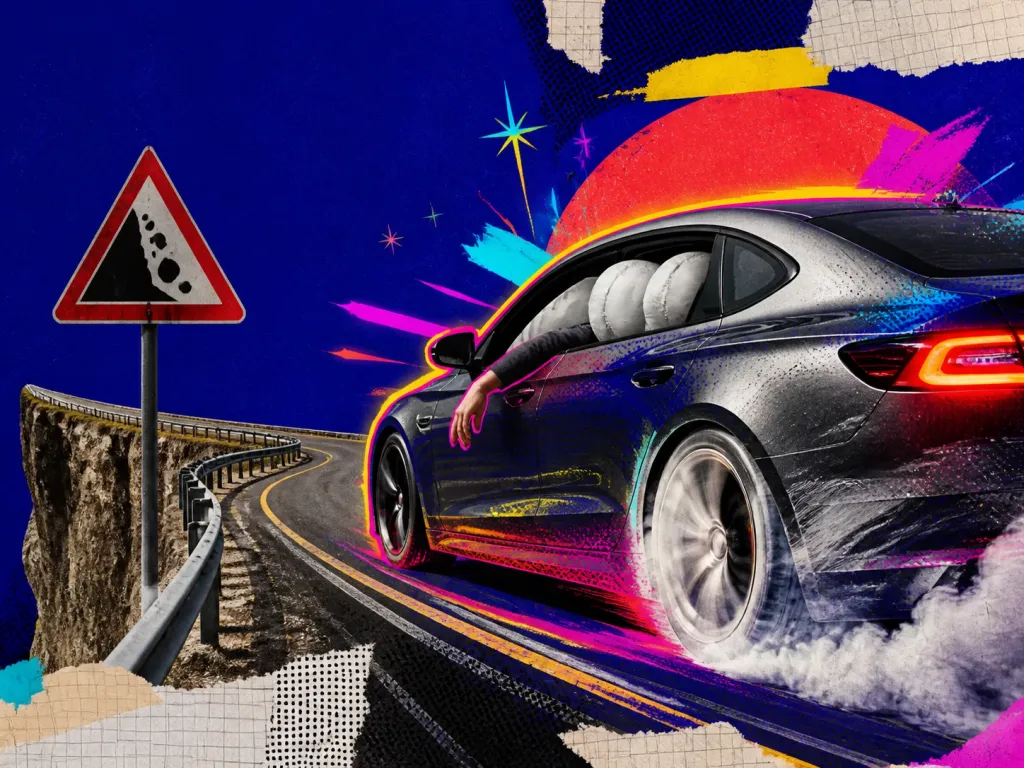
- Driving – people drive more aggressively in cars with advanced safety features than in older models.
- Sports & outdoor activities – skiers or cyclists go faster when wearing protective gear, assuming it will save them.
- Finance – investors take bigger risks when they believe their losses are insured.
Questions to check
- Safety doesn’t make you invincible – protection reduces risk but doesn’t eliminate it.
- Monitor your behavior – don’t let a sense of security lead to reckless decisions.
- Think about consequences – if you’re taking bigger risks because of added safety, ask yourself if it’s really worth it.
Long-form guide
The Safety Trap: How the Peltzman Effect Makes Us Push Our Luck
On a bluebird day at the ski hill, my friend clipped on a brand-new helmet. It was glossy, snug, and made him look like a snow-sports superhero. By noon, he had also found an extra 10 mph. When we stopped for hot chocolate, he shrugged: “I feel way safer.” That afternoon he crashed into a fence. He wasn’t hurt—helmet did its job—but the story stuck with me. The gear worked. His brain, maybe not.
On this page
What is Peltzman Effect – when feeling safe makes you take more risks and why it matters
The Peltzman Effect is the tendency to take more risks when we feel safer. The cushion invites the leap. The Peltzman Effect says that when safety improves, people often dial risk-taking up to keep their preferred level of danger. We compensate. Sam Peltzman studied this in the 1970s and found that some auto safety regulations (like seat belts) reduced driver deaths but were partially offset by riskier driving that increased harm to pedestrians and other road users (Peltzman, 1975).
If it feels less costly to make a mistake, I can push harder; If the guardrails look sturdy, I’ll lean on them; If the consequences shrink, the appetite for risk grows. The logic isn’t mysterious. We live by gut math: This doesn’t mean safety measures “don’t work.” Helmets prevent head injuries. Airbags save lives. But behavior changes can erode some benefits and redistribute risk. Your added speed may keep you safe while putting others in harm’s way. Or the benefit remains, but smaller than expected. That gap is the Peltzman Effect.
It can turn safety wins into mixed results. We spend money, then wonder why outcomes barely move; It shifts risk onto people who didn’t get a vote—pedestrians, juniors on the team, customers; It hides in noble intentions. “We made it safer,” we say, then quietly adapt our behavior and erase the margin. Why it matters: It also matters because we can manage it. When people understand their own tendencies, they don’t stop using safety tools; they use them as designed. That’s our drumbeat: notice, name, adjust. The Peltzman Effect is powerful only when it’s invisible.
Where the Peltzman Effect shows up and where it doesn’t
Feedback is immediate: “I can drive faster and feel fine.” Quick feedback teaches your nervous system that the new risk is acceptable; Rewards scale: “Speed got me there sooner.” The payoffs stack, so people chase them; The protection is visible: “I see my helmet.” Visible safety signals license risk-taking; The protected person controls the risk: Drivers, traders, skiers—people with agency adjust fastest. Strong Peltzman effects show up when: The risk is to someone else and you care about them (your kid, your team, your customers);
The protection is invisible or baked into the environment (better road design, unobtrusive guardrails); The safe choice is the easy choice, not the posture for going faster; Culture reinforces caution and punishes boundary-pushing. Weaker effects show up when: Safety often works best when it’s elegant and quiet. When the safest action is also the laziest action, the Peltzman Effect has less room to run.
Seat belts, airbags, and the speedometer that “accidentally” crept up
Let’s walk through places you’ve likely seen this—some classic, some modern, some that may sting a little. Peltzman’s original research looked at U.S. auto safety regulation. Safer cars coincided with drivers who took more risks, which partly offset gains and changed who got hurt (Peltzman, 1975). Later evidence is mixed on the size of the effect, but the basic behavior is easy to spot: a seat belt feels like armor;
an airbag feels like a crash pillow. People tailgate a hair closer, glance at their phones a beat longer. Airbags and belts still save lives, but not as many as you’d expect if behavior didn’t shift. The subtle twist: risk can move to people outside the car—cyclists, pedestrians, motorcyclists. Someone else pays for your comfort.
Cyclists and the helmet paradox
When ABS became common, many drivers felt invincible in rain and snow. Insurance claims for certain crash types didn’t fall as much as expected. Drivers followed closer, or drove faster in poor weather, assuming ABS would rescue them. The tech worked; it couldn’t rewrite physics. ABS helps you steer while braking, but it doesn’t defy momentum. It doesn’t fix bald tires or black ice. Yet plenty of drivers acted like it did.
A quirky study found that drivers pass closer to helmeted cyclists, possibly because the helmet signals competence, which reduces drivers’ perceived need for a wide berth (Walker, 2007). Cyclists with helmets sometimes ride more aggressively for the same reason. Result: helmets still protect heads, but proximity risk increases. Two groups adjusting at once—cyclists and drivers—show how social signals bend behavior in unexpected ways.
Health insurance and “more cake, please”
At resorts, rental counters push helmets. Good. But anyone who skis with kids has watched the “new helmet swagger.” The helmet doesn’t cause speed; it removes the last whisper of friction from speed. Instructors know this and adjust drills to keep new helmet wearers in control. If you’re a parent, you already manage this with rules like “no straight-lining” and “hands on knees in the steeps.”
When medication or insurance lowers the cost of a bad outcome, some people relax other safeguards. After statins became widespread, some patients eased up on diet and exercise. The meds worked, but the net health gain wasn’t as big as hoped because daily habits shifted. In public health, this shows up in sunscreen too—some people stay longer in the sun because they feel protected, then skip reapplication. The lotion works; the lingering doesn’t.
Finance: stop-loss comfort and bigger bets
During the pandemic, we saw classic risk compensation: people who masked up felt safer and sometimes expanded their social circles or time indoors. Others, seeing masks as a signal of safety, relaxed distancing. The net effect varied across settings and cultures, but the pattern recurred: change the felt cost of a mistake, and behavior adapts. Some studies found limited or context-dependent risk compensation, but the mechanism is familiar to anyone who watched rules loosen at the office and lunches lengthen. Traders use stop-loss orders to limit downside. Sensible. But the presence of a “floor” can nudge risk up elsewhere: larger position sizes, tighter stops that get whipsawed, then revenge trades. The safety tool dulls fear, and dulled fear invites bigger swings. It’s not the stop-loss; it’s the false sense that guardrails remove danger rather than reshape it.
Deposit insurance adds another layer. When banks know deposits are insured, they might lean into risk. Regulators exist to counter that moral hazard. Still, history shows the dance: protect the downside, and folks look for higher upside.
Playground redesigns: Peltzman Effect
Teams roll out two-factor authentication and phishing filters. Risk drops—until people relax. They reuse passwords “just for this vendor.” They click links because “the IT team has my back.” A sophisticated phish leaps the fence anyway. The tech worked; the posture slipped. Many CISOs add periodic phishing drills and “report suspicious” nudges to keep behavior aligned with the new baseline.
Add rubber surfacing and soft edges, and sometimes kids (and parents) climb higher and attempt bigger stunts. The safer ground encourages riskier play. There are real benefits—fewer broken bones—but supervisors need to adjust: broader sightlines, teach fall techniques, set clear rules for flows on busy structures. The lesson: design is half the job; behavior is the other half.
Workplace safety harnesses
Feature flags and rollbacks make shipping safer. Great. But teams often extend deadlines, take larger architectural swings, or cut test coverage because “we can always kill-switch it.” Flags reduce blast radius; they don’t fix poor design or missing observability. The result can be more incidents of smaller size, which still burn time and trust. Mature teams couple flags with stronger pre-merge checks and alerting.
Roofers with fall protection sometimes lean out farther or carry heavier loads per trip. Harnesses save lives—full stop. But foremen watch for “harness bravado” and compensate with training and pacing. They also audit anchor points obsessively. The harness invites boldness; the system should absorb it.
Backup systems and sloppier habits
Pilots fly with checklists and automation. They’re trained to not let cockpit tech nudge them into overconfidence. Aviation’s deep safety culture fights the Peltzman Effect head-on with standard operating procedures, disciplined crew resource management, and error reporting without blame. Aviation arguably has the world’s best playbook for absorbing safety improvements without letting risk creep—the behavior is engineered almost as carefully as the machines.
Teams with daily offsite backups sometimes relax on patching or permissions. “We can restore if something breaks.” True, but you can’t restore reputation. You can’t restore a customer who churned because of downtime. Backups absorb catastrophe; they shouldn’t license carelessness.
Recognize the early signs
N+1 or N+2 power makes operators comfortable. It should. But then someone schedules maintenance during peak load because “we have headroom.” That’s where cascading failures are born. The fix is boring and effective: strict change windows, load limits that account for the worst plausible surprise, and post-mortems that include “why did we spend our safety margin?” Let’s bring this home. You can spot the Peltzman Effect before it bites. And you can design around it without turning into a scold.
You hear “we’re covered” more often than “let’s keep it boring.” A new safety tool arrives, and the team immediately stretches goals: tighter deadlines, bigger bets, less test time; “It’s fine; we have insurance” creeps into decision-making; Metrics improve in one area but get worse in edges and exceptions: fewer high-severity incidents, more frequent low-severity ones; The protection is visible and celebrated; the adaptation is quiet and unmeasured. The strongest tell is language. When people talk about safety as permission rather than protection, risk compensation is underway.
Avoid the trap with design, not lectures
People don’t change because you wag a finger. They change when the environment nudges them toward the behavior you want and the consequences are vivid. Split the message: “This reduces harm if something goes wrong. It is not a license to push harder.” Repeat it until it’s boring; Pair safety upgrades with constraint upgrades. New seat belts? Also limit top speed. New feature flags? Also tighten staging gates. New insurance? Also raise review thresholds; Make the risk visible again. Dashboards, near-miss logs, and quick debriefs keep the hair on the back of your neck alive without fearmongering; Adjust incentives. If the team wins by shipping fast, they’ll spend safety margin to ship faster. If they win by shipping reliably, they’ll use safety as a buffer, not fuel; Teach “risk budget” thinking. Decide the risk you’ll accept before you feel safe. Write it down. Hold yourself to it.
We use this framing with our own work: “What will we not do now that we feel safer?” It’s a surprisingly productive question. If you’re a manager, bake this into your rollout plans. If you’re an individual, apply it to your weekend rides or your brokerage account. The same brain drives both.
Risk homeostasis: Peltzman Effect
It’s easy to tangle the Peltzman Effect with cousins and look-alikes. The differences matter because the fixes differ. Moral hazard happens when someone takes more risk because they don’t bear the full cost—like insured banks lending aggressively. It overlaps with Peltzman: insurance lowers felt downside, so behavior shifts. But moral hazard is about who pays. Peltzman can happen even when you pay your own costs; you just discount them because you feel safer.
Gerald Wilde popularized the idea that people maintain a target level of risk—nudging behavior to stay near that “set point” (Wilde, 1994). That’s the same melody as Peltzman. The debate is about how fixed that set point is and how much we can move it with culture, incentives, or design. Aviation suggests we can move it quite a lot.
Optimism bias: Peltzman Effect
Overconfidence is about inflated belief in your skill. The Peltzman Effect can feed it: safety tools create performance that looks like skill, and you credit yourself. Overconfidence magnifies risk compensation because you don’t feel like you’re compensating—you feel like you’ve leveled up. When small rule-bending doesn’t cause immediate harm, it becomes the new normal. Over time, that squeezes your safety margin to zero. The Peltzman Effect can accelerate this by making the early deviations painless. The fixes overlap: make deviations visible, enforce guardrails, and celebrate boring compliance.
This is the “it won’t happen to me” story. Safety tech amplifies it by giving your optimism a prop: “We have airbags.” That’s how you get tailgating and texting. The counter is realism with data and storytelling that reconnects consequences with choices. Do something good, then give yourself permission to do something bad. “I went to the gym; I’ve earned pizza.” The Peltzman Effect rhymes with this: “I installed a smoke detector; I can light candles.” The mechanism is emotional credit. The fix is to split identity from action: “I’m the kind of person who does both safety and discipline,” not “I earned a pass.”
How to make the Peltzman Effect work for you
We’re not here to scowl at helmets. We love helmets. We want you to keep the safety gains and skip the risk bloat. Here’s how to make that real. Write down the margin. If the new tool saves 20% of incidents, decide to “bank” at least 15%. Make it explicit: “We will not increase throughput targets for 3 months.” Add friction where speed tempts you most. A confirm dialog on irreversible actions. A second reviewer on outsized bets. A cooling-off period before big clicks in your trading app;
Celebrate restraint, not just heroic saves. If your culture praises “we shipped early!” but yawns at “we shipped solid,” you’ll keep bleeding margin; Share the downstream view. Show who pays when your behavior shifts—customers, pedestrians, future-you. People act better when they can see the person they might hurt; Practice failure. Simulate the crash with the safety on. Teams that run game days don’t confuse guardrails with invincibility. Individuals who practice emergency stops don’t treat ABS like magic. Underline this: the Peltzman Effect isn’t fate. It’s a nudge. You can nudge back.
Wrap-up: Bank the margin
We love tools that make us safer. Helmets. Feature flags. Backups. Strong meds that save lives. But safety innovations often cut a quiet deal with our instincts. The safer we feel, the more we push—until the gains erode or drift onto someone else’s shoulders. You don’t need to fight your brain; you need to coach it. Name the Peltzman Effect. Decide your risk budget before you feel invincible. Pair every new guardrail with one tiny friction that keeps you honest. Make the boring choice easy and the flashy choice deliberate.
We’re building a Cognitive Biases app because these patterns shape our days more than we admit. Catching them in the moment is a superpower. Keep the helmet on. Keep your speed in check. Bank the margin. And if you see someone reaching for the turbo because they bolted on a seat belt, hand them this guide and say, kindly, “Let’s keep the win we just earned.”
Peltzman, S. (1975). The Effects of Automobile Safety Regulation; Walker, I. (2007). Drivers overtaking bicyclists: Objective measurement of passing distance; Wilde, G. J. S. (1994). Target Risk; Hedlund, J. (2000). Risky business: safety regulations, risk compensation, and individual behavior. References:
Decision checklist
- Name the safety change. What protection just got better?
- List the shiny new risks it tempts you to take
- Decide on a risk budget in advance—quantify it if you can
- Add a constraint that offsets temptation: limits, time buffers, thresholds
- Make the new baseline measurable: leading indicators, not just outcomes
- Change incentives so safety doesn’t convert into speed by default
- Schedule a check-in in 2 weeks to ask, “Did we spend the margin?”
- Capture near misses. Treat them as signals, not stories
- Communicate “this is a seat belt, not a turbo.”
- Rehearse what you’ll do when the cushion fails. Practice once
- Say it aloud: “This is protection, not permission.”
- Pre-commit a risk budget and document it