Anthropomorphism – when nonhuman systems are read as humanlike
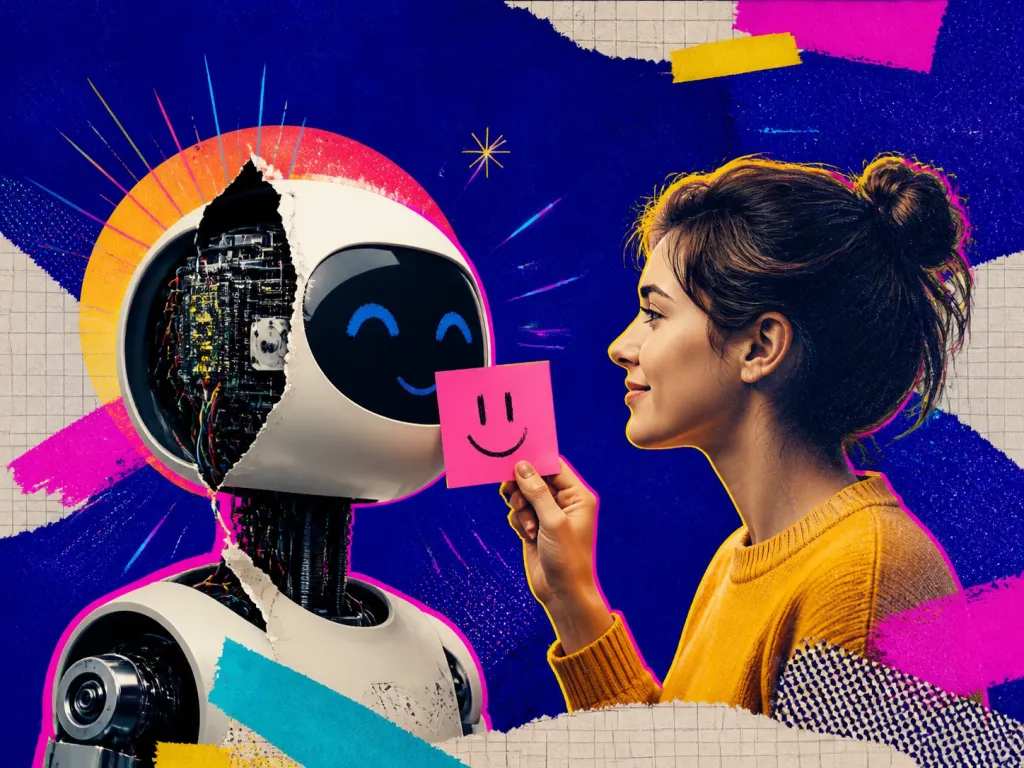
Anthropomorphism is the attribution of humanlike characteristics, intentions, emotions, or mental states to nonhuman agents. It is a common psychological process, not automatically an error. The problem appears when humanlike cues are treated as evidence that an animal, robot, or AI has capabilities, understanding, motives, or consciousness that have not actually been demonstrated.
Examples and situations
- AI assistants – fluent first-person language or a warm voice feels like proof that the system understands or cares.
- Robots – a face, gaze, or social gesture changes what people expect the machine to know or feel.
- Everyday objects – unpredictable behavior is described with human motives, which can hide the mechanical or statistical explanation.
Questions to check
- Separate observable behavior from the humanlike mental state you are inferring.
- Translate impressions such as 'it understands me' into specific capabilities that can be tested.
- Use performance evidence, documentation, and independent verification when accuracy matters.
- Remember that anthropomorphic language can be useful shorthand without being literal evidence about a system’s mind.
Long-form guide
The Cat That Loved Coffee: A Friendly Guide to Anthropomorphism
I used to work with a designer who swore her coffee machine “woke up grumpy.” She’d pat it twice, whisper “be nice,” then press brew. When it sputtered and whined, she muttered, “Yeah, yeah, Mondays.” The rest of the team rolled their eyes—until the day the machine “refused” to make decaf for the client who hated caffeine. Suddenly everyone had a theory about the machine’s “attitude.”
On this page
What Is Anthropomorphism—and Why It Matters
Cute. Harmless. Also, a small window into a big habit. Anthropomorphism is our tendency to give objects, animals, or systems human traits, motives, or feelings. Below is a field guide: what anthropomorphism is, why it matters, where it shows up, how to spot it in yourself and your team, what to do about it, and what it often gets confused with. Anthropomorphism starts early. A toddler scolds the table for bumping her leg. A teenager names his car “Gus” and thanks him when he starts on the first try. Adults tell smart speakers “please,” attribute moods to weather, and swear the printer “knows” when you’re late.
That’s the gist. But it helps to understand the “why” behind it. We’re prediction machines. When something moves or changes, we instinctively look for causes and intentions. Human minds are our best model, so we project those models onto anything that acts in a way we can’t fully predict (Epley, Waytz, & Cacioppo, 2007); We’re social to our core. Treating things like social partners can make us feel safer and less alone. This has survival value and emotional value; We focus on cues that feel human-ish: faces, voices, eye-like patterns, contingent responses, and motion that looks goal-directed. Show people two triangles and a circle moving around a screen and many will see bullying, courtship, or rescue—classic finding (Heider & Simmel, 1944); Media tricks us. Even slight human cues—names, “uh-huh” fillers, or polite phrasing—push us to treat computers like people (Reeves & Nass, 1996).
Why it matters: Design: We give voice assistants names and see them as teammates. Great for engagement, risky for privacy and over-trust; Safety: Drivers who “trust” autopilot systems and talk to them like chauffeurs overestimate their abilities; Ethics: We might protect robots that look sad and ignore animals that don’t show pain like we do; Money: Cute brand mascots can sway choices more than facts; Teams: We misread complex systems (markets, algorithms) as fickle or malicious and make bad calls. Anthropomorphism helps us connect fast. It can also blind us to how things really work.
The Roomba With a Route, and a Personality
A friend of ours named her Roomba “Dot” because the app drew little dotted lines. When Dot got stuck under the couch, she apologized—“My fault, girl.” When the battery wore out early, she felt oddly betrayed. The human storyline—helpful partner, then letdown—made her buy the same brand again because “Dot tried her best.” That’s not a product review. That’s a relationship narrative. Designers know this. They give robots expressive beeps and “searching” wiggles. Those cues invite you to forgive, to wait, to invest. It’s delightful—until you forget it’s a broom with scripts.
Office elevators skip floors and pause strangely. People complain the elevator “doesn’t like” them. In one building, a contractor added a fake “Door Close” button to calm riders who wanted control. Pressing it felt like persuading a colleague to cooperate. That feeling reduced impatience and complaints, even though it did nothing. Anthropomorphism links to control. When a system frustrates you, it’s easier to imagine it as stubborn than to accept you’re at the mercy of timings and algorithms.
Pets, Livestock, and Moral Knots
We read dogs better than we read cows. Dogs give us expressive faces and contingent behaviors that map neatly to our social playbook. As a result, many people lavish medical care on dogs and struggle to see cattle suffering with the same vividness. That’s not an argument against loving dogs. It’s a spotlight on a bias: animals that mirror our social cues get more of our empathy, even if their capacity to feel pain is similar.
In research, people who are lonely or seek control tend to anthropomorphize more, including toward pets, robots, or even gadgets (Epley et al., 2007). That social glue helps mental health; it also shapes policy and buying behavior.
The Algorithm “Targeted” Me
Microsoft’s Clippy asked, “It looks like you’re writing a letter. Need help?” People despised it, partly because Clippy felt like an overeager coworker who interrupted and made bad guesses. The human metaphor backfired: we judged it by human politeness rules. When it violated them, we felt invaded. Design lesson: if you humanize a tool, users will apply human expectations—empathy, competence, timing, humility. Fail those, and the failure feels personal. A marketing model flags your account for a price test. Your friend gets a discount email; you don’t. You conclude the company is “punishing” loyal customers. The system isn’t moral. It’s a set of weights following rules. But the human story—favoritism—feels more plausible because it’s familiar. We invent a motive where there’s only math.
This matters for governance. When a city uses a risk model for inspections, people might see “bias” as the algorithm’s hidden agenda. Bias can be real in data and design. But attributing intent (“it wants to purge poor neighborhoods”) distracts from the fixable technical and policy levers.
The God of Small Appliances
A driver names their car “Marta” and praises her for lane changes. Later, in heavy rain, Marta “seems nervous.” The driver takes over late because they were reading Marta’s “mood,” not the system’s capability limits. When interfaces show sleek, human-like feedback (calm voice, apologetic tone), they smuggle in a false sense of competence. That’s charming—and dangerous.
When a toaster “chooses violence” and scorches bread, we disarm our frustration by joking, “He woke up wrong.” Humor helps. It also hides a maintenance problem. A loose thermistor isn’t moody; it’s broken. We stay in the story, not the fix.
Animated Shapes and Sudden Morals
A chatbot remembers your name, sprinkles empathy (“That sounds tough”), and keeps a consistent tone. You feel seen. That feeling can be good. But when a bot says, “I’m here for you,” some people form attachments and disclose personal data they would never tell a static form. Designers know this, regulators fret about it, and users float between care and over-sharing. Anthropomorphic cues drive trust—earned or not (Reeves & Nass, 1996).
That old Heider & Simmel film showed just three shapes moving. Viewers described jealousy, bullying, rescue. The mind leaps from motion to story. This spills into sports (“the ball wanted to go in”), finance (“the market got scared”), and nature (“the storm hunted the coast”). The story sticks because it compresses complexity into a character arc.
Recognize and Avoid Anthropomorphism (Without Losing Your Soul)
Charities raise more when they show a single named animal—“Luna the Sea Turtle”—with a backstory, compared to statistics about population decline. People will donate more to a story than to a broader cause, a twist of the identifiable victim effect amplified by anthropomorphism. This saves some animals. It can also skew priorities away from ecosystems that don’t have a mascot-friendly face.
You don’t need to scrub all warmth from your life to think clearly. You can keep the nicknames and the poetry and still make solid decisions. Here’s how to spot anthropomorphism before it steers you.
Watch for the Cues That Trick You
If the sentence in your head uses a human motive—wants, knows, tries, decides—about a thing that doesn’t have a mind, pause. The printer isn’t “plotting.”; The market doesn’t “get angry.”; The app didn’t “lie.”. This doesn’t mean never use vivid language. It means treat it like seasoning, not the meal. Faces: A robot with eyes pulls empathy. Even two dots and a line will do; Voices: Polite, apologetic, or confident phrasing; Contingency: Responds right after you act, even randomly—your mind sees “it reacted to me.”; Unpredictability: Glitches invite motives; Naming: You name it, you care. That’s okay; just note what changes.
Once you see these cues, you’ll spot the nudge. 1) What evidence would look different if a mind were not involved? If an algorithm is “biased,” show the distribution and the inputs. If a device “hates Mondays,” check logs and maintenance history. 2) What’s the non-human explanation? Sensors get noisy. Networks drop packets. Models overfit. Heat expands. These are boring, and they’re usually right. 3) What decision am I about to make because of the story? If you’re about to switch brands, give more data, or take a safety risk, slow down.
For Designers and Leaders
Match the cue to the capability. If your system can’t consent, apologize, or care, avoid cues that promise that; Make state visible. Replace fake “moods” with clear status: what the system can do now, what it can’t, and why; Choose pronouns with care. “I” suggests agency. Use it when a system truly acts on user behalf with constraints and accountability. Otherwise, prefer neutral phrasing; Support graceful refusal. Instead of “I’m sorry, I can’t do that,” try “This feature isn’t available offline. Here are your options.”; Give control affordances that work. Don’t fake buttons to soothe. Provide genuine stop, override, and feedback loops; Prepare users for boundaries. “Autopilot keeps lanes under clear lane markings on dry roads. It will not detect all obstacles. Keep hands on the wheel.” Clarity beats charisma.
Name things if it helps—but maintain a “maintenance mode.” When Dot the Roomba traps herself, joke, then check the layout; When you feel a betrayal by a product, write down what happened like a bug report. Facts counter feelings; Don’t assume malice from complexity. Most “how could it?” moments have three steps: a trigger, a rule, a corner case; Give empathy to actual beings. If a chatbot’s apology comforts you, also call the friend who can actually care back. Print that. Tape it near the team’s whiteboard.
Related or Confusable Ideas
Anthropomorphism sits in a busy neighborhood. It’s easy to mix it up with other mental shortcuts. Pareidolia: Seeing patterns (faces in clouds) where none exist. It feeds anthropomorphism but doesn’t require motives; Intentional stance: Treating something as a rational agent to predict its behavior (Dennett’s term). Useful for chess software or animals; it can still mislead when the system lacks goals; The media equation: People treat media like real people when it shows social cues (Reeves & Nass, 1996). This is a mechanism of anthropomorphism; The Machiavellian market: We often use metaphor as shorthand—“the market is nervous.” That’s personification in language.
It becomes a bias when you start believing the metaphor guides prediction or ethics; Anthropodenial: The flip side—refusing to attribute human-like feelings to animals even when evidence suggests they have them (de Waal, 1999). Both over- and under-attribution can be errors; The identifiable victim effect: We give more to a single story than to a statistic. Anthropomorphism amplifies this by making the “victim” feel like a person with motives and feelings; The fundamental attribution error: We favor disposition (motive, character) over situation in explaining behavior. When the “actor” is an object or system, anthropomorphism is how the error shows up.
Scene: The Chatbot “Understood” Me—Until It Didn’t
Sometimes the best way to learn to spot this is to watch it in slow motion. You: “Google Maps is trying to get me killed.” Reality: The routing model optimizes for time, not driver nerves, and you didn’t set “avoid highways.” Fix: Change settings. Zoom out. Add a five-minute buffer next time. Save blame for the schedule, not the app’s imaginary appetite for chaos.
You: “It knows my mood!” Reality: It mirrored your sentiment words and repeated your language pattern. Fix: Enjoy the fluency. Don’t rely on it for crisis decisions. If you feel an urge to overshare, pause and decide what you’d type in a public forum.
Scene: A/B Test Fallout
The unit pauses, looks “hesitant,” and people urge it on like a skittish animal. Reality: The vision model is uncertain about a reflective surface and halts by design. Fix (for engineers): Add an explicit “uncertainty” indicator and a “proceed with manual confirmation” workflow. Fix (for operators): Treat hesitations as signals about data, not desires. Report the context.
Marketing says, “The algorithm prefers young users.” Reality: The model maximized click-through and discovered a proxy for youth in device type and app version. Fix: Audit inputs. Add fairness constraints. Stop saying “prefers”—say “optimizes for X using Y signals.”
When Anthropomorphism Helps
Let’s not throw joy out the window. This habit evolved for reasons. Learning: Teaching kids fractions with friendly pizza slices helps. The story wraps the math in a form that sticks; Empathy glue: Naming storms improves preparedness because people remember. Naming a recycling bin “Benny” increases use in some contexts. The affect matters; Adherence: People stick with health routines more when the app “cheers” them on. That tiny anthropomorphic nudge makes a good habit feel social.
The trick is to keep the benefits while tempering the risks. Tie cute cues to honest capabilities. Keep stakes in mind. Match tone to context. If it’s life-or-death or money-on-the-line, drain the drama; show the data.
Building Better Teams With Less Make-Believe
On product teams, anthropomorphism creeps into planning language: “The model will learn this over time.” Okay, but how? What data? What guardrails? What retrain schedule?; “The assistant will understand sarcasm.” Under which inputs? With what error rate?; “Users will trust her.” Why her? Which cues? What informed consent?. Replace vibes with specifics. Write user stories and system stories side by side. User story: “As a driver, I want lane-keeping to warn me if it can’t see lines.”; System story: “When camera confidence < T for 2 seconds, trigger audio alert, show greyed lane lines, disable auto-steer, and log event.”.
During retros, name anthropomorphism when it shows up. Not to shame, but to clarify. “We’re giving the assistant too much agency in our language; let’s rewrite the roadmap with state changes and thresholds.” The useful question is simple: do we really mean that, or do we need to specify behavior?
Wrap-up: Keep the Names, Learn the Gears
We named the stray cat behind our studio “Manager.” She sits on the sill like a tiny CEO, judges our code, and purrs over pizza. We talk to her like a colleague. It keeps the day human. Then we get back to the build: specifications, thresholds, fail-safes, logs. Manager doesn’t approve pull requests. We do. Anthropomorphism is a bridge we throw over uncertainty. Sometimes it leads to care and laughter. Sometimes it leads us off a cliff. The skill is not to burn the bridge—it’s to check what’s on the other side before we cross.
If your coffee machine “wakes up grumpy,” smile. Then descale it. If your app “betrays” you, take a screenshot and file a bug. If your team pitches an assistant who “understands you,” ask for the states and the limits. Keep a friendly skeptic on your shoulder. It doesn’t kill the story. It taps the page and asks, “Do you mean a character—or a system?” Answer that well, and you’ll design better, decide better, and still have room to call your Roomba Dot.
References (sparingly): Epley, N., Waytz, A., & Cacioppo, J. T. (2007). On seeing human: A three-factor theory of anthropomorphism; Heider, F., & Simmel, M. (1944). An experimental study of apparent behavior; Reeves, B., & Nass, C. (1996). The Media Equation; de Waal, F. (1999). Anthropodenial: Evolution and human nature.
Decision checklist
- Did I just assign a human motive to a non-human thing?
- Is my judgment changing because it has a name, face, or voice?
- Can I list the system’s actual inputs, outputs, and limits?
- Am I treating a random or complex outcome like a plan?
- Before I act, can I check logs, settings, or documentation?
- Does the interface suggest feelings or agency it doesn’t have?
- For safety choices, am I deferring to “confidence” instead of capability?
- If I’m designing this, do my words and visuals match the real function?
- Replace human motives with system behavior in writing and speech
- Name the inputs, outputs, thresholds, and failure modes
- Match human-like cues (faces, voices) to real capabilities
- Show uncertainty explicitly; don’t hide it behind confident tone
Evidence review
What the evidence supports
Anthropomorphism is the attribution of humanlike properties, intentions, emotions, or mental states to nonhuman agents. It is a well-established psychological phenomenon, but it is not automatically a cognitive error: humanlike models can sometimes be useful. The risk appears when humanlike cues are treated as evidence for capabilities, understanding, accuracy, consciousness, or motives that have not actually been demonstrated.
How researchers describe the pattern
Classic theory links anthropomorphism to accessible human knowledge, motivation to understand and predict an agent, and sociality motives. Experiments show that unpredictability and effectance motivation can increase anthropomorphism. In LLM interfaces, humanlike cues such as voice or first-person framing can also change perceived anthropomorphism and judgments of information accuracy in some contexts, so interface style can become entangled with epistemic trust.
Practical interpretation
Translate a humanlike impression into a capability claim you can test. Fluent language, warmth, first-person phrasing, memory-like behavior, or a voice do not by themselves establish understanding, reliability, intention, or consciousness. When accuracy matters, evaluate outputs against task-specific evidence and documented system capabilities rather than against how human the interaction feels.
Reviewed sources
- On seeing human: a three-factor theory of anthropomorphism theory and evidence review · 2007 · DOI 10.1037/0033-295X.114.4.864
- Making sense by making sentient: effectance motivation increases anthropomorphism experiments · 2010 · DOI 10.1037/a0020240
- Believing Anthropomorphism: Examining the Role of Anthropomorphic Cues on Trust in Large Language Models large online experiment / preprint · 2024
- Humanlikeness as design, anthropomorphism as inference: a conceptual framework for human-robot interaction conceptual framework · 2026 · DOI 10.3389/fcogn.2026.1786256
Editorial review: 2026-08-18. The controlled evidence class is an editorial reading aid, not a numeric truth score; the descriptive status above carries the entry-specific qualification.
Continue from here
Choose the next useful move.
Evidence-linked concepts
Nearby ideas, with the relationship made explicit.
These links are reviewed separately from the original library’s related-entry suggestions. A relation means the concepts overlap or are often confused; it does not mean they are interchangeable.
Appearance–Capability Expectation – when a robot’s design changes what you expect it can do
Humanlike appearance and interaction cues can shape both anthropomorphic mental-state attributions and expectations about a system's capabilities. Neither impression is evidence by itself that the inferred mind or capability is present.
Open reviewed entry