
Appearance–Capability Expectation – when a robot’s design changes what you expect it can do
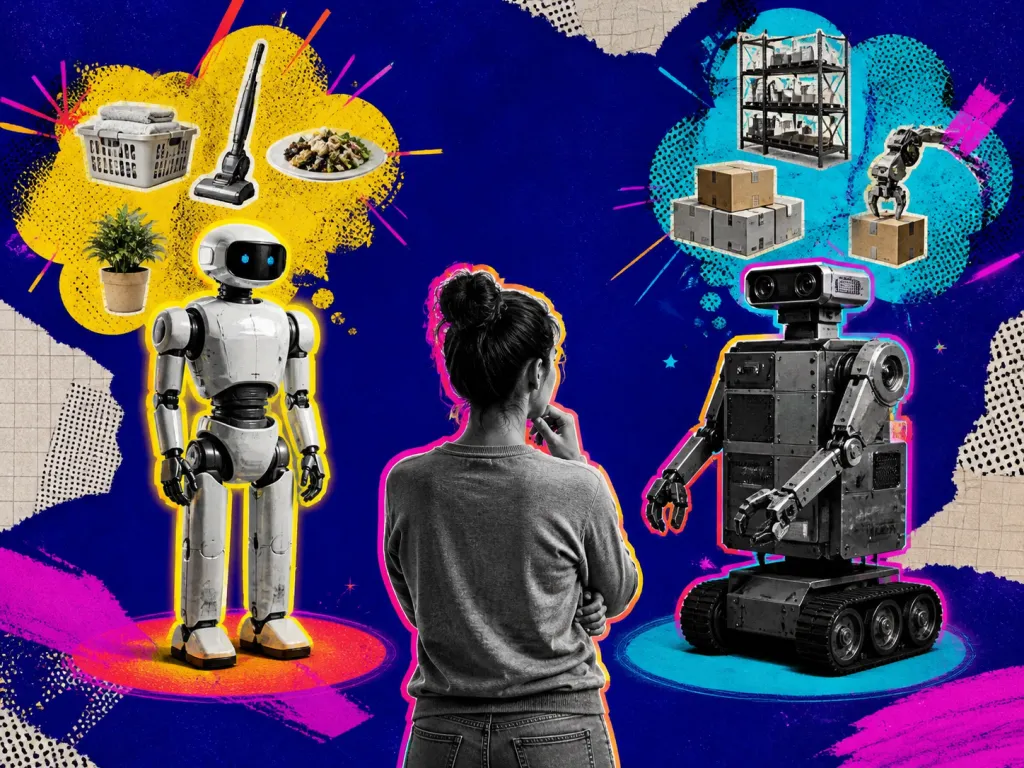
Appearance–Capability Expectation is this project’s plain-language label for a human–robot interaction pattern, not a standardized bias name. Research shows that robot appearance, morphology, framing, and human-likeness can shape expectations about competence, social behavior, and likely capabilities before users have much direct performance evidence. The direction is not universal: a more humanlike design does not always increase trust or perceived competence.
Examples and situations
- Humanoid design – a face, hands, or human proportions imply abilities the robot has never demonstrated.
- Minimal design – a machine that looks simple is assumed to be less capable even when its tested performance is strong.
- Conversational interfaces – natural speech, a name, or social gestures are mistaken for evidence of general understanding.
Questions to check
- Write down the capabilities the design makes you expect, then check them against observed performance.
- Separate social presentation from task competence and reliability.
- Prefer capability matrices, documented limits, and representative tests over visual impressions.
- For designers, make intended functions and important limitations explicit instead of letting appearance carry the whole message.
Long-form guide
Don’t Let the Shiny Arm Fool You: Form–Function Attribution Bias in Robots (and You)
You’re standing in a demo hall. Two warehouse robots idle by a taped-off track. One looks like a spaceship’s pet: glossy polycarbonate shell, LED “eyes” that blink with a little personality, whisper‑quiet motors. The other is a shoebox on wheels with zip ties, an orange extension cord hanging off the side, and handwritten labels. The slick one croons its boot chime. The shoebox coughs.
On this page
What is Form–Function Attribution Bias and why it matters
Which one do you trust to run your factory? By the time the glossy robot glides through a choreographed course, your brain has already voted. You don’t notice how many times it slows to avoid a small obstacle. You don’t see the operator nudging it with a tablet. Your eyes gravitate to the cinematic glow of the LEDs. Meanwhile, the zip‑tie robot knocks out the same task faster, then repeats it five more times. No drama. No blinking eyes. No fans.
Form–Function Attribution Bias is the tendency to judge capability from appearance. We assume a robot’s form signals its function—even when it doesn’t. Form–Function Attribution Bias happens when you infer what a system can do from how it looks. It’s a mash-up of several well‑documented effects: The “what is beautiful is usable” effect: people rate better-looking interfaces as more usable—even when usability is identical (Kurosu & Kashimura, 1995; Tractinsky et al., 2000); The halo effect: attractive or “professional-looking” things get a bonus in perceived competence (Dion et al., 1972); Anthropomorphism: human-like cues in robots make us attribute mind and intent (Epley et al., 2007); Media equation: we treat media and machines like social actors, unconsciously (Reeves & Nass, 1996).
Put these together and you get a fast, automatic shortcut: sleek means smart; cute means safe; heavy means strong; industrial means reliable. Sometimes those proxies are right. Often they’re not. Why it matters: Bad buying decisions: teams overspend on polished hardware with thin functionality, or pass on homely tools that would nail the job; Trust calibration: operators either overtrust or undertrust robots; both cause accidents (Hancock et al., 2011); Safety theater: companies add “safety-looking” features (lights, guards) without improving actual safety; Ethics and policy: lawmakers and the public judge threat and capability from appearance (drone size, humanoid shape), skewing rules and funding; Product design drift: teams chase aesthetics that sell demos but add friction in the field—glare on screens, hard-to-wipe bezels, fragile skins; Team morale: engineers who build the “ugly but robust” thing get sidelined; surface wins over substance. If you evaluate robots, sell them, regulate them, or live around them, this bias shows up in your day-to-day. It nudges without asking permission.
1) The hospital courier that smiled too hard
Stories beat charts. Here are a handful from the trenches and the edges. A hospital bought a fleet of corridor courier robots. The model with the “friendliest” face won after a walk‑off: big pixel eyes, a pastel shell, and a gentle chime that sounded like a lullaby. Nurses loved it. Patients waved at it. The procurement team signed on the spot. First month, the robots time out by the elevators. Turns out the gleaming top shell hides a tall center of gravity.
As the robot noses up to the elevator threshold, a tiny floor lip makes it tilt. Its LIDAR reads that tilt as a collision risk, and it balks. The team tunes thresholds and gets it moving, but it now creeps near edges. Deliveries slip from 12 minutes to 22 minutes. Night shift routes stack up. The old “ugly” units—returned to the vendor—had lower shells and never noticed the lip. Appearance cue that misled: a smooth, round, friendly form implying seamless mobility. Actual determinant: sensor placement and chassis geometry.
2) The warehouse shoebox that didn’t flinch
A regional e‑commerce company piloted two autonomous pallet movers. The shiny unit promised “adaptive intelligence” on the brochure. The unbranded unit arrived in a plywood crate with foam glued on like someone’s garage project. The pilot test day, management gathered around the glossy one. The demo was fine, but it paused near reflective wrap and asked for “operator assist.” Twice.
Out of politeness, they gave the scrappy unit a try. It bulldozed the route, even with that same reflective wrap. Why? The vendor had spent months in similar warehouses and tuned the LIDAR fusion for shiny shrink‑wrap. It looked rough because they kept patching function first. Misleading cue: pristine industrial design equals maturity. Reality: hours-on-floor beat hours-in-Keynote.
3) “Can it do sarcasm?” The domestic assistant debate
A startup demoed a home assistant: sleek, soundbar-shaped, brushed aluminum ends. Its marketing video showed it dimming lights after the user says, “It’s movie time.” On the spot, a VC asked if it understood sarcasm. The founder hesitated. Investors inferred sophistication from the premium look and crisp audio;
they assumed nuanced language understanding. In reality, it followed a small set of scripted intents. It could not parse anything close to sarcasm. Misleading cue: premium material and sound design signal high cognitive ability. Reality: NLP competence lives in the model and data, not the anodized cap.
4) The humble exoskeleton that saved backs
Logistics buyer compares two back‑assist exoskeletons. One looks like something out of a sci‑fi movie—sleek panels, integrated LEDs. The other is webbing, rivets, and a few blunt hinges. Workers try both during a two‑week “ugly trial.” The shiny one draws interest day one, then sits.
It’s sweaty and hard to wipe down. The plain harness becomes the preferred option: lighter, easier to adjust, survives a coffee spill. Injury reports drop. Two units break; the vendor ships parts overnight and shares a repair video. Misleading cue: future-looking form equals advanced biomechanics. Reality: comfort, cleanability, and maintainability over eight-hour shifts.
5) The drone that looked harmless; 6) Security theater, bot edition
Municipal parks considered drones for bird‑nest monitoring. The small white quadcopter looked like a toy—too cute to disturb wildlife. The black, angular one looked “military” and dangerous. In test flights, the white drone’s high‑pitch whine spooked birds;
the black one, with larger propellers and lower RPM, disturbed them less. Rangers found more abandoned nests in plots flown with the “harmless” toy. Misleading cue: toy-like form equals gentleness. Reality: acoustic profile matters more than color and shape.
A corporate lobby installed a tall white “security robot” that patrolled and flashed, with a big blue light bar. It made everyone feel watched. It collected nearly no useful footage—poor sensor placement, low-resolution images, and no integration with badge systems.
When an incident happened, the recordings were blur. They later swapped it for fewer, ugly cameras at good angles, plus better lighting, and saw actual detection improve. Misleading cue: presence and performance veneer equate to protection. Reality: coverage, integration, evidence quality.
7) The lab robot with the sexy arm
A research lab chose an articulated arm for an automation cell. The brochure showed the arm pouring coffee and drawing sketches. It looked lithe and dexterous. In practice, the task required high‑torque moves in a tight space and a rigid wrist. The slender arm oscillated. They needed a heavier, less photogenic model. Misleading cue: graceful motion equals precision under load. Reality: stiffness, torque curves, and control loops decide.
We could go on. You have your own versions. They all rhyme: we see a surface, we fill in a story, we skip the checks. You won’t logic your way out of this bias by wishing it away. It’s pre‑verbal, fast, and embodied. But you can catch it in the act and pin it to the table.
A simple way to spot the bias in the moment
You feel charmed, impressed, or reassured before you’ve seen data; You find yourself using words like “sleek,” “friendly,” “intuitive,” or “solid” to justify capability; You assume traits: “It must be safe around kids,” “It will be accurate,” “It’s probably reliable.” You treat a demo as truth rather than a trailer: the operator’s tablet stays out of your sight; you barely notice;
You dislike the look of a device and feel a twinge of contempt. You stop asking questions. When you notice any of those, call a timeout. Name it: “I’m reacting to form.” Saying it out loud gives your team permission to adjust.
Write down your capability stack before you see the thing
Do this on paper. Literally a list. What must the robot do? In what environment? With what tolerances? Over what duty cycle? With what maintenance plan? Write thresholds and nice‑to‑haves. If your team writes the spec only after the demo, you just built a shrine to the bias.
Build a “Function First” arena. Strip the gloss. Ask for demos in neutral environments, with lighting and acoustics closer to your use case. Reflective floors, dust, crowd noise, the works; Hide the skins. When possible, test with covers or skins removed. You’ll see sensor layouts, heat management, and serviceability. It’s harder to fool yourself when you see inside; Force blind trials. Evaluate two options without vendor labels or marketing decks. Randomize order. Debrief after measuring outcomes.
Put operators at the center
Gloss sells to executives; function lives with operators. Ask them to run the tests. Ask what annoyed them. They’ll mention handle placement, gloved touchscreens, haptics in noisy settings, glare on displays, charging cables that block walkways. Those “small” things pile into uptime and safety.
Quantify the boring parts. Mean time between failures (MTBF) and time to repair; False positive/false negative rates around your edge cases; Battery life across temperature ranges; Cleanability and infection control steps (in healthcare); Operator training hours to competence; Total cost of ownership over 3–5 years. If a vendor can’t give you these or demonstrate them, that’s your metric right there.
Talk with numbers, not adjectives
Replace “It feels robust” with “It completed 23/24 runs within tolerance.” Replace “It seems safe” with “No person–robot near misses at X cm threshold across 2 hours in a mixed corridor.” Your language shapes your judgment. Tape that checklist to your laptop. Keep a pen handy.
Use narrative traps against themselves. Before a demo, write two short fables: The “Shiny Trap”: A good-looking robot fails because it hides a functional mismatch that matters to you; The “Ugly Duckling”: A rough-looking robot wins because it nails a detail that won’t show in a demo. Read them aloud to the team. It sounds corny. It works.
Related or confusable ideas
Biases travel in packs. Form–Function Attribution Bias often gets mistaken for these cousins: Aesthetic–Usability Effect: Users perceive more attractive products as easier to use (Kurosu & Kashimura, 1995; Tractinsky et al., 2000). That’s a piece of our story. Form–Function Attribution goes beyond usability: it’s about inferring capability, safety, and intelligence itself; Halo Effect: One positive attribute bleeds into others (Dion et al., 1972). A polished shell gives a halo to reliability. Same mechanism; different domain; Anthropomorphism: Giving human traits to nonhumans (Epley et al., 2007). Robot faces and gestures trigger social inferences—trust, intent, competence; Representativeness Heuristic: We judge probability by similarity (Tversky & Kahneman, 1974). A robot that looks like sci‑fi “genius machines” feels more capable;
Authority Bias: We defer to perceived experts. A vendor with lab coats, white lighting, and austere design cues can borrow authority for tech that hasn’t earned it; Novelty Bias: Newer‑looking equals better. In robotics, new often means unproven and brittle; Uncanny Valley: As robots look more humanlike, our affinity dips, then rises again (Mori, 1970). This changes how we judge intent and safety, often overshadowing actual function; Machine Heuristic: The intuition that machines are objective and accurate by default (Sundar & Nass, 2001). A sleek robot heightens the “it must be right” reflex. Knowing the neighboring effects helps you pick the right counter. If your team is reacting to cute eyes, you need different guardrails than if they’re dazzled by aluminum and edge‑lit glass.
How to design against the bias (if you’re the builder)
We’ve been on the other side of the table too. You want your robot to look like it belongs in the world. You also want people to judge it for what it truly does. Align form with true affordances. If your robot is great at slow, careful manipulation, emphasize stability and control in the form. Don’t promise speed with racy lines and pulsing LEDs; Make truth legible. Show status with signals that map to real states and thresholds. If there’s a risk mode, don’t disguise it with the same “friendly” cues as normal operation; Design for care and service. A beautiful housing that needs 40 minutes to open kills uptime. Use fasteners and panels that invite maintenance. Industrial beauty is access; Resist demo‑driven skins.
Skins that hide sensors, vents, or service ports trap heat and make cleaning hard. If you must use a skin for safety or hygiene, co‑design with maintenance; Include “warts and all” demos. Build a second demo track: messy floor, unexpected obstacles, hard lighting. Scare your own team first; Publish capability envelopes. Show the ranges where performance degrades. Don’t bury conditions on page 38; Give operators the day one kit. Include spare parts, cleaning instructions, calibration steps—as early as possible. If people can care for your robot, they’ll trust it more for the right reasons; Audit your aesthetics. Ask: what are we implying with this visual language? Does it match what the robot truly does? Have a skeptic sign off. Design can counter the bias, not just cause it. Thoughtful form invites the right expectations.
A deeper cut: why your brain does this
We’re visual animals. Our ancestors survived by reading the world at a glance: smooth skin meant a fresh fruit; bright colors often meant poison; bulky silhouettes suggested strength. The brain’s fast system still leans on surface features. In labs and offices, those features are brushed aluminum, chamfered edges, matte plastic, animated eyes, and perfect kerning. Research shows that people attribute usability and trustworthiness to attractive designs even when function is controlled (Tractinsky et al., 2000). In human–robot interaction, social cues—eyes, gaze, gesture—nudge people to treat robots as agents (Epley et al., 2007).
In safety, overtrust leads to misuse; undertrust leads to disuse (Hancock et al., 2011). All of that stacks up in your perception before you can open a spreadsheet. You can’t out‑smart that system, but you can out‑structure it. The north star: make the structure easy enough that you’ll actually use it in the heat of a decision.
The 10‑minute field protocol we use
When we walk into a demo or a site test, we do this, in this order. It’s not fancy. It works. 1) Pre‑commit the outcome metrics. One sheet of paper. Three to five metrics with pass/fail thresholds. 2) Hide the adjectives. We ban “sleek,” “friendly,” “solid,” and “intuitive” from the room. We keep a jar. You say one, you put a dollar in. 3) Run the ugly route first. Dust, glare, uneven floors, noise. If the vendor flinches, we note it. If the robot nails it, we note that too. 4) Swap operators. Let the newest person run it after 15 minutes of onboarding. See what breaks.
5) Time the maintenance touch. Swap a battery. Clean a sensor. Update firmware. We watch who reaches for the right tool and how long it takes. 6) Blind label once. Cover logos and distinctive skins. Show the team the results without brand info. Ask them to pick. 7) Debrief with the pre‑commit sheet. Nothing else. Only then let adjectives play. If you only take one thing from this article, try that protocol once. It moves mountains.
Wrap‑up: your eyes aren’t the enemy, but they need a partner
We love beautiful machines. We write songs about them. We paint them with light. That’s fine. Beauty can make tools welcome in human spaces. It can reduce fear, invite care, and give dignity to work. But beauty is not ability. And when we forget that, we get worse hospitals, riskier warehouses, sillier gadgets, and laws written for movie props instead of reality. The fix is not to become puritans about form.
The fix is to train your team to ask the unglamorous questions, to test where the glossy brochure won’t, and to let operators steer decisions. If you’re a builder, the fix is to make your signals honest and your skins serviceable, and to publish the real performance map. Go run the “ugly route” once this week. See what changes. Keep it close. Use it often. And when the shiny arm waves at you, wave back—then hand it the checklist.
Decision checklist
- Did we write success/failure criteria before the demo?
- Did we run tasks in our real environment, including edge cases?
- Did operators—not just managers—score the trials?
- Did we record quantitative outcomes and compare across units?
- Did we inspect serviceability: time to swap parts, clean, update?
- Did we see raw logs and error handling, not just the highlight reel?
- Did we validate safety and compliance beyond visual cues?
- Did we estimate total cost of ownership with spares and downtime?
- Did we run a blind or label‑hidden test at least once?
- Did we explicitly list what the look made us assume—and verify?
Evidence review
What the evidence supports
Research supports the broader pattern that a robot's appearance, morphology, framing, and human-likeness shape expectations about its competence, social qualities, and likely behavior. However, 'Form-Function Attribution Bias' is not an established standardized name in the literature. On this site it should be treated as a project label for appearance-driven capability expectations, not as a universally recognized cognitive-bias construct.
How researchers describe the pattern
Visual and social design cues help users build a mental model before they have much direct performance evidence. Humanlike or technically styled forms can set different expectations, and expectation-setting can change later competence or trust judgments. The direction is not universal: a more anthropomorphic appearance does not always increase perceived competence, empathy, or trust, and effects depend on task and context.
Practical interpretation
Separate what the system looks or sounds like from what it has demonstrated it can do. For an AI or robot, write down the capabilities implied by the interface and then check each against observed performance, documentation, or controlled tests. Designers should communicate limitations and intended functions directly instead of letting appearance carry the whole capability message.
Reviewed sources
- Judging a bot by its cover: an experiment on expectation setting for personal robots experiment · 2010 · DOI 10.1145/1734454.1734472
- What Does A Robot Look Like?: A Multi-Site Examination of User Expectations About Robot Appearance multi-study exploratory research · 2017 · DOI 10.1177/1541931213601786
- Feeling with a robot—the role of anthropomorphism by design and the tendency to anthropomorphize in human-robot interaction experiment · 2023 · DOI 10.3389/frobt.2023.1149601
- Humanlikeness as design, anthropomorphism as inference: a conceptual framework for human-robot interaction conceptual framework · 2026 · DOI 10.3389/fcogn.2026.1786256
Editorial review: 2026-08-18. The controlled evidence class is an editorial reading aid, not a numeric truth score; the descriptive status above carries the entry-specific qualification.
Continue from here
Choose the next useful move.
Evidence-linked concepts
Nearby ideas, with the relationship made explicit.
These links are reviewed separately from the original library’s related-entry suggestions. A relation means the concepts overlap or are often confused; it does not mean they are interchangeable.
Anthropomorphism – when nonhuman systems are read as humanlike
Humanlike appearance and interaction cues can shape both anthropomorphic mental-state attributions and expectations about a system's capabilities. Neither impression is evidence by itself that the inferred mind or capability is present.
Open reviewed entry